
Why Maple Panels Make Exceptional Orthodox Icons

Last Updated: November 5, 2026
Quick Summary
Maple panels make exceptional Orthodox icons because maple's dense, tight, uniform grain holds its shape and stays out of the image's way, letting printed detail and color read cleanly. Maple also resists dents and dings from handling, incense smoke, and the small knocks that come with a busy parish. Its dimensional stability keeps the board flat, so the finish and mounting hold up over decades.
- Solid maple needs bracing, a frame or cradle, and sealing on every face to manage moisture.
- Maple plywood uses cross-grain veneer layers with a void-free core and resists cupping.
- Linden, or basswood, is the historic favorite among icon painters but dents and wears faster.
- Birch plywood is the closest competitor, though maple runs slightly harder and denser.
- Keep icons out of direct sunlight and dust with a dry, soft cloth, never spray polish.
Table of Contents
- Why Are Orthodox Icons Painted on Wood?
- How Maple Panels Support Icon Durability and Clarity
- Solid Maple Versus Maple Plywood for Icon Boards
- Maple vs Birch Plywood: Which Panel Holds Up Better?
- The Best Wood for Painting Panels and Icon Surfaces
- How to Care for an Orthodox Icon on a Maple Panel
- Choosing the Right Maple Panel Icon for Your Space
- Frequently Asked Questions
Why Are Orthodox Icons Painted on Wood?
Wood has carried sacred images for nearly two thousand years, and the reasons are practical as much as theological. The earliest panel icons were painted on wood because it was the most stable, abundant surface available to iconographers in the Byzantine world. A wooden board does not tear like papyrus, crack like plaster, or shatter like glass.
The Orthodox Church in America's explanation of iconography notes that icons are often called "windows to heaven," and the physical panel itself is treated as an offering, prepared with care and prayer. At Theophany Works, we build every icon on that same premise: the board matters as much as the image.
There is also a theological layer. Wood recalls the cross and the Tree of Life. An icon on wood is a crafted object, not a poster. It has weight, grain, and warmth. That tactile quality is part of why the tradition has held for centuries.
The question worth asking in 2026 is not whether to use wood, but which wood. Maple panels have become a strong answer, and the rest of this guide explains why.
How Maple Panels Support Icon Durability and Clarity
Maple is a dense hardwood with a tight, uniform grain, and that combination does two things for an icon: it holds its shape, and it stays out of the image's way.
A tight grain means fewer dramatic figure lines running under the artwork. On a boldly grained wood, the surface can compete with the image. Maple's light, even tone gives a quiet background, so printed detail and color read cleanly. For icons reproduced at larger sizes, where any softness becomes obvious, that matters.
Hardness is the second advantage. Maple resists dents and dings from handling, incense smoke, and the small knocks that come with a busy parish. Icon boards get moved, dusted, and leaned against walls. A harder surface takes that wear better than a soft one.
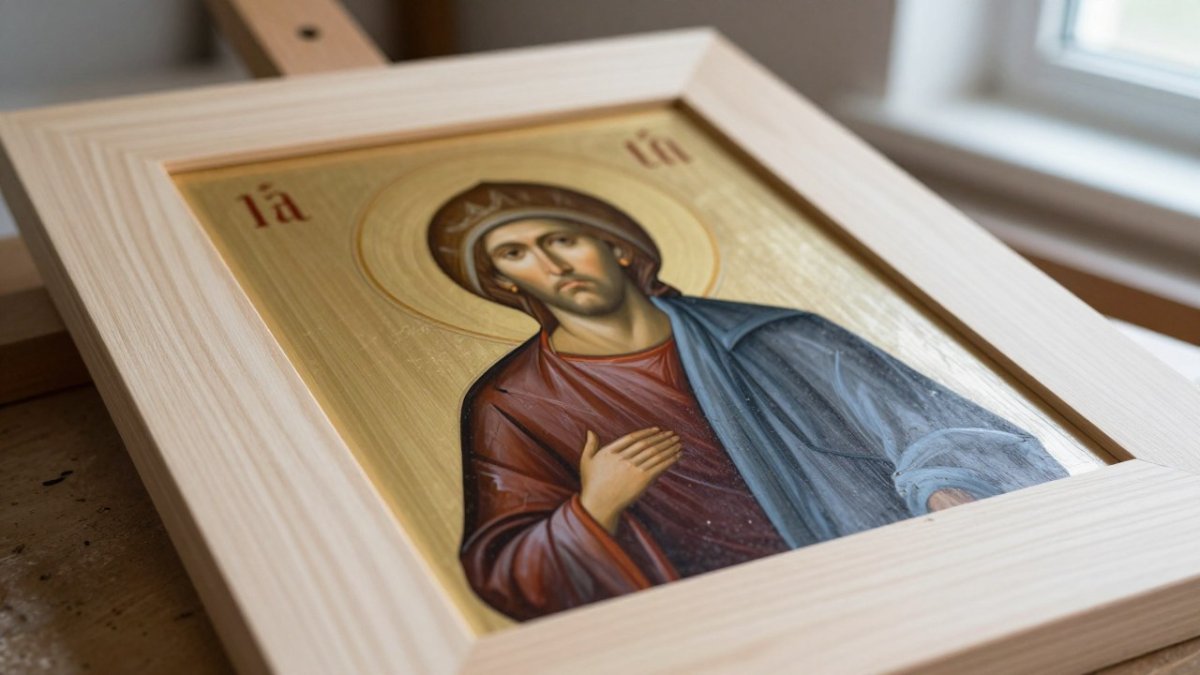
Stability is the third. Wood moves with humidity, and a board that shifts will eventually crack its finish or separate from its mounting. Maple's dimensional stability is one reason it shows up in cabinetry and furniture that must stay flat for decades.
Solid Maple Versus Maple Plywood for Icon Boards
Here is where buyers get confused, and it is worth being blunt: "maple panel" can mean two very different things, and the difference determines how the board will behave under paint, gesso, and decades of hanging.
Solid maple is a single piece of hardwood milled from one board. It is beautiful, heavy, and expensive, and it carries a real risk that traditional iconographers manage rather than ignore. A wide solid board can cup or warp as it takes on and releases moisture, and it may crack along the grain. The standard response is construction: bracing across the back, a frame or cradle to hold the panel flat, and sealing every face, including the back and edges, so moisture enters and leaves evenly. A solid maple panel made this way can last for generations, but it is a woodworking project, not a blank you pull off a shelf.
Maple plywood is built from layers of wood veneer glued in alternating directions, finished with a maple face veneer.
| Feature | Solid Maple | Maple Plywood |
|---|---|---|
| Construction | Single board, needs bracing | Cross-grain veneer layers, void-free core |
| Stability | Good when braced and sealed | Excellent, cross-grain core resists cupping |
| Weight | Heavy | Lighter |
| Cost | Higher | Lower |
| Warp risk | Higher on wide boards | Low |
| Edge behavior | Solid grain throughout | Shows plies unless banded or framed |
| Best for | Small carved panels, exposed edges | Large, flat icon boards |
If you want to compare wood versus canvas formats in more depth, our guide to high resolution Orthodox icon prints walks through resolution checks and panel options.
Maple vs Birch Plywood: Which Panel Holds Up Better?
Both are hard, light-colored, and popular for panels, so the comparison is fair. The difference shows up in grain and in how the finished surface reads.
Woodworking Network's coverage of hardwood panel selection makes the same point about matching material to end use rather than buying on price alone.
The Best Wood for Painting Panels and Icon Surfaces
Most wood-benefit articles compare species on hardness and price. For icon work, the useful comparison is narrower: which wood takes a ground evenly, holds it without cracking, and stays flat enough that the image does not distort as the panel moves. That is the lens this section uses.
Linden, also called basswood, is the historic favorite among icon painters. It is soft, carves beautifully for ornamental frames, and takes gesso evenly because its closed, uniform grain does not telegraph through a thin ground. Its weakness is exactly its strength: soft wood dents and wears faster, and a linden panel needs a frame or cradle to stay flat at larger sizes. Natural Pigments' guide to wood painting panels discusses how panel woods behave as they dry and which are suited to carved icon details, a useful reference if you plan to paint rather than print.
Poplar is a common middle ground. It is affordable, reasonably stable, and available in wide boards, but its grain is plainer and its greenish cast can show through a thin ground. It is a practical choice for practice panels and for pieces that will be fully covered.
Oak is too open-grained and heavy for most icon work. The large pores and pronounced figure compete with the image, and the wood's movement is harder to control in a wide panel. Pine is soft and resinous, prone to movement, and pitch can bleed through a ground over time.
Birch plywood is the closest competitor to maple plywood. It is hard, light-colored, and machines cleanly, and its fine closed grain takes a ground well. Maple runs slightly harder and denser, with a tighter, more uniform appearance, so less grain telegraphs through and fine detail stays crisp. Birch dents more readily under the same handling, and cost favors birch for utility panels and practice pieces.
If you are weighing hand-painted originals against printed reproductions, our buyer's guide to authentic icons compares the two honestly, including what you give up at each price point.
How to Care for an Orthodox Icon on a Maple Panel
Care is simpler than most people expect, but a few habits protect the piece for decades.
- Keep it out of direct sunlight. UV exposure can fade any image over time. A north-facing wall or a shaded corner is ideal.
- Control humidity. Aim for stable indoor conditions. Avoid hanging an icon directly above a radiator, stove, or bathroom door where steam swings humidity.
- Dust with a dry, soft cloth. Never use spray polish or wet wipes on the surface. A dry microfiber cloth is enough.
- Handle by the frame, not the face. Oils from fingers can dull a finish over years.
- Check the hanging hardware yearly. A heavy panel needs a secure anchor.
Choosing the Right Maple Panel Icon for Your Space
Size is the decision most people get wrong. Measure the wall or altar first, then choose an icon that fills roughly two-thirds of the available width. A piece that is too small looks lost; one that is too large crowds the space and can feel heavy in a small room.
For a home altar, a medium panel above a small table works well, with a candle and cross below. Our guide to setting up a home altar walks through placement, arrangement, and creating a peaceful prayer space. If you want to browse the actual selection, you can view the icon collection and match a subject to your space.
For parishes, larger panels suit nave walls and side chapels, where clarity at distance matters most. Our guide to durable icons for church interiors covers panels, inks, and finishes for pieces meant to serve a congregation for decades.
A final word on authenticity. Ask where the icon is made and how the image was captured. Ours are reproduced in our Lancaster, Pennsylvania studio from high-resolution images captured onsite at churches and monasteries, then printed with archival inks and mounted on maple.
Frequently Asked Questions
Why are Orthodox icons painted on wood?
Wood has been the traditional support for Orthodox icons for centuries because it is rigid, lightweight, and takes gesso and paint well. A stable board keeps the image flat so it does not distort over time. Maple panels continue that tradition with a dense hardwood that resists warping and holds a smooth surface, which matters for both hand-painted icons and archival canvas mounted onto a board.
How does a maple panel affect the durability of an Orthodox icon?
Maple is a hardwood with a dense, tight grain. When the panel is sealed with a UV protectant clear coat, as Theophany Works does, the image is sealed with that coat.
Is solid maple better than maple plywood for an icon board?
Ask the maker which construction they use and why, since the choice affects weight, cost, and long-term behavior.
How should you care for an Orthodox icon on a maple panel?
Keep the icon out of direct sunlight and away from heat sources, and avoid damp rooms where humidity swings. Dust gently with a soft dry cloth rather than wet cleaners. Do not lean heavy objects against the surface or hang the icon where it can be knocked.
The challenge is not finding an icon. It is finding one built to last, with a board that stays flat, a surface that resists wear, and an image faithful to the tradition. Theophany Works crafts each icon on a smooth maple-shelled panel, prints it with archival inks on fine art canvas, and seals it with a UV protectant clear coat for lasting color. Get started with Theophany Works and give your home altar or parish a piece made to be handed down.

Explore Popular Articles
Agiografia Icons vs Christianity Art: What's the Difference?
Last Updated: November 26, 2026 Quick Summary Agiografia icons are liturgical objects made to be ve...
How to Choose Icon Size for Screens and Sacred Art
Last Updated: November 24, 2026 Quick Summary To choose icon size, first decide whether you mean a...
7 Handcrafted Maple Panel Religious Art Pieces Worth Considering
Last Updated: November 22, 2026 Quick Summary Handcrafted maple panel religious art pairs a sacred...
How to Choose Between Modern and Traditional Icon Printing
Last Updated: November 17, 2026 Quick Summary Choose modern icon printing when you need faithful, d...