
7 Handcrafted Maple Panel Religious Art Pieces Worth Considering
Last Updated: November 22, 2026
Quick Summary
Handcrafted maple panel religious art pairs a sacred image with a solid maple board, and at Theophany Works each piece is photographed onsite at churches and monasteries, printed in archival ink on fine art canvas, mounted to a smooth maple panel, and sealed with a UV protectant clear coat. The panel's dense, fine grain takes detail cleanly and holds its shape better than softer woods or stretched canvas.
- Solid maple moves with humidity, while veneered or shelled panels are more dimensionally stable but depend on the core and adhesive.
- The Ancient Style Holy Face Plaque is offered in 8 × 10-inch and 11 × 14-inch sizes with the grain visible.
- The Saint Michael Gothic Triptych is a limited edition with a hand-painted center panel and engraved Gothic scenes.
- Aim for roughly 35 to 55 percent relative humidity and keep panels off exterior walls and away from heat sources.
- Dust with a dry microfiber cloth and avoid sprays, solvents, and wet cloths on sealed panels.
Table of Contents
- Why Are Orthodox Icons Painted on Wood?
- Religious Art on Wood Panels: What Sets Handcrafted Work Apart
- What a Maple Art Panel Offers That Other Surfaces Do Not
- Comparing Handcrafted Maple Panel Religious Art Side by Side
- Triptych Art and Multi-Panel Formats for Home Altars and Parishes
- Caring for Maple Panel Icons So They Last Decades
- Commissioning Custom Maple Panel Religious Art for Your Space
- Choosing the Right Maple Panel Icon for Your Prayer Space
- Frequently Asked Questions
Why Are Orthodox Icons Painted on Wood?
Wood is the traditional ground of Orthodox iconography because the board itself carries theological weight: it echoes the timber of the Cross and the ark of the covenant, and gives the image a physical body a flat print cannot.
A properly seasoned board, gessoed and sealed, gives paint a stable surface that moves with humidity instead of cracking away from it.
At Theophany Works, we build on that same logic.
Religious Art on Wood Panels: What Sets Handcrafted Work Apart
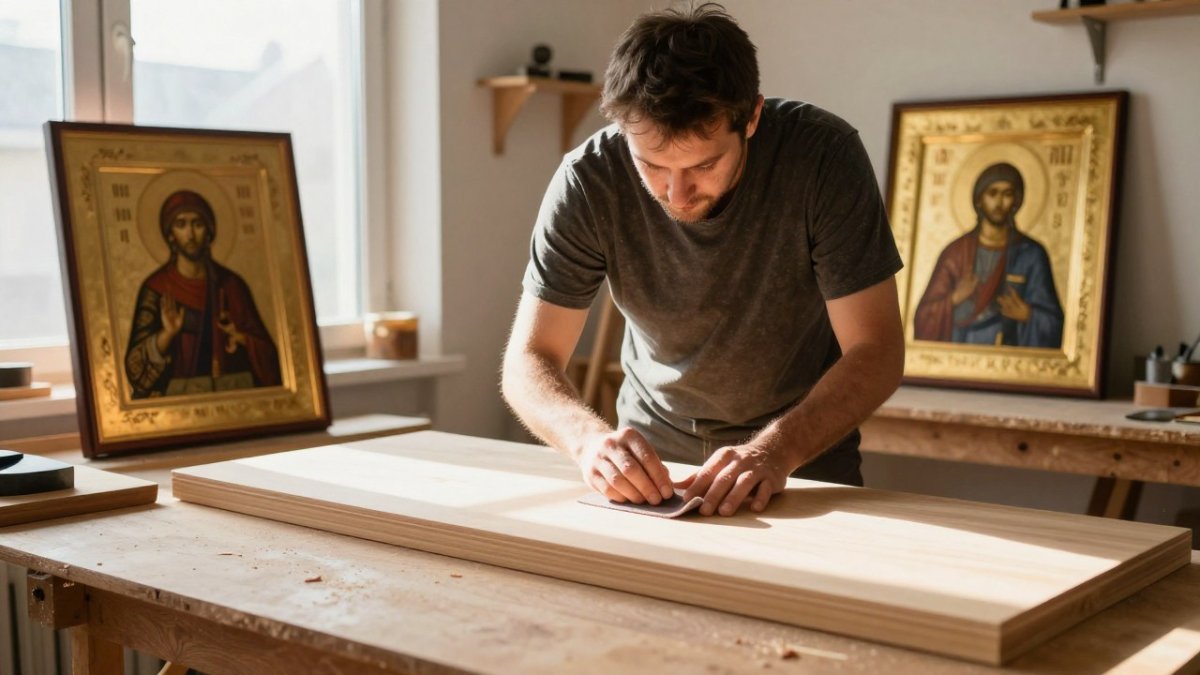
Handcrafted work is distinguished less by the image than by how the panel is prepared, joined, and finished. A mass-produced plaque and a handcrafted panel can carry the same saint but will not age or feel the same.
Here is what separates the two in practice:
- Material honesty. Solid maple or maple-shelled panels are chosen for grain, stability, and a smooth face; particleboard with a printed veneer is not the same object.
- Surface preparation. Sanded, sealed, and finished surfaces resist warping and moisture creep at the edges.
- Joining and framing. Cradled panels and hinged multi-panel formats are built to hold their shape.
A common mistake is judging a religious artwork only by the image file. The board, mounting, and finish are what you live with for decades.
What a Maple Art Panel Offers That Other Surfaces Do Not
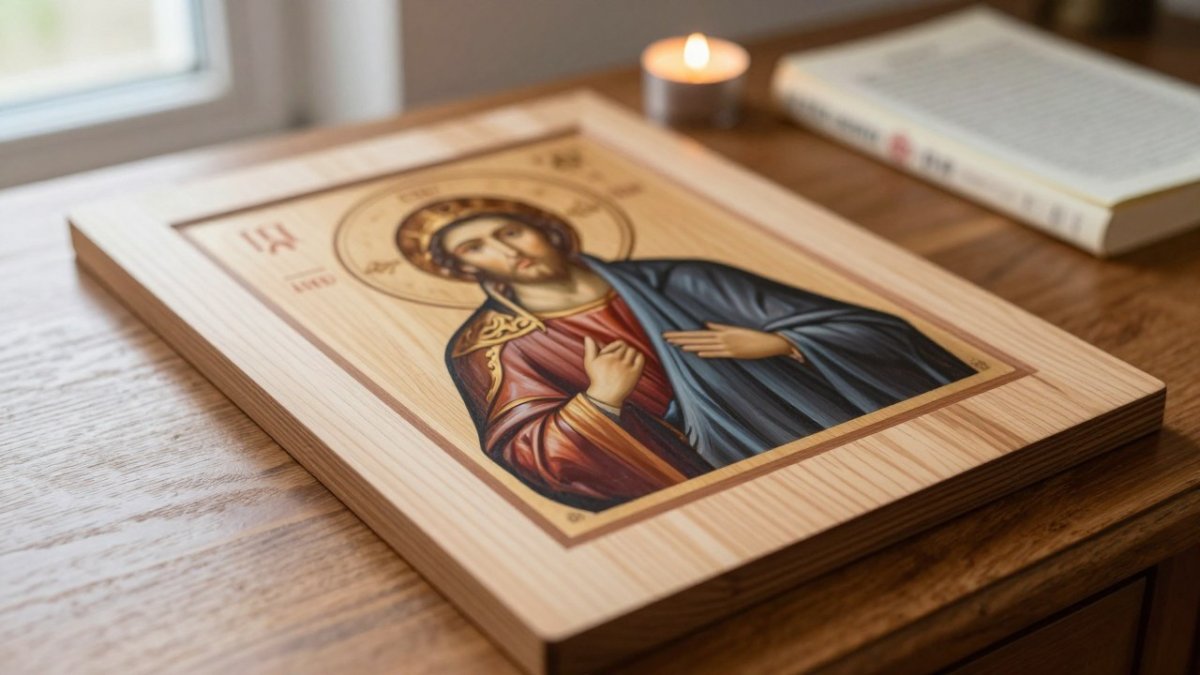
A maple art panel offers a dense, fine-grained surface that takes detail cleanly and holds its shape better than softer woods or stretched canvas. Maple's tight, even grain keeps the face smooth under a printed or painted image, and the natural grain can remain visible as part of the finished look.
Compared with other common surfaces:
- Canvas alone is light and inexpensive, but it flexes and needs stretching and framing to hang well.
- Paper prints are the most fragile option and yellow fastest without careful framing behind glass.
- Softwoods like pine can dent and show pronounced grain that competes with the image.
For a home altar or parish wall, that rigidity matters: larger pieces stay flat and the image stays crisp at size. For panel construction, sizing, and print options in more depth, our guide to high resolution Orthodox icon prints walks through resolution checks, canvas and wood panel choices, and how to print icons for a home altar.
Comparing Handcrafted Maple Panel Religious Art Side by Side
Most search results for handcrafted maple panel religious art fall into one of four buckets: a marketplace category page, an art-history reference, a single product listing, or a gallery of examples. None put the options side by side and explain what differs. This section compares construction, imagery, finish, intended use, and price drivers.
The five things that actually differ
Before the product-by-product notes, here is the framework to apply to any maple religious panel you are considering.
- Panel construction. Solid maple, maple-veneered plywood or MDF, and maple-shelled cradled panels behave differently over time. Solid maple moves with humidity; a veneered or shelled panel is more dimensionally stable but depends on the core and adhesive. Ask what is under the maple face.
- Imagery method. A panel can carry a printed reproduction on canvas or paper, a direct UV print on wood, a hand-painted original, an engraved or carved relief, or a combination. Each has a different detail ceiling, aging profile, and price floor.
- Finish. Natural clear coat, UV protectant clear coat, walnut or dark stain, gold finish, and hand-rubbed oil change how the grain reads and how the piece holds color. A UV clear coat slows fading; it does not stop it.
Side-by-side summary
| Piece | Format | Construction and Imagery | Finish | Best For | Price Driver |
|---|---|---|---|---|---|
| Theophany Works canvas-on-maple icons | Single panel, multiple sizes | Archival canvas print mounted to a smooth maple-shelled panel | UV protectant clear coat | Home altars, parishes, larger sizes | Size, panel construction, print method |
| Ancient Style Holy Face Plaque | Single plaque, 8 × 10 in and 11 × 14 in | Image printed directly on hard maple, visible grain | Not specified in the listing | Small devotional display | Size and direct-to-wood print |
| Saint Michael Gothic Triptych | Three hinged panels | Maple, engraved scenes, hand-painted center | Hand-painted and engraved finish | A Saint Michael centerpiece | Hand-painting, engraving, limited edition |
| Sacred Medieval Knight Four-Panel | Four-piece wall set | Handcrafted maple, Gothic window design | Not specified in the listing | Large wall display | Number of pieces, size, handcrafting |
Theophany Works canvas-on-maple icons
Our icons pair a photographed sacred image with a maple panel body. Each image is captured onsite at churches and monasteries, printed with archival inks on fine art canvas, mounted to a smooth maple-shelled panel, and sealed with a UV protectant clear coat.
Best for: households and parishes that want a durable panel icon at a competitive price. Skip if: you specifically want a hand-painted original rather than a printed reproduction.
Ancient Style Holy Face Plaque
This plaque carries the Holy Face image commissioned by Pope Pius IX, printed directly on hard maple so the natural wood grain stays visible. It is offered in 8 × 10-inch and 11 × 14-inch sizes, suiting a small shelf or modest wall.
Best for: a compact devotional piece with visible wood character. Skip if: you need a large format or documented finishing details.
Saint Michael Gothic Maple Wood Triptych
A limited-edition three-panel triptych built from maple, with engraved Gothic scenes framing a hand-painted Saint Michael center panel. A personalized back is available, making it a candidate for a named gift. The hand-painted center and engraving are the main price drivers; limited editions mean availability can change without notice.
Best for: buyers who want a multi-panel Saint Michael piece with a hand-painted focal figure. Skip if: you need guaranteed availability, since limited editions can sell out.
Sacred Medieval Knight Four-Panel Maple Wall Art
This four-piece set is handcrafted from maple and designed to resemble an ornate Gothic stained-glass window. The format is large and architectural, reading as church decor rather than a single devotional image.
Best for: a large wall in a parish hall or a home with Gothic decor. Skip if: you need a single icon for a prayer corner or a small altar.
How to read the price differences
Across these formats, price is driven less by the subject than by five factors: panel size, solid versus engineered construction, printed versus hand-worked imagery, finish complexity (a UV clear coat versus hand-painting, engraving, or gold), and limited-edition status. A printed single panel and a hand-painted triptych can carry the same saint and still sit in different price tiers for reasons unrelated to the image file. When comparing listings, ask for the construction, imagery method, and finish in writing; those three answers explain most of the price gap.
Triptych Art and Multi-Panel Formats for Home Altars and Parishes
Triptych art is a three-panel format, usually with a central image flanked by two hinged or fixed side panels. It frames a focal image while allowing the piece to open, close, or travel. Diptychs, polyptychs, and four-panel sets follow the same logic at different scales.
These formats suit sacred settings well:
- Home altars benefit from a central panel that anchors the arrangement, with side panels for the Theotokos, a guardian angel, or a patron saint.
- Portable altars and shrines rely on hinged panels that protect the image in transit.
- Parish walls use larger polyptych arrangements to organize a devotional program across a wall.
If you are building the space around a multi-panel piece, our step-by-step guide to setting up a home altar covers choosing a location, selecting icons, and arranging sacred objects around the central image.
Caring for Maple Panel Icons So They Last Decades
Maple panel icons last decades when the wood is kept in a stable environment and the finish is left intact. This section covers both, plus what to inspect and when to call a conservator.
Why maple needs specific care
Maple is a dense hardwood with a tight, even grain, which is why it takes detail cleanly and holds its shape. It is also hygroscopic: it absorbs and releases moisture from the air, expanding and contracting slightly across the grain as humidity changes. A panel sealed on the face but raw or thinly finished on the back can cup or bow when one side takes on moisture faster than the other, which is why construction and finish coverage on all sides matter as much as the image itself.
Humidity and temperature
- Aim for a stable indoor range rather than a specific number; most practitioners find roughly 35 to 55 percent relative humidity avoids the worst swings. Avoid placing a panel near a bathroom door, kitchen, humidifier, or heating vent that cycles on and off.
- Keep panels off exterior walls, where condensation and cold can affect the wood, and away from radiators, fireplaces, and space heaters.
- In dry winter air, a whole-room humidifier is gentler than pointing a unit at the panel. In damp summers, a dehumidifier in the room does more good than any surface treatment.
Watch out: a panel stable in one home can cup within a season after a move to a different climate; give it a few weeks in the new space before deciding the board has warped permanently.
Sunlight and UV
A UV protectant clear coat slows fading, but it does not make a panel sunlight-proof. Strong daylight fades any print over time, unevenly if one side faces a window. Hang away from windows and skylights, or use UV-filtering film on nearby glass. Rotate a multi-panel arrangement only if the pieces are designed to be moved; hinged triptychs should stay in their intended orientation.
Cleaning and finish protection
- Dust with a dry microfiber cloth. Work with the grain and use a light touch over engraved or carved relief, where dust collects in the recesses.
- Avoid sprays, solvents, and wet cloths. Water can wick into seams and edges, and solvents can dull or lift a clear coat.
- Do not use furniture polish on a sealed panel unless the maker specifies it; silicone and oil polishes can leave a film that is hard to remove later.
Mounting and handling
- Match the hardware to the panel's weight and your wall type. A heavy maple panel on a single small nail is the most common cause of a fall, and the damage is usually to a corner of the board.
- Use two hanging points where the maker provides them, and check the hanging point once a year for loosening.
- When moving a panel, carry it by the edges with both hands and keep it vertical; lifting a large panel by the top edge can flex the board.
What to inspect, and when to call a conservator
Check the panel once a season for cupping or bowing, cracks at the edges, lifting finish, and fading in the image. Minor dust and stable grain are normal. Cracking, active flaking of paint or print, mold, or a board that rocks against the wall are signs to stop handling the piece and consult a conservator. For safe mounting in the meantime, our guide to Orthodox icon mounting techniques explains how to match hardware to icon weight, wall type, and panel construction.
A simple care routine
- Hang away from windows, heat sources, and exterior walls.
- Keep indoor humidity stable and avoid pointing humidifiers at the panel.
- Dust with a dry microfiber cloth or soft brush; no sprays or wet cloths.
Commissioning Custom Maple Panel Religious Art for Your Space
Commissioning custom maple panel religious art starts with three decisions: the subject, the size, and the setting. Get those right and the rest, from finish to mounting, follows.
A practical sequence:
- Name the subject. A specific saint, feast, or scene, including any iconographic details that matter to your family or parish.
- Measure the space. Note the wall width, the height above the altar or shelf, and the viewing distance.
- Choose the format. Single panel, diptych, triptych, or a larger multi-panel arrangement.
- Confirm the finish. Natural maple, walnut stain, gold finish, or a carved and engraved treatment.
- Plan the mounting. Decide the hanging height and hardware before the piece arrives.
If you are furnishing a mission parish or a growing church interior, our overview of custom work and large-scale iconography projects shows how larger commissions are approached.
Choosing the Right Maple Panel Icon for Your Prayer Space
Choosing the right maple panel icon comes down to matching the subject to the space and the format to the way you pray.
A short decision framework:
- Small shelf or bedside corner: a single panel in a modest size, such as the 8 × 10-inch range.
- Dedicated prayer corner: a central panel with one or two supporting icons, arranged around a focal point.
- Family altar: a triptych or multi-panel format that can hold a central image and side figures.
For help selecting and arranging the pieces themselves, our guide to choosing icons for your prayer corner covers how to select, arrange, and pray with Orthodox icons at home.
The hardest part of buying handcrafted maple panel religious art is not finding an image you love.
Frequently Asked Questions
What is handcrafted maple panel religious art?
It is sacred imagery produced by hand and mounted on a solid maple wood panel rather than a thin frame or paper print. At Theophany Works, high-resolution images photographed onsite at churches and monasteries are printed with archival inks on fine art canvas, then mounted onto smooth maple panels and sealed with a UV protectant clear coat. The result is a tactile, durable devotional piece suited to home altars, prayer corners, and parish walls. Each piece is made in a Lancaster, Pennsylvania studio.
Why are Orthodox icons painted on wood?
Wood has carried sacred images since the earliest panel paintings, and the tradition stuck for practical and theological reasons. A rigid wood panel holds paint and gold without warping, survives handling in processions, and gives the image a physical weight that suits veneration. Maple art panels continue that lineage with a smooth, stable surface.
Is maple a good wood for religious art?
Maple is dense, close-grained, and takes a smooth sanded surface, which makes it a strong base for printed and painted religious artwork. It resists denting better than softer woods and holds detail cleanly. The trade-off is that maple expands and contracts with humidity, so a sealed panel and stable indoor placement matter. Look for a UV protectant topcoat and a cradled or solid backing. Walnut and oak are common alternatives, but maple's pale tone keeps the image itself the focus.
How do you care for religious art on a wood panel?
Keep the panel out of direct sunlight and away from heat sources like radiators and stoves, since UV exposure and dry heat are the main threats to printed color and wood stability. Dust with a soft dry cloth rather than a wet one, and avoid ammonia or alcohol cleaners that can dull the clear coat. Hang with proper mounting hardware rated for the panel's weight.

Explore Popular Articles
Agiografia Icons vs Christianity Art: What's the Difference?
Last Updated: November 26, 2026 Quick Summary Agiografia icons are liturgical objects made to be ve...
How to Choose Icon Size for Screens and Sacred Art
Last Updated: November 24, 2026 Quick Summary To choose icon size, first decide whether you mean a...
7 Handcrafted Maple Panel Religious Art Pieces Worth Considering
Last Updated: November 22, 2026 Quick Summary Handcrafted maple panel religious art pairs a sacred...
How to Choose Between Modern and Traditional Icon Printing
Last Updated: November 17, 2026 Quick Summary Choose modern icon printing when you need faithful, d...