
Durable Icons for Church Interiors: A Complete Guide

Table of Contents
- Why Durable Icons Matter in Church Interiors
- Church Icon Panels: Wood, Canvas, and Composite Options
- Archival Inks for Religious Art: What Keeps Color True
- UV-Protective Finish for Icons: Shielding Sacred Art from Light Damage
- Church Icon Placement: Where Icons Belong and How to Mount Them Safely
- Choosing the Right Size and Style for Your Space
- Cleaning and Maintaining Durable Icons for Church Interiors
- Frequently Asked Questions
Last Updated: October 21, 2026
Why Durable Icons Matter in Church Interiors
Durable icons for church interiors are sacred images built to withstand decades of heat, candle smoke, sunlight, and handling without losing their color or structural integrity. At Theophany Works, we build every panel with that lifespan in mind. A parish invests in iconography once and expects it to serve generations of worshipers.
The stakes are higher than they look. Icons sit in some of the harshest conditions a building offers: direct sun through east-facing windows, soot from beeswax candles, humidity swings between heated winters and humid summers, and constant touching during veneration. A print that fades in three years is not just a bad purchase. It is a quiet failure of the space itself.
That is why the material choices below matter more than most buyers realize. Wood warps. Canvas stretches. Inks shift. The right combination of panel, ink, and finish is what separates an icon that lasts from one that disappoints.
Below, we break down each decision so you can choose with confidence.
Church Icon Panels: Wood, Canvas, and Composite Options
Church icon panels come in three main constructions, and each one behaves differently over time. Wood is the traditional choice. Canvas offers flexibility and lower weight. Composite boards sit in between on cost and durability.
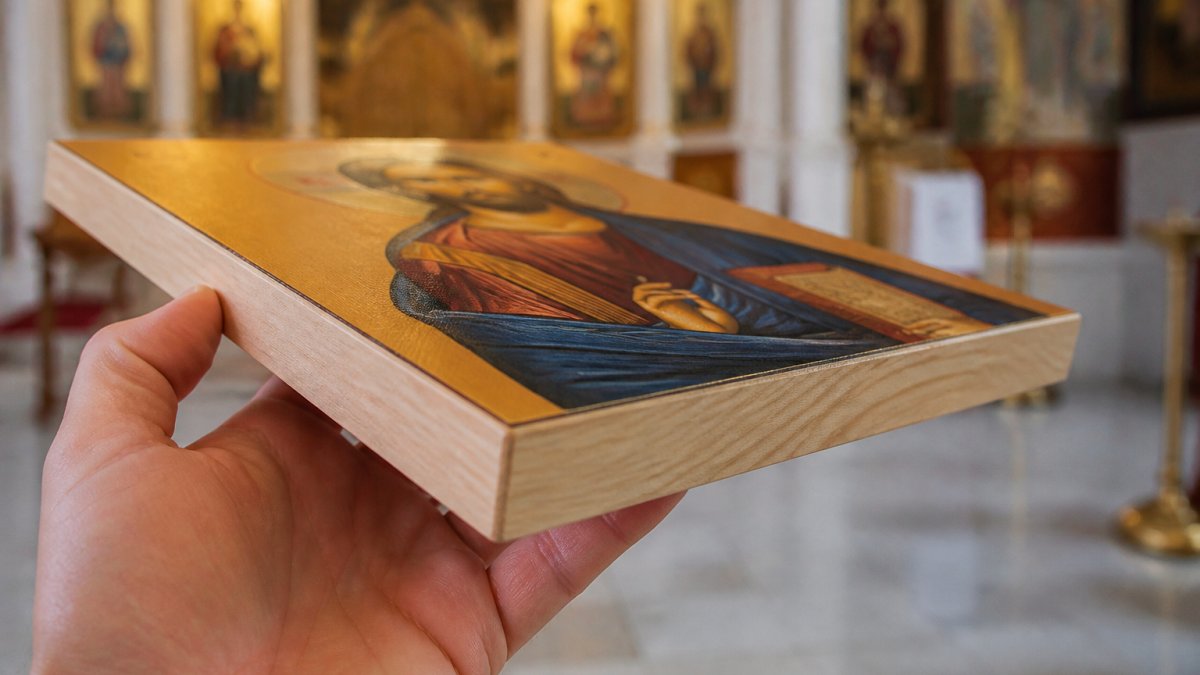
Here is how the three compare:
| Panel Type | Durability | Weight | Best For | Watch Out For |
|---|---|---|---|---|
| Solid wood | High, resists warping when sealed | Heavy | Large church panels, long-term installs | Cracking if unsealed |
| Canvas on board | High, stable and light | Moderate | Home altars, medium panels | Sagging if poorly mounted |
| Composite board | Moderate | Light | Tight budgets, temporary spaces | Edge wear over years |
We mount fine art canvas onto smooth maple shelled panels so the image stays flat and the wood does the structural work.
What most buyers miss is the sealing step. An unsealed wood panel will absorb moisture and move. A sealed one holds steady for decades.
Archival Inks for Religious Art: What Keeps Color True
Archival inks for religious art are pigment-based inks designed to resist fading and color shift over long periods. They hold their tone far better than standard dye-based inks when exposed to light and air.
The difference shows up in the details. Deep reds, golds, and blues are the first colors to drift in cheaper prints. Archival pigment inks keep those tones stable because the pigment particles resist breakdown.
At Theophany Works, we print each sacred image with archival inks on premium fine art canvas. The source images are captured onsite at churches and monasteries at high resolution, so the color that reaches the canvas starts accurate. That matters for faces, halos, and vestments where a slight shift is immediately visible.
A common mistake is judging a print by how it looks on day one. Almost any print looks good fresh out of the box. The real test is year five and year ten.
So how do you judge ink quality before you buy? Ask three questions:
- Is the ink pigment-based or dye-based?
- Is the canvas acid-free and fine art grade?
- Is there a protective finish over the print?
If the answer to any of these is unclear, that is your signal to keep looking.
UV-Protective Finish for Icons: Shielding Sacred Art from Light Damage
A UV-protective finish for icons is a clear coating that blocks the ultraviolet light responsible for most fading and yellowing. It is the single most overlooked layer in icon construction, and the one that most directly extends an icon's life.
Light damage is cumulative and invisible until it is too late. Sunlight through a window, even indirect, breaks down color over years. By the time fading shows, the damage cannot be reversed.
We seal every panel with a UV protectant clear coat. This does two things. It shields the print from light damage, and it adds a protective layer against dust, fingerprints, and the small abrasions that come from regular veneration.
The finish also affects how the icon looks. A good clear coat deepens the image without glare, so the colors read richer in candlelight. That is a small thing that matters every Sunday.
Church Icon Placement: Where Icons Belong and How to Mount Them Safely
Church icon placement follows both liturgical tradition and plain physical safety. Icons go where the faithful can see and venerate them without risk to the artwork or to people.
The iconostasis, side walls, and entry areas are the usual homes. Height matters: icons should sit at a comfortable viewing level, not so high that they are hard to see and not so low that they get knocked.
Mounting is where good intentions fail. A heavy wood panel needs real hardware, not a single nail.
Follow this mounting checklist:
- Use two anchors per panel, rated well above the panel's weight
- Anchor into studs or use proper masonry anchors for stone walls
- Keep panels at least a hand's width from heat sources and candle flames
- Add a small spacer behind the panel for airflow
- Recheck anchors once a year, especially in older buildings
For large parish icons, hire a professional installer. The cost of a proper mount is small next to the cost of a fallen panel.
Choosing the Right Size and Style for Your Space
Size and style should follow the space, not the other way around. A panel that looks right in a small chapel will disappear on a large nave wall.
Start by measuring the wall and the viewing distance. A viewer standing several feet back needs a larger panel to read the image clearly. A home altar calls for something more intimate.
Style is a matter of tradition and taste. Match the icon's style to the rest of the space so the room reads as one whole. Mixing wildly different styles in one sightline looks accidental.
A simple way to choose:
- Small home altar: one focal icon, moderate size
- Side chapel: matched set at eye level
- Large nave: bold panels scaled to the wall
Our high-resolution source images keep clarity even in larger sizes, which is exactly where cheap prints fall apart.
Cleaning and Maintaining Durable Icons for Church Interiors
Cleaning and maintaining durable icons for church interiors is mostly about restraint. The right care keeps the finish intact for decades. The wrong care strips it away in one afternoon.
Dust with a soft, dry cloth. That handles most of it. For fingerprints, use a barely damp cloth and dry immediately. Never spray cleaner directly on the panel.
Avoid these, which cause real damage:
- Harsh or abrasive cleaners
- Solvents and alcohol
- Soaking or heavy wet wiping
- Direct flame or heat near the panel
Check the finish once a year. If the clear coat looks dull or worn, have it re-sealed by someone who knows the material. In a busy parish, a yearly look-over catches small issues before they grow.
Handle panels by the edges, never by the face. Oils from hands are the quiet enemy of any finish.
Every parish and home altar deserves iconography that will still be here for the next generation. The challenge is choosing materials that hold up, and that means real wood, archival inks, and a UV-protective finish working together. At Theophany Works, we handcraft each icon in our studio, print with archival inks on premium fine art canvas, mount onto smooth maple shelled panels, and seal with a UV protectant clear coat for lasting beauty. Get started with Theophany Works and furnish your sacred space with iconography built to endure.
Frequently Asked Questions
What materials are best for icons displayed in a church?
Wood panels with a canvas surface offer a balance of durability and traditional appearance. Solid wood resists warping when sealed properly, while archival canvas holds color well. Avoid paper prints and thin composites that can bow in humid sanctuaries. Look for panels sealed with a UV-protective finish and printed with archival inks for religious art, which resist fading and surface wear over decades of liturgical use.
How can a church protect icons from fading and surface damage?
Ultraviolet light is the main cause of fading. Position icons away from direct sunlight and use a UV-protective finish for icons to block damaging rays. Keep icons out of damp areas and clean them with a dry, soft cloth rather than wet cleaners. For high-traffic areas, mount icons securely and consider a protective clear coat that resists scratches and incidental contact.
Are canvas icons suitable for church interiors?
Yes. Canvas mounted on wood panels provides a durable, lightweight option that looks appropriate in church settings. High-resolution printing with archival inks for religious art captures fine detail, and a UV-protective finish for icons extends color life. Canvas panels are also easier to hang and move than heavy solid wood, making them practical for mission parishes and growing congregations.
Where should icons be placed inside an Orthodox church?
Church icon placement follows liturgical tradition: the iconostasis separates the sanctuary from the nave, with icons of Christ, the Theotokos, and the saints arranged in order. Icons also appear on side walls, in chapels, and at the entrance. Place smaller icons at eye level for veneration and larger panels where they can be seen from a distance, always avoiding direct sunlight and heat sources.
Explore Popular Articles
Agiografia Icons vs Christianity Art: What's the Difference?
Last Updated: November 26, 2026 Quick Summary Agiografia icons are liturgical objects made to be ve...
How to Choose Icon Size for Screens and Sacred Art
Last Updated: November 24, 2026 Quick Summary To choose icon size, first decide whether you mean a...
7 Handcrafted Maple Panel Religious Art Pieces Worth Considering
Last Updated: November 22, 2026 Quick Summary Handcrafted maple panel religious art pairs a sacred...
How to Choose Between Modern and Traditional Icon Printing
Last Updated: November 17, 2026 Quick Summary Choose modern icon printing when you need faithful, d...