High Resolution Orthodox Icon Prints: 2026 Buyer's Guide

Table of Contents
- What Makes High Resolution Orthodox Icon Prints Different
- Printable Orthodox Icons: Digital Files Versus Physical Prints
- Orthodox Icon Canvas Prints: What the Material Delivers
- Orthodox Icons on Wood Panels: Mounting, Finish, and Durability
- How to Print Orthodox Icons Without Losing Image Quality
- Sizing and Display: Matching Icon Prints to Home Altars and Parish Walls
- Choosing High Resolution Orthodox Icon Prints for Devotional Use
- Frequently Asked Questions
Last Updated: October 19, 2026
What Makes High Resolution Orthodox Icon Prints Different
High resolution orthodox icon prints are reproductions of sacred images made from large source files, so the fine detail of the original, the gold background, the folds of a garment, the line of a saint's face, survives the printing process instead of blurring into a soft approximation. At Theophany Works, we photograph icons onsite at churches and monasteries, then print those files with archival inks.
Resolution, Source Photography, and the Detail That Survives Printing
Most buyers never see the source file, which is exactly why it matters. A print can only be as sharp as the photograph behind it.
A common mistake is judging a print by its listed dimensions instead of its detail. A large canvas printed from a weak source looks worse than a small one from a strong source. When you compare orthodox icon prints, ask where the image came from and how it was captured.
How to assess resolution before you buy. Resolution is not a single number; it is a relationship between pixel dimensions, print size, and viewing distance. Three practical checks will separate a genuinely high-resolution print from one that only claims to be:
- Pixel dimensions versus print size. A file needs enough pixels to fill the ordered size at a sensible density. As a working rule, a print viewed at arm's length (roughly 12 to 18 inches, typical for a home prayer corner) holds fine detail at about 300 pixels per inch (PPI). A print viewed from across a room (6 feet or more, typical for a parish wall) can look sharp at 150 PPI or even 100 PPI, because the eye resolves less detail at distance. Multiply the print's width and height in inches by the target PPI to get the minimum pixel dimensions the source file should have. A 12 x 16 inch icon for a home altar at 300 PPI needs roughly 3,600 x 4,800 pixels; the same icon on a parish wall at 150 PPI needs about 1,800 x 2,400 pixels. If a provider cannot tell you the pixel dimensions of the file behind a given size, that is a warning sign.
- Source capture quality. A high pixel count does not rescue a soft photograph. Ask whether the icon was photographed onsite, with even lighting, straight-on and without glass between the camera and the surface. Interpolation, the process of enlarging a file in software, adds pixels but not detail; an upscaled file can hit the pixel target and still look mushy. Onsite capture of aged gold and pigment also preserves the true color that stock images often brighten into something less honest.
- Viewing distance and the honest ceiling. Every print has a size beyond which it stops looking sharp, no matter how good the file. Decide where the icon will hang first, then choose the largest size that still meets the PPI target for that distance. A provider who will discuss that trade-off openly is more useful than one who lists only dimensions.
Faithful Reproduction and Iconographic Accuracy
Fidelity is not the same as sharpness. An icon can be technically crisp and still get the tradition wrong: the wrong inscription, a saint's attribute misplaced, proportions that drift from the canon.
We work with master iconographer Kyriakos Kosova, whose partnership keeps our reproductions anchored to Orthodox tradition rather than to what looks attractive on a screen. That matters most when you are choosing a specific saint or feast for a home altar.
Printable Orthodox Icons: Digital Files Versus Physical Prints
Printable Orthodox icons are digital image files you download and print yourself, while physical prints arrive finished and ready to hang. The right choice depends on control versus convenience. Digital files suit parishes that already have a print vendor and need to reproduce the same image at several sizes.
| Format | Best For | You Control | Trade-Off |
|---|---|---|---|
| Digital download | Parishes reprinting at multiple sizes | Paper, size, printer | Color and quality depend on your printer |
| Paper print | Framed display, low cost | Frame and mat | Needs framing, less durable |
| Canvas print | Large walls, warm texture | Mounting and hanging | Surface texture softens very fine linework |
| Wood-mounted panel | Home altars, lasting finish | Placement | Heavier, needs solid hanging hardware |
One honest limitation of digital files: the color you see on screen rarely matches what your printer produces. A physical print removes that guesswork.
Orthodox Icon Canvas Prints: What the Material Delivers
Orthodox icon canvas prints put the image on fine art canvas, which gives a warm, tactile surface that reads well at a distance and holds up on a large wall.
The material's weakness is texture. A pronounced canvas weave can soften extremely fine linework, so the quality of the print depends on the canvas being fine enough to hold detail.
Orthodox Icons on Wood Panels: Mounting, Finish, and Durability
Orthodox icons on wood panels carry the weight and presence people associate with traditional icons, without the cost of hand-painting. The panel is where durability is won or lost.
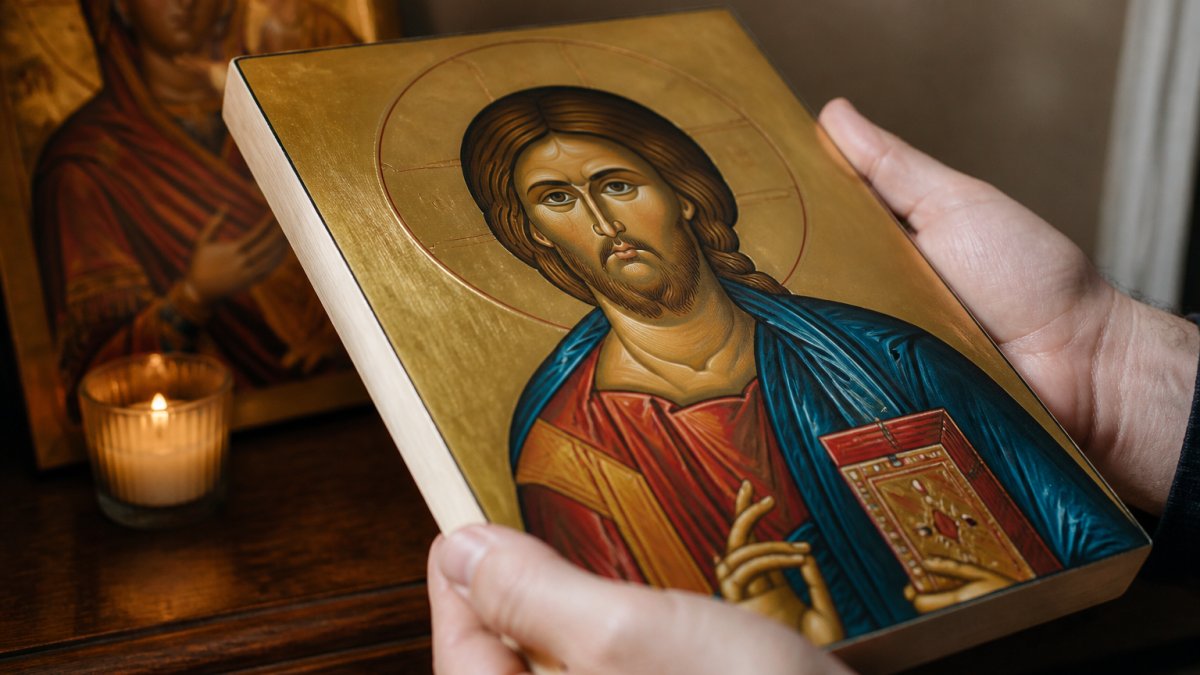
We mount our prints onto smooth maple shelled panels and seal each one with a UV protectant clear coat.
How to Print Orthodox Icons Without Losing Image Quality
Learning how to print Orthodox icons well comes down to five steps, and skipping any one of them shows in the finished piece.
- Start with the largest source file available. A file sized for a small print will pixelate when enlarged.
- Set your printer to its highest quality mode and match the paper type setting to the actual paper.
- Use a fine-art or matte paper rated for pigment inks so the colors sit on the surface rather than soaking in.
- Print a small test strip first to check color and sharpness before committing a full sheet.
- Let the print cure fully before framing or mounting, following the paper maker's guidance.
The most common mistake is enlarging a file beyond its native resolution. If a digital file is only meant for a modest size, printing it large will soften every edge.
Sizing and Display: Matching Icon Prints to Home Altars and Parish Walls
Sizing is where most first-time buyers guess and regret it.
For a home altar, a modest vertical icon above the prayer corner usually works better than a wide horizontal piece, because portrait orientation matches the traditional proportions of most icons.
Framing choices and what each one asks of you. The frame is part of how an icon reads, and the right choice depends on the material and the room:
- Paper prints need a frame and mat for rigidity and protection. Choose a frame deep enough to keep the glass off the print surface, and use mat or conservation glass in rooms with strong daylight. A mat also gives the image visual breathing room and keeps the print from touching the glass.
- Canvas prints are often stretched over a wooden stretcher bar and hung unframed, which suits large parish walls and keeps weight down. A floater frame, which leaves a small gap between canvas edge and frame, adds a finished look without cropping the image.
- Wood-mounted panels are typically hung as-is, with the panel edge acting as the frame. That makes the panel's edge quality part of the purchase decision, and it means hanging hardware must be rated for the panel's weight.
Matching size to purpose. A gift icon for a baptism or name day usually works at a modest size that suits a bedroom wall or shelf.
Choosing High Resolution Orthodox Icon Prints for Devotional Use
Choosing well means matching the print to its purpose, not chasing the biggest or cheapest option. A gift for a baptism, a saint for a name day, a set for a growing mission parish: each calls for a different balance of size, material, and budget.
Here is how we would decide:
- For a home altar: a wood-mounted panel in portrait orientation, sealed against light and handling.
- For a large parish wall: a canvas print sized to read from the back of the room.
- For a tight budget: a paper print you frame yourself, from a strong source file.
- For a specific saint or scene: confirm the provider offers custom pieces before you fall in love with a catalog image.
We built Theophany Works around these decisions: high-resolution images captured onsite, archival inks on fine art canvas, smooth maple panels, and a UV protectant clear coat.
Frequently Asked Questions
How can I tell whether an Orthodox icon image is high resolution?
Ask for the pixel dimensions of the source file, not just a preview. As a working rule, a print needs roughly 150 to 300 pixels per inch at its final size, so a 16 by 20 inch icon wants a file around 2400 by 3000 pixels at the lower end. Look closely at faces, hands, and lettering in a sample image: fine gold striations and facial features should stay sharp rather than blurring into blocks. Providers who photograph icons onsite at churches and monasteries can usually share that source information directly.
Are printable Orthodox icons a good alternative to ordering a finished print?
Printable Orthodox icons suit people who already own a good printer, want a small size, or need a file quickly for a card or bulletin. The tradeoff is control over the outcome: home printers vary in color accuracy, paper quality, and fade resistance, and most consumer inks are not archival. Physical prints from a studio that uses archival inks and a UV protectant clear coat generally hold color longer and arrive ready to hang. For a home altar or church wall, the finished print is usually the safer choice.
How large can I print an Orthodox icon without losing image quality?
It depends entirely on the source file. A high-resolution photograph captured onsite at a church or monastery can support large formats because the original detail is there. A web image pulled from a search result will fall apart past a few inches. Ask the provider what sizes they offer from a given image, and check whether they show a close-up of the printed detail. Studios that print from their own high-resolution captures can often go considerably larger than a home setup.
What is the difference between a printed icon and a hand-painted icon?
A hand-painted icon is original work in egg tempera or acrylic on prepared wood, and it carries the iconographer's time, training, and individual hand. A printed icon reproduces an existing sacred image using archival inks on canvas or paper, then may be mounted on a wood panel and sealed. Prints cost less and allow consistent reproduction of a venerated original; hand-painted pieces are one of a kind. Many parishes use prints for large-scale walls and reserve hand-painted icons for focal points.
The hardest part of buying iconography is trusting that what arrives will match what you hoped for. We photograph icons onsite, print them with archival inks on premium fine art canvas, mount them on smooth maple panels, and seal each one with a UV protectant clear coat, so the clarity and color hold up for years of devotional use. Explore the Theophany Works collection and subscribe to our newsletter for new arrivals, guidance on sizing, and reflections on faithful reproduction.
Explore Popular Articles
Agiografia Icons vs Christianity Art: What's the Difference?
Last Updated: November 26, 2026 Quick Summary Agiografia icons are liturgical objects made to be ve...
How to Choose Icon Size for Screens and Sacred Art
Last Updated: November 24, 2026 Quick Summary To choose icon size, first decide whether you mean a...
7 Handcrafted Maple Panel Religious Art Pieces Worth Considering
Last Updated: November 22, 2026 Quick Summary Handcrafted maple panel religious art pairs a sacred...
How to Choose Between Modern and Traditional Icon Printing
Last Updated: November 17, 2026 Quick Summary Choose modern icon printing when you need faithful, d...