
How to Set Up a Home Altar: Step-by-Step Guide

Table of Contents
- Step 1: Choose Where to Place a Home Altar
- Step 2: Select a Sturdy Table or Shelf
- Step 3: Decide on a Theme and Intention
- Step 4: What to Put on a Home Altar
- Step 5: Incorporate the Four Elements
- Step 6: How to Make a Prayer Altar at Home for Daily Use
- Home Altar Ideas for Small Spaces and Shared Homes
- Frequently Asked Questions
Last Updated: October 18, 2026
Step 1: Choose Where to Place a Home Altar
A home altar belongs in a spot where prayer can happen without moving furniture or clearing clutter first. The best location is a quiet corner you pass every day but that stays out of the main traffic flow.
Start with these placement rules:
- East-facing when possible. Orthodox tradition orients prayer toward the east, so a wall that faces east is the first choice.
- Low traffic. Avoid hallways, kitchen walkways, and anywhere pets run through.
- Visible but protected. You want to see it daily. You also want it away from direct sun and damp.
- Near where you pray. A bedroom corner or a quiet nook off the living room works well.
The Orthodox Church has long treated the home as a small church, a place where prayer and devotion continue beyond the parish walls. That idea should guide your choice: the altar is not decoration.
One insider note: a spot that looks perfect on paper often fails in practice. Sit in the space for a few minutes at the time of day you normally pray. If noise, glare, or foot traffic breaks your focus, pick another wall.
Step 2: Select a Sturdy Table or Shelf
The surface under your altar matters more than most guides admit. A sturdy table or shelf keeps candles safe, holds the weight of icons, and gives the arrangement a stable base. Wobbly furniture and open flame do not mix.
What to look for:
- Solid build. A small wooden table, a bookshelf, or a wall-mounted shelf all work if they do not rock.
- Right height. Kneeling or standing prayer should feel natural. Measure before you commit.
- Depth for icons. Leave room for a standing icon, a candle, and a small vase without crowding.
- Away from fabric. Curtains and bedding near an open flame are a hazard.
A common mistake is choosing a surface that is too small. The altar fills up fast once you add an icon, a candle, a cross, and a prayer book. Give yourself a little extra room.
If you are working with a tight budget, a repurposed side table or a sturdy wooden crate turned on its side works fine. The surface does not need to be expensive. It needs to be steady.
Step 3: Decide on a Theme and Intention
Every home altar needs a purpose, and that purpose shapes everything you place on it. A home altar is a designated sacred space set apart for prayer, meditation, and devotion within a household. The theme you choose gives the space its focus.
Ask yourself what the altar is for:
- Daily prayer. Keep it simple: an icon, a candle, a prayer book.
- A specific season. Lent, Pascha, or a feast day can guide the colors and images you use.
- A family focus. Baptismal names, name days, and family saints give the altar personal meaning.
- A memorial corner. Icons of departed loved ones and a place for remembrance.
Write your intention down. One sentence is enough. "This altar is for morning and evening prayer" or "This space honors our family's patron saints." That sentence keeps the arrangement from drifting into clutter.
The theme also sets the tone. A simple, spare altar suits a small apartment. A more elaborate arrangement fits a family room where the whole household gathers. Neither is more correct than the other.
Step 4: What to Put on a Home Altar
The core objects are few: an icon, a candle, a cross, and a prayer book. Everything else is optional. This is the part where most people overbuy and then wonder why the space feels crowded.
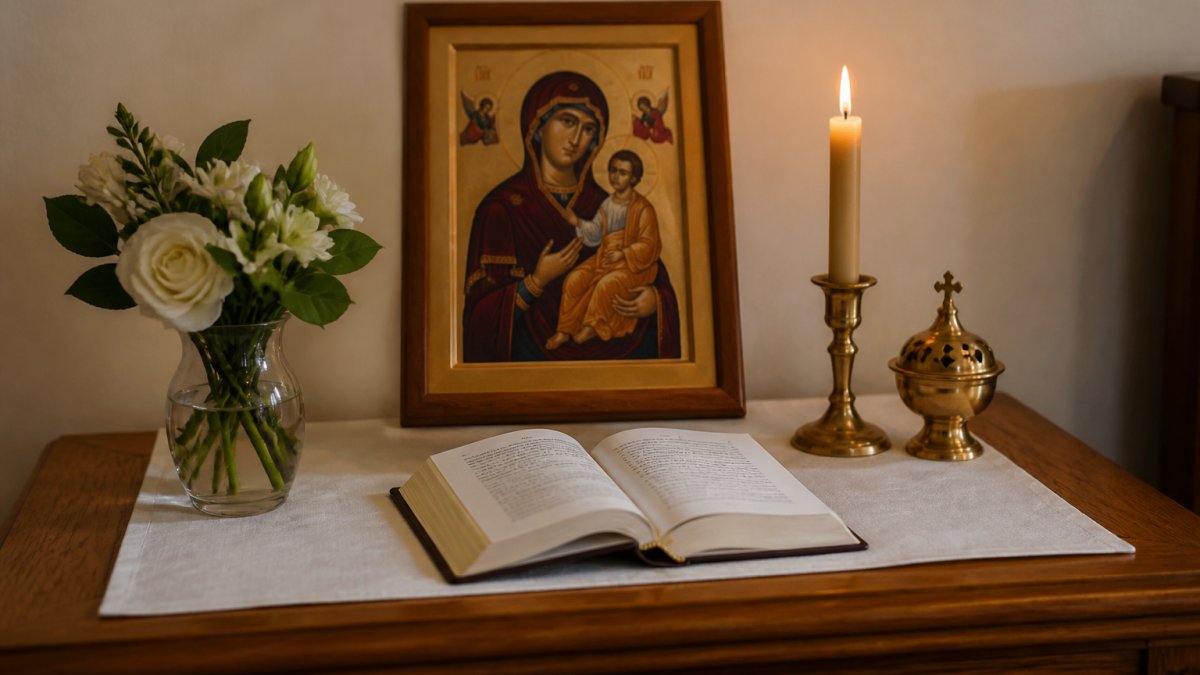
Start with the essentials:
- An icon or image. This is the focal point. Choose one with clear, dignified imagery.
- A candle or light source. Beeswax candles are traditional. A battery-operated candle is a safe stand-in for homes with children or pets.
- A cross. Small and simple works well.
- A prayer book. Keep the one you actually use within reach.
- A small vase. Fresh flowers or a sprig of greenery add life.
Then add meaningful personal items: a baptismal cross, a family photo, a stone from a pilgrimage, a handwritten prayer. These personal objects turn a display into a living space of devotion.
What most guides miss is the quality of the focal image. A blurred or flimsy print undercuts the whole space.
Step 5: Incorporate the Four Elements
The four elements, earth, air, fire, and water, give an altar structure and symbolism, but they are not a universal requirement. The results ranking for this query mix Christian prayer corners, earth-honoring setups, and witchcraft or elemental examples, and the objects and practices should fit the reader's beliefs.
Here is how to bring each element in, with the trade-offs most guides skip:
- Earth. Wood, stone, clay, or a natural linen cloth. The surface itself can carry this element. A wooden cutting board from the kitchen works as a base and costs nothing. Avoid porous stone that stains when water spills.
- Air. An open window nearby, incense, or a feather. Smoke-sensitive households should skip incense and use a small fan or simply crack a window for a few minutes before prayer. A feather from a craft store is inexpensive; do not take feathers from protected birds.
- Fire. A candle or oil lamp. This is the most traditional element and the one to handle with the most care. Battery-operated candles are a safe stand-in for homes with children, pets, or renters whose leases prohibit open flame. If you use a real candle, place it on a nonflammable tray and keep it at least 12 inches from curtains, bedding, and paper.
- Water. A small bowl of fresh water, changed regularly. Some families keep a holy water vessel. A shallow ceramic dish from a thrift store works. Change the water daily so it does not grow stagnant or breed mosquitoes in warm months.
Arrange them so they balance. Fire and water near each other need a stable surface between them. Earth and air are easy to place: the wood of the table and the open room already carry them. A common pattern is to place earth at the base, fire at the center, water to one side, and air represented by the open space above.
Accessibility matters here too. If kneeling is difficult, place the altar at standing height and keep the candle within easy reach. If you have limited mobility or use a walker, a wall shelf at chest height is safer than a low table you have to bend toward. If you share a home with someone who has asthma or smoke sensitivity, choose a battery-operated candle and skip incense entirely. None of these choices make the altar less sacred; they make it usable.
Step 6: How to Make a Prayer Altar at Home for Daily Use
A prayer altar at home earns its place by being easy to use every day. The setup that looks beautiful but takes ten minutes to prepare will quietly stop getting used.
Build a daily routine around it:
- Keep matches and a lighter within reach. Fumbling for them breaks the rhythm.
- Leave the prayer book open to the day's reading.
- Set a fixed time. Morning and evening are the traditional anchors.
- Keep the surface clear of mail, keys, and everything else that lands there.
A simple rule: if you have to move something to pray, the altar is doing the wrong job. Clear the surface and keep only the sacred objects on it.
For families, a short evening prayer together at the altar builds the habit faster than any solo resolve. Children remember the space where the family gathered, not the perfection of the arrangement.
Home Altar Ideas for Small Spaces and Shared Homes
Small apartments and shared houses need creative solutions, and they work better than most people expect.
Try these approaches:
- A wall shelf at eye level holds an icon, a candle, and a cross in under a foot of depth. Mount it into a stud or use heavy-duty anchors; a shelf that pulls out of drywall is a fire hazard.
- A corner shelf uses dead space and keeps the altar out of walkways.
- A small cabinet with doors lets you close the altar for privacy in a shared room. A used medicine cabinet or a child's nightstand with a door works.
- A windowsill can work if it faces east and stays dry. Keep the candle away from the glass and check that the sill does not get direct afternoon sun.
- A fabric-covered box stores the objects and becomes the surface when opened. A sturdy shoebox lined with a clean cloth is enough to start.
For shared homes, respect matters. Ask housemates before placing an altar in a common room, and keep the space tidy so it reads as intentional rather than cluttered.
Budget-friendly options are everywhere. Thrift stores, hand-me-down furniture, and a single well-chosen icon do more than a room full of new purchases.
Care, cleaning, and changing the altar. Dust the surface weekly with a dry cloth; wax and ash build up faster than people expect.
Step-by-step examples for different purposes. These sample setups translate the general advice into a practical arrangement:
- Prayer altar (Christian). A small table facing east, a clean white or linen cloth, a standing icon at the back, a cross to one side, a beeswax or battery-operated candle in front, and a prayer book open to the day's reading. Keep matches or a lighter in a small drawer nearby.
- Meditation altar (nonspecific). A low shelf or tray, a cushion on the floor in front, a small bowl of water, a candle, and one natural object such as a stone or a sprig of greenery. Keep the surface sparse so the eye has one place to rest.
- Remembrance altar. A shelf at eye level, a framed photo of the person being remembered, a small candle, a stone from a meaningful place, and a handwritten prayer or note. Refresh the candle and dust the frame weekly.
- Nature-focused altar. A windowsill or tray with a wooden base, a small bowl of water, a seasonal natural object (a pinecone in winter, a flower in spring), and a battery-operated candle if open flame is not practical. Change the natural object as the season turns.
Frequently Asked Questions
How do you set up a home altar for daily prayer?
Start by choosing a quiet, distraction-free spot, such as a corner of your bedroom or a dedicated shelf. Place a sturdy table or shelf there, cover it with a clean cloth, and arrange icons, a candle, and any meaningful objects. Keep the space simple so it remains focused on prayer. Set aside a specific time each day to stand or sit before your home altar, light the candle, and pray. Consistency matters more than elaborate decoration.
What should you put on a home altar?
A traditional home altar includes icons of Christ, the Theotokos, and your patron saint, a candle or oil lamp, a cross, and a prayer book. You can add a small bowl of water, fresh flowers, or a incense burner. Personal items like a wedding photo or a keepsake from a pilgrimage can also have a place. Keep the arrangement uncluttered so each object points toward prayer rather than distraction.
Where should your altar be in your home?
Place your home altar in a quiet area where you can pray without interruption, ideally facing east, the traditional direction of prayer. A corner of a bedroom, a dedicated shelf in a living room, or a small alcove works well. Avoid high-traffic zones like the kitchen or hallway. If space is limited, a wall-mounted shelf or the top of a dresser can serve as a simple altar.
How do you keep a home altar clean and meaningful?
Dust the altar surface and icons weekly with a soft cloth, and replace candle stubs or spent incense regularly. Change the cloth seasonally or when it becomes soiled. Refresh flowers before they wilt. More importantly, keep the space free of clutter and unrelated objects. Treat the altar as a sacred space by maintaining its order and cleanliness, which helps preserve its purpose as a place of devotion.
Explore Popular Articles
Agiografia Icons vs Christianity Art: What's the Difference?
Last Updated: November 26, 2026 Quick Summary Agiografia icons are liturgical objects made to be ve...
How to Choose Icon Size for Screens and Sacred Art
Last Updated: November 24, 2026 Quick Summary To choose icon size, first decide whether you mean a...
7 Handcrafted Maple Panel Religious Art Pieces Worth Considering
Last Updated: November 22, 2026 Quick Summary Handcrafted maple panel religious art pairs a sacred...
How to Choose Between Modern and Traditional Icon Printing
Last Updated: November 17, 2026 Quick Summary Choose modern icon printing when you need faithful, d...