
How to Choose Between Modern and Traditional Icon Printing
Last Updated: November 17, 2026
Quick Summary
Choose modern icon printing when you need faithful, durable, clearly reproduced images for a home altar or growing parish, and traditional hand-painted icons when you want a unique devotional piece and have the budget and months of time it requires. Modern icon printing reproduces a photographed original with archival inks on canvas mounted to a maple panel, while a hand-painted icon is a unique creation built layer by layer in pigment.
- A hand-painted icon takes months to produce, while a printed icon takes days to a few weeks.
- Every printed icon starts with a high-resolution photograph captured onsite at churches and monasteries.
- Prints are made with archival inks on fine art canvas, mounted on maple panels, and sealed with a UV protectant coat.
- A painted icon can often be consolidated, cleaned, and retouched by a trained conservator, which prints cannot.
- Hanging any icon on an exterior-facing wall or directly above a heat source is the most common cause of premature damage.
Table of Contents
- What Modern and Traditional Icon Printing Really Mean
- Printed Icons vs Hand-Painted Icons: A Side-by-Side Comparison
- The Icon Printing Process: From Onsite Photography to Archival Canvas
- Icon Print Cost: What Drives Price and What You Get at Each Level
- Durability, Conservation, and How Icon Prints Age
- Orthodox Icon Prints in the Home Altar and the Parish
- How to Inspect a Reproduction and Judge Its Quality
- Choosing the Right Icon for Your Space at Theophany Works
- Frequently Asked Questions
What Modern and Traditional Icon Printing Really Mean
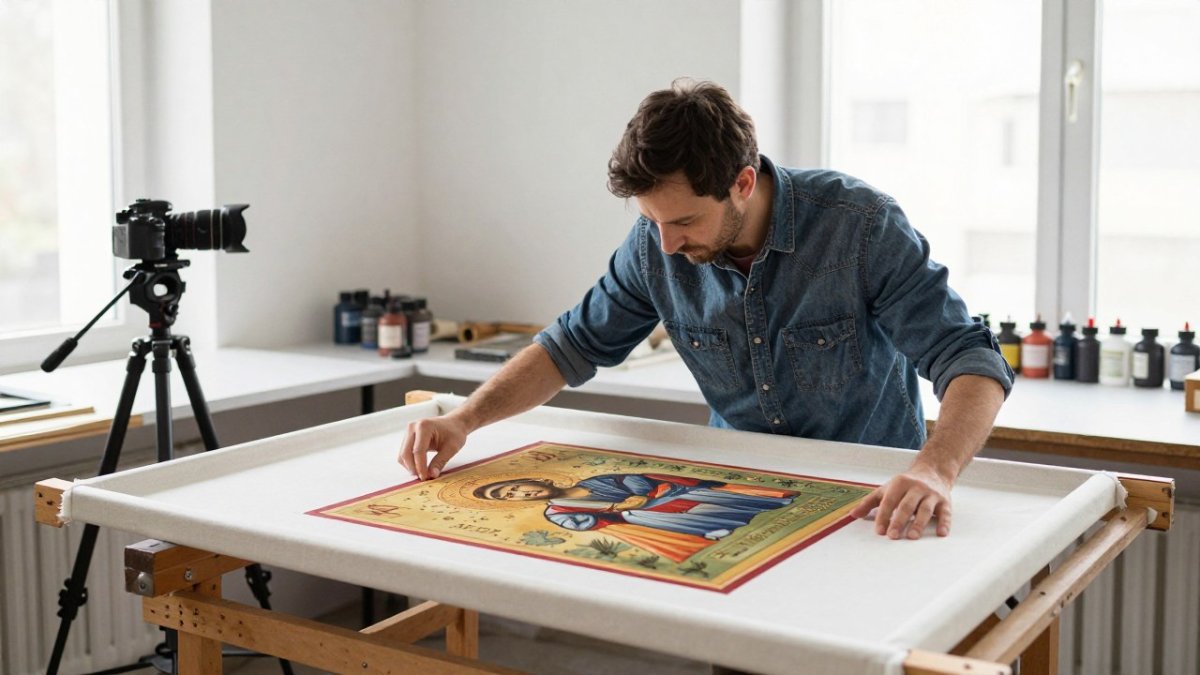
Modern vs traditional icon printing comes down to a single distinction: a hand-painted icon is a unique creation built up layer by layer in pigment, while a printed icon is a high-resolution reproduction of an existing sacred image, transferred to canvas or panel with archival inks. At Theophany Works, we print icons from images photographed onsite at churches and monasteries, then mount them on maple panels and seal them with a UV protectant coat. That process sits firmly on the modern side, and we think it deserves a fair hearing. Below, we break down how both approaches work and which one fits your altar or parish.
The debate is older than most buyers realize. Icon painting itself is a tradition of copying: iconographers have long worked from prototypes, manuals, and older images rather than inventing freely. A reproduction is not automatically a betrayal of tradition. The real questions are how the image is made, how long it lasts, and whether the work serves prayer rather than decoration.
Printed Icons vs Hand-Painted Icons: A Side-by-Side Comparison
Printed icons offer clarity and scale; hand-painted icons offer uniqueness and the value of original craftsmanship. Neither is "more Orthodox" by default. What separates them is the process behind the image and how it will be used.
| Factor | Printed Icon | Hand-Painted Icon |
|---|---|---|
| Origin | Reproduction of a photographed original | Unique creation by an iconographer |
| Time to produce | Days to a few weeks | Months |
| Cost level | Lower | Higher |
| Consistency across sizes | High, even in large formats | Varies by artist |
| Surface | Archival canvas on maple panel | Painted wood panel |
| Best for | Home altars, mission parishes, large-scale needs | Memorial gifts, focused devotional pieces |
A common mistake is assuming a print is a cheap imitation of a hand-painted piece. In practice, the two serve different purposes. A hand-painted icon is a singular devotional object; a printed icon lets a whole parish venerate a faithful image at a scale one artist could never supply alone.
The Icon Printing Process: From Onsite Photography to Archival Canvas
Every printed icon begins with a photograph. We capture high-resolution images onsite at churches and monasteries. The image is printed with archival inks on premium fine art canvas, mounted onto a smooth maple panel, and sealed with a UV protectant clear coat. The result is a tactile, natural surface that reads as an object, not a poster.
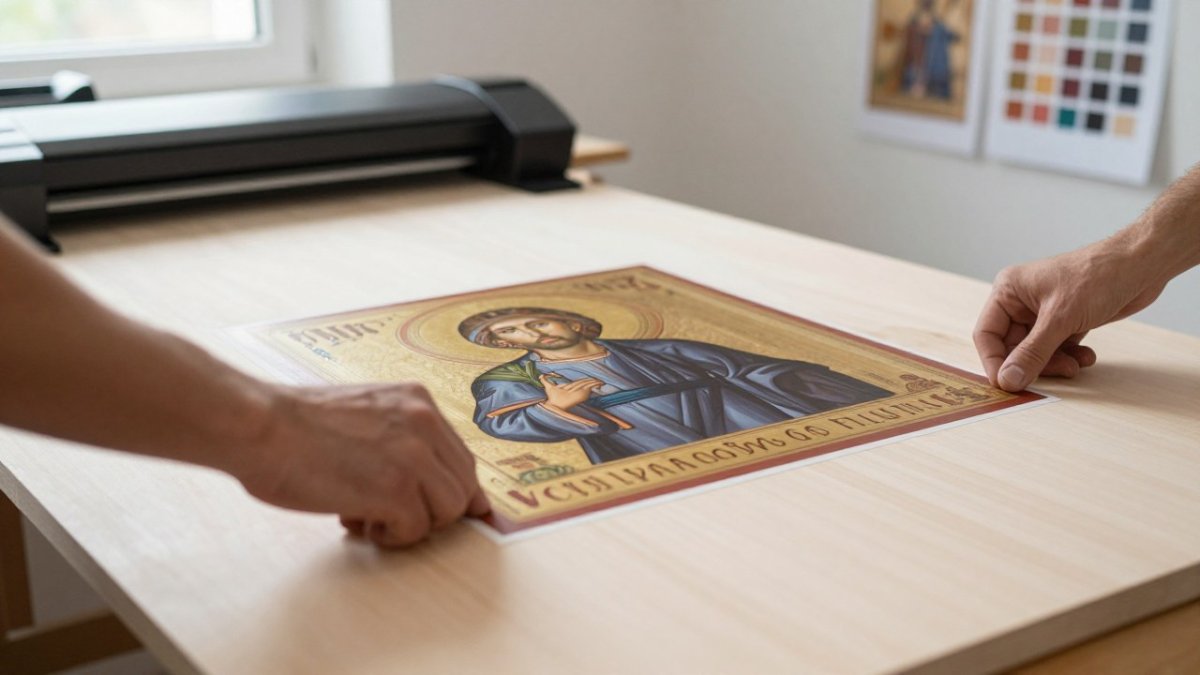
You can see exactly how this works on our custom Orthodox icon printing services page, which covers the materials and options before you order. The process matters because it determines everything downstream: a sharp source image and a stable panel are what keep an icon readable in a large size.
Icon Print Cost: What Drives Price and What You Get at Each Level
When comparing canvas icon prints, ask what the substrate is and whether the inks are archival.
We do not publish fixed prices because every order varies by size, substrate, and finish. For current pricing, check our site directly. If you are weighing printed against painted, our guide on where to buy authentic icons compares the two honestly.
Durability, Conservation, and How Icon Prints Age
Durability is where the print-versus-painting comparison gets practical. The useful questions are what degrades each type of icon, whether damage can be repaired, and what care each one needs in an ordinary home or parish.
What degrades a print. Three forces do most of the damage. Ultraviolet light breaks down colorants and causes fading, which is why a UV protectant clear coat matters, it slows the process but does not stop it, so direct sun is still the enemy. Moisture and humidity swings attack the substrate: paper cockles, canvas can slacken, and adhesives can fail if a print is mounted on cardboard rather than a solid panel. Surface abrasion from handling, dusting, and candle smoke dulls the image over time. A print on archival canvas, mounted to a maple panel, and sealed with a UV coat is more resistant to these forces, but it is still a surface that can be scratched.
What degrades a painting. A hand-painted icon on wood faces a different set of risks. Egg tempera and oil films can crack, darken, or flake as the wood panel expands and contracts with humidity. Gold leaf can lift at the edges. Varnish yellows with age. These changes are slow and often reversible by a conservator, but they are real, and they mean a painted icon needs a more stable environment than a print does.
Repairability. This is the sharpest practical difference. A painted icon can often be consolidated, cleaned, and retouched by a trained conservator, which is part of why painted pieces hold value over time. The trade-off is that conservation costs money and requires finding someone qualified.
Care in practice. Both types need the same basics: keep them out of direct sun, away from damp walls and radiators, and off surfaces where candle smoke and incense settle heavily. For prints, dust with a soft dry cloth and avoid wet cleaning that could soak the canvas edge. For painted icons, avoid sudden humidity swings and handle by the frame, not the painted surface.
Watch out: hanging any icon on an exterior-facing wall or directly above a heat source is the most common cause of premature damage, and it affects prints and paintings alike.
For readers who want the full material breakdown, our high resolution Orthodox icon prints buyer's guide covers resolution checks, canvas and panel options, and sizing. And if longevity in a parish setting is the priority, our roundup of durable Orthodox icons for parishes shows what holds up to candle smoke and daily veneration.
Orthodox Icon Prints in the Home Altar and the Parish
Printed icons fit the home altar and the parish better than many buyers expect. In a home prayer corner, a printed icon on a maple panel gives you a clear, dignified image at a size that suits the space. In a mission parish on a tight budget, printed icons let you furnish a whole church interior with consistent, professional-looking images rather than a patchwork of mismatched pieces.
A small parish worried about looking "cheap" should judge by the surface and the mounting, not the word "print." A canvas print sealed on a solid panel reads as a finished devotional object. For help selecting and arranging pieces, see our guide to choosing icons for your prayer corner. The practical rule: match the icon to the space and the purpose, then choose the method that delivers it.
How to Inspect a Reproduction and Judge Its Quality
Judge a reproduction by its source image, its materials, and its finish. A faithful print starts with a sharp, well-photographed original; no amount of fancy mounting rescues a blurry source. Ask where the image came from and whether it was captured onsite or copied from a low-quality file.
Use this checklist before you buy:
- Is the source image high-resolution and clearly photographed?
- Does the print use archival inks rather than dye-based inks?
- Is the canvas mounted on a solid panel, not glued to cardboard?
- Is there a UV protectant finish to slow fading?
- Does the seller explain the process, or stay vague about it?
- Are the proportions and details of the original preserved?
Choosing the Right Icon for Your Space at Theophany Works
Choosing between modern and traditional icon printing is really a question of purpose. If you need a unique, hand-painted devotional piece and have the budget and patience for months of work, a traditional icon is the right call. If you need faithful, durable, clearly reproduced images for a home altar or a growing parish, modern printing delivers more for the money.
At Theophany Works, we make that second path with care: icons photographed onsite, printed with archival inks on fine art canvas, mounted on smooth maple panels, and sealed with a UV protectant coat. The clarity holds even in large sizes, and the finish gives each piece a tactile, natural feel.
The hardest part is not deciding between printed and painted. It is finding a maker who will tell you honestly how the image was produced and why it will last. That transparency is what we built Theophany Works around: onsite photography, archival materials, maple mounting, and a UV-sealed finish on every piece. Get started with Theophany Works and furnish your altar or parish with iconography made to endure.
Frequently Asked Questions
What is the difference between modern and traditional icon printing?
Traditional icon printing relies on older reproduction methods with limited color range and paper stocks that yellow over time. Modern icon printing uses high-resolution capture, archival pigment inks, and fine art canvas or panel substrates. The result is sharper detail, a wider and more stable color palette, and a print that resists fading far longer. The icon's composition and style stay rooted in Byzantine tradition; the difference is in how faithfully and durably that image is reproduced.
Can a printed icon be considered a traditional Orthodox icon?
A printed icon is a reproduction, not a unique hand-painted creation, and Orthodox practice treats it as such. What matters for devotional use is theological accuracy and worthy presentation. Reproductions made from high-resolution images of established, venerated icons, printed with archival materials and mounted on a solid panel, are widely used in homes and mission parishes. They serve prayer and veneration; they are not sold as original artwork or as the work of a single iconographer.
How can I tell whether an icon is printed or hand-painted?
Look closely at the surface at an angle. A hand-painted icon shows brush texture, slight variations in pigment thickness, and often visible brushstrokes in the highlights and robes. A print has a uniform surface, and under magnification you may see a fine dot pattern from the printing process. Check the edges and the back as well: a print on canvas mounted to a panel usually reveals a canvas weave and a clean, even border. Ask the seller directly about materials and method.
Are printed icons less expensive than hand-painted icons?
Yes, generally by a wide margin. A hand-painted icon represents many hours of an iconographer's labor plus gold leaf and prepared wood, so it commands a much higher price. For current pricing, request a quote from the seller.

Explore Popular Articles
Agiografia Icons vs Christianity Art: What's the Difference?
Last Updated: November 26, 2026 Quick Summary Agiografia icons are liturgical objects made to be ve...
How to Choose Icon Size for Screens and Sacred Art
Last Updated: November 24, 2026 Quick Summary To choose icon size, first decide whether you mean a...
7 Handcrafted Maple Panel Religious Art Pieces Worth Considering
Last Updated: November 22, 2026 Quick Summary Handcrafted maple panel religious art pairs a sacred...
How to Choose Between Modern and Traditional Icon Printing
Last Updated: November 17, 2026 Quick Summary Choose modern icon printing when you need faithful, d...