
Agiografia Icons vs Christianity Art: What's the Difference?
Last Updated: November 26, 2026
Quick Summary
Agiografia icons are liturgical objects made to be venerated and prayed before, while most Christian art is made to illustrate, decorate, or express. That difference in purpose shapes everything else, from the flat perspective to the gold leaf. An icon asks you to look through it toward the person depicted, not to admire the artist's vision.
- The word agiografia comes from the Greek for holy writing, so the intent is stated up front.
- Icons use flat perspective, stylized forms, halos, and gold backgrounds; naturalism arrived in religious art with the Renaissance.
- Gold stands for divine light, blue belongs to the Virgin Mary, and red can signal martyrdom or divinity.
- Choose an Orthodox icon in this order: intended use, subject, size, and budget.
- Christianity Art is a broad field covering Catholic, Protestant, modern, and commercial religious imagery.
Table of Contents
- Agiografia Icons vs Christianity Art: What's the Difference?
- The Difference Between Orthodox Icons and Religious Paintings
- The Meaning of Orthodox Iconography: A Window into Heaven
- Veneration and Liturgical Use: How Icons Function in Worship
- How to Choose an Orthodox Icon for Your Home or Parish
- Authentic Orthodox Icons: Assessing Materials, Craftsmanship, and Provenance
- Commissioned Icons vs Printed Reproductions: A Practical Cost Breakdown
- Comparing Agiografia Icons and Christianity Art Directly
- Frequently Asked Questions
Agiografia Icons vs Christianity Art: What's the Difference?
The short answer: an Orthodox icon is a liturgical object made to be venerated and prayed before, while most Christian art is made to illustrate, decorate, or express. That distinction shapes everything else, from the flat perspective to the gold leaf. At Theophany Works, we build our pieces around that first purpose. Below, we break down what separates agiografia icons vs christianity art, and how to tell which one belongs in your space.
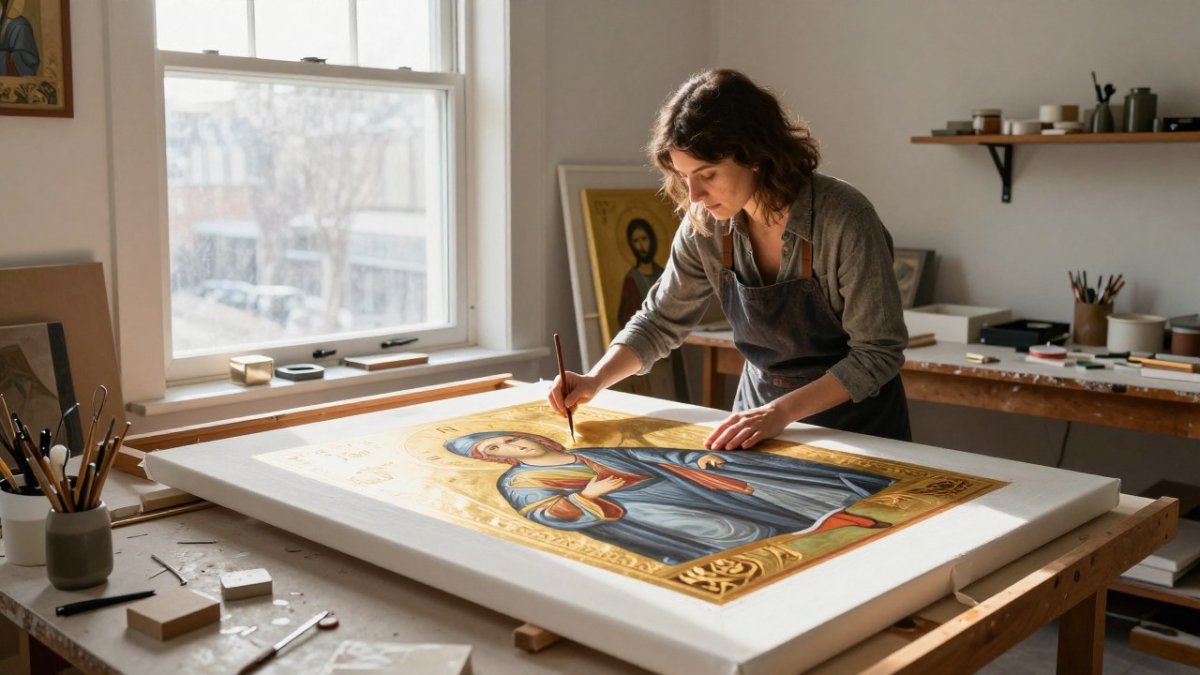
The word agiografia comes from the Greek for "holy writing," which tells you the intent up front. An iconographer is not composing a scene. They are copying a prototype handed down through generations.
That single idea explains why an icon looks the way it does.
The Difference Between Orthodox Icons and Religious Paintings
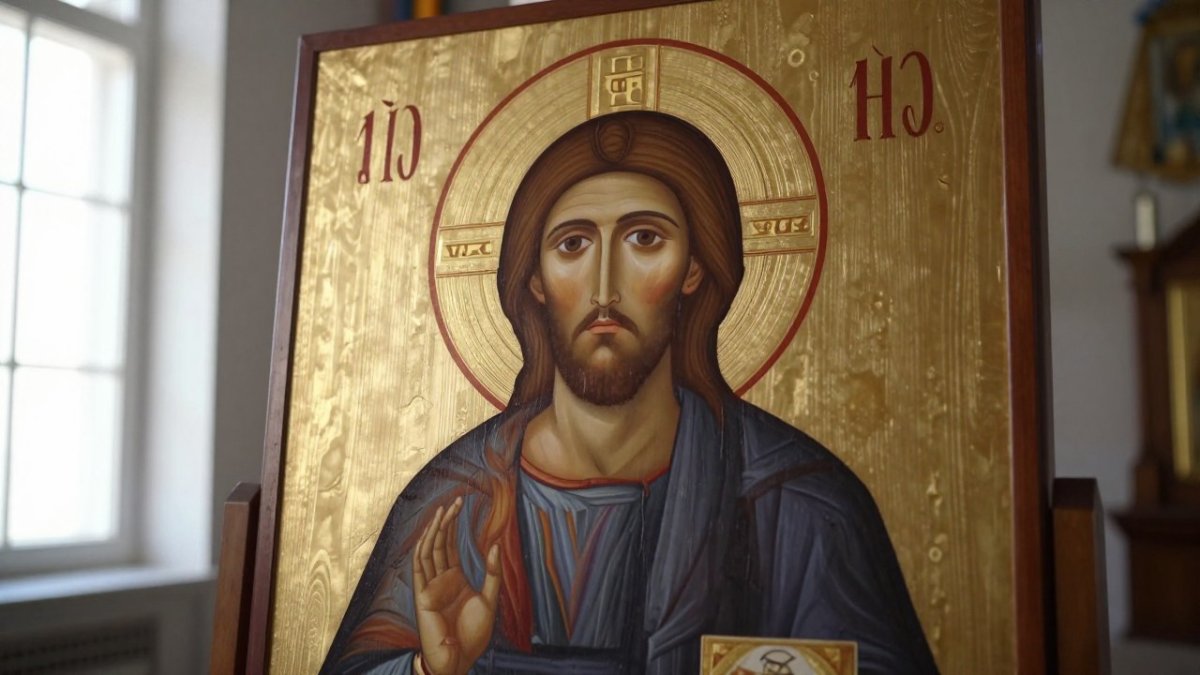
The difference between Orthodox icons and religious paintings is purpose, not skill. A religious painting invites you to admire the artist's vision. An icon asks you to look through it toward the person depicted. One is a picture of a holy event; the other is a meeting point.
Theological Purpose vs Artistic Expression
A religious painting is a theological statement rendered by an individual imagination. An icon is a devotional image governed by the Orthodox tradition, where the iconographer fasts, prays, and follows inherited conventions rather than inventing. The church treats the icon as a window into heaven, not a portrait.
Stylized Forms vs Naturalism
Naturalism arrived in religious art with the Renaissance. Icons never took that turn. Flat perspective, stylized forms, and reverse perspective keep the holy figures slightly removed from ordinary space. The halo, the elongated proportion, and the gold background all signal that you are looking at a sacred image, not a scene.
The Meaning of Orthodox Iconography: A Window into Heaven
The meaning of Orthodox iconography is that the image makes present what it depicts. Icons are not idols; the Orthodox faithful venerate the person, not the paint and wood. The theology behind this rests on the Incarnation: if God became visible, visible images of Christ are permissible.
Symbolism in Color, Gesture, and Composition
Every element carries weight. Gold stands for divine light. Blue belongs to the Virgin Mary. Red can signal martyrdom or divinity. A hand raised in blessing, the posture of a saint, the placement of figures in the composition: all of it is a sacred visual language passed down, not chosen for effect.
A common mistake is reading an icon like a Renaissance painting and hunting for the artist's personality. In practice, the iconographer's job is to disappear.
Veneration and Liturgical Use: How Icons Function in Worship
Veneration is the act of showing reverence to the holy person represented, and it is central to how icons function in worship. Icons stand on the iconostasis, in processions, and in the home altar. The faithful kiss them, bow before them, and light candles in front of them.
This is where the icon differs most sharply from contemporary art. An icon is made for liturgical use, not for a gallery wall. It is a means of prayer first and an object of beauty second. That is why durability matters so much: a piece destined for a parish has to survive incense, candle smoke, and decades of use.
How to Choose an Orthodox Icon for Your Home or Parish
Choosing an Orthodox icon starts with four decisions, in this order: intended use, subject, size, and budget. Most buyers reverse the order and start with size or price, which is why so many icons end up in the wrong room or the wrong scale for the wall.
Step 1: Define the Intended Use
The first question is whether the icon is for private prayer, a home altar, a parish church, a school, or a gift. Each use sets different priorities:
- Home altar or prayer corner: a smaller panel placed at eye level works best. The icon should be easy to venerate, close enough to kiss or bow before without strain.
- Parish church: larger panels need clarity at distance, which means high-resolution printing and strong contrast. A parish icon also has to survive incense, candle smoke, and decades of handling.
- Gift or heirloom: durability and provenance matter more than size. A solid wood panel with archival inks and a sealed surface will outlast a paper print by decades.
- Study or classroom: a paper print or small canvas is fine; the goal is instruction, not veneration.
Step 2: Choose the Subject
For a home altar, begin with Christ and the Theotokos (the Virgin Mary), the two subjects present in nearly every Orthodox prayer corner. Then add a patron saint or a scene tied to your family or parish. For a parish, the subject is usually dictated by the church's dedication or the liturgical calendar.
A common pattern is to start with a single icon and expand over time rather than buying a full set at once. This lets you match style and scale as the collection grows.
Step 3: Match Size to the Space
Measure the wall or altar before you shop. An icon that is too large for a home altar overwhelms the space; one that is too small for a parish wall disappears at distance.
Step 4: Set a Budget and Match It to Materials
Budget determines materials, not devotion. If you are weighing prints, our high resolution Orthodox icon prints guide explains resolution checks and sizing.
For a step-by-step walkthrough of subject, sizing, and placement, see our guide on 7 steps to choose Orthodox icons for your home altar.
Authentic Orthodox Icons: Assessing Materials, Craftsmanship, and Provenance
Authentic Orthodox icons are judged on three things: what the image is printed or painted on, how the image was sourced, and whether you can trace it to a real workshop. Ask where the image came from and who made the panel.
- Materials: solid wood panels, fine art canvas, archival inks
- Craftsmanship: smooth edges, sealed surfaces, no bubbling or warping
- Provenance: a named studio, a documented source for the image
Our own pieces are printed with archival inks on premium fine art canvas, mounted onto smooth maple panels, and sealed with a UV protectant clear coat. For a deeper look at how hand-built icons are made, read traditional craftsmanship for Orthodox icons. If you are still shopping, our guide on where to buy authentic icons covers spotting fakes.
Commissioned Icons vs Printed Reproductions: A Practical Cost Breakdown
| Option | Relative Cost | Lead Time | Best For |
|---|---|---|---|
| Commissioned hand-painted icon | Highest | Weeks to months | Churches, heirlooms |
| Printed canvas on maple panel | Moderate | Days | Home altars, missions |
| Paper print | Lowest | Immediate | Study, temporary use |
If you are weighing prints, our high resolution Orthodox icon prints guide explains resolution checks and sizing.
Comparing Agiografia Icons and Christianity Art Directly
The direct comparison comes down to intent, tradition, and use. Agiografia icons are a specific category: images made within the Orthodox iconographic tradition, following inherited visual conventions and intended for veneration. "Christianity Art" is a much broader field, it includes Catholic devotional art, Protestant illustrative art, modern Christian art, and commercial religious imagery, where the artist's individual expression often matters as much as the subject.
A Side-by-Side Comparison
| Dimension | Agiografia Icons | Christianity Art (broad) |
|---|---|---|
| Primary purpose | Veneration and prayer | Illustration, decoration, expression, instruction |
| Visual tradition | Inherited conventions: flat perspective, stylized forms, gold background, halo | Varies widely; often naturalistic or expressive |
| Role of the artist | Iconographer follows a prototype; personal style is minimized | Artist's individual vision is often central |
| Typical subjects | Christ, the Theotokos, saints, feast days | Broad: biblical scenes, saints, abstract, symbolic |
| Materials | Wood panel, canvas, archival inks, gold leaf | Canvas, paper, digital, mixed media |
| Best for | Home altars, parishes, prayer corners | Living rooms, gifts, galleries, classrooms |
How the Traditions Differ
The comparison gets sharper when you separate the traditions within Christianity Art:
- Orthodox: icons are liturgical objects; veneration is central; visual conventions are inherited, not invented.
- Coptic: icons share much of the Orthodox visual language but with distinct stylistic features and a separate liturgical tradition.
- Catholic: devotional art ranges from Renaissance naturalism to modern figurative work; the artist's expression is more prominent, and the image is typically for devotion or decoration rather than veneration in the Orthodox sense.
- Protestant: many traditions emphasize the Word over the image; religious art is often illustrative or symbolic rather than devotional.
Treating "Christian art" as a single uniform category is the most common mistake in this comparison. The tradition behind the image shapes how it is used and what it is for.
Which One Belongs in Your Space?
If you want an image for prayer and veneration, choose the icon. If you want a beautiful religious painting for a living room, a general Christian art piece may suit you. If you are unsure, start with the intended use: a prayer corner calls for an icon; a gallery wall calls for art.
For a side-by-side look at where to buy, see our comparison of Agiografia Icons and The Holy Art.
The hardest part of buying an icon is not finding a beautiful image; it is finding one that is faithful to the tradition and built to last. That is the problem we set out to solve at Theophany Works. Every piece is handcrafted in our Lancaster, Pennsylvania studio, printed with archival inks on fine art canvas, mounted onto smooth maple panels, and sealed with a UV protectant clear coat for lasting color. If you are furnishing a home altar or a growing mission parish, start there.
Frequently Asked Questions
How are Orthodox icons different from religious paintings?
Orthodox icons are created as aids to prayer and worship, following inherited visual conventions rather than artistic innovation. The iconographer works within a tradition that governs color, gesture, and composition. Religious paintings, by contrast, often reflect the artist's personal style and use naturalistic perspective. Icons use stylized forms and reverse perspective to draw the viewer into the sacred image, while religious paintings typically present a scene to be observed. This difference in purpose shapes every visual decision.
What should I look for when buying authentic Orthodox icons?
Look for fidelity to traditional iconography, quality materials, and clear provenance. Authentic Orthodox icons follow established visual conventions for halos, gestures, and color symbolism. Ask about the printing or painting method, the substrate, and any protective finish. Request details about where the image originated and whether the iconographer is named.
Can an Orthodox icon be considered art?
An Orthodox icon can be appreciated as art, but its primary identity is devotional. Icons are theology in visual form, created for prayer and liturgical use. The iconographer follows inherited tradition rather than personal expression, which distinguishes the work from modern Christian art. That said, the craftsmanship, composition, and symbolism of a well-made icon are genuinely artistic. Many collectors and faithful alike value icons for both their spiritual meaning and their visual beauty.
Do Catholics and Orthodox use the same icons?
Catholics and Orthodox share many of the same subjects, including Christ, the Virgin Mary, and the saints, and both traditions use sacred images in worship. The differences lie in emphasis and practice. Orthodox icons follow stricter inherited visual conventions and are central to liturgical life and veneration. Catholic sacred art has historically allowed broader stylistic range, including Renaissance naturalism. Some images are used across both traditions, but the theological framing and visual rules differ.

Explore Popular Articles
Agiografia Icons vs Christianity Art: What's the Difference?
Last Updated: November 26, 2026 Quick Summary Agiografia icons are liturgical objects made to be ve...
How to Choose Icon Size for Screens and Sacred Art
Last Updated: November 24, 2026 Quick Summary To choose icon size, first decide whether you mean a...
7 Handcrafted Maple Panel Religious Art Pieces Worth Considering
Last Updated: November 22, 2026 Quick Summary Handcrafted maple panel religious art pairs a sacred...
How to Choose Between Modern and Traditional Icon Printing
Last Updated: November 17, 2026 Quick Summary Choose modern icon printing when you need faithful, d...