
Traditional Craftsmanship for Orthodox Icons: A Complete Guide
Last Updated: November 19, 2026
Quick Summary
Traditional craftsmanship for orthodox icons means building the panel, gesso ground, and gold leaf, then painting in egg tempera from a recognized prototype with correct inscriptions. The method is slow and layered, and its durability depends on seasoned wood, proper ground preparation, and protective varnish or coatings.
- Choose seasoned hardwood such as linden, maple, oak, or cypress, because green wood cups and splits.
- Build the gesso ground in many thin, sanded coats to hold egg tempera.
- Transfer the image from a recognized prototype so pose, gestures, and proportions are canonically accurate.
- Check that the piece has a proper inscription, since its absence means the icon is not fully identified.
- Keep icons out of direct sunlight, away from heat and damp walls, and dust them only with a soft dry cloth.
Table of Contents
- What Orthodox Icons Are and Why Craftsmanship Matters
- How Orthodox Icons Are Made: Step by Step
- Orthodox Icon Materials and Their Role in Durability
- Hand-Painted Versus Printed Icons: Choosing by Purpose
- Choosing Durable Icons for Church Interiors
- Orthodox Icon Care and Maintenance
- Planning Your Icon Order: Next Steps for Your Home or Parish
- Frequently Asked Questions
Orthodox icons are among the most recognizable sacred images in Christian tradition, and the craftsmanship behind them has changed little in centuries.
Most buyers focus on the image itself, but the construction beneath it determines whether an icon will still look right in ten years. Below, we cover the spiritual and canonical foundations, the making process, the materials that matter, and how to choose and care for an icon.
What Orthodox Icons Are and Why Craftsmanship Matters
An Orthodox icon is a sacred image of Christ, the Virgin Mary, a saint, or a feast of the Church, made to be venerated rather than admired as decoration. The tradition treats the image as a window to the person depicted rather than a portrait, which is why craftsmanship carries theological weight.
The spiritual purpose of a sacred image
Because an icon is meant for prayer, its construction is part of its purpose. A cracked panel, a flaking surface, or a faded face interrupts veneration in a way a worn museum painting does not. Many devout families treat a home icon as a lifelong possession passed to the next generation, making durability a spiritual concern as much as a practical one.
The canonical rules that shape an icon
Traditional iconography is governed by conventions that developed over centuries and are still taught in iconography schools and monastic workshops. The main ones a buyer can actually check are:
- Prototype fidelity. An iconographer works from a recognized prototype, a model of the subject handed down through workshop pattern books and church tradition. The pose, gestures, and proportions of the face follow that model rather than the painter's imagination.
- Inscriptions. The name of the person or feast is painted on the icon, usually in Church Slavonic or Greek. An icon without a proper inscription is, in traditional practice, not fully identified as the person it depicts.
- Nimbus and attributes. A halo marks holiness; the shape and treatment of the halo, and the objects a saint holds, identify who is shown and are not freely varied.
These conventions separate devotional iconography from religious-themed art. A naturalistic painting of a saint can be beautiful and sincere, but if it ignores the prototype, the inscription, and the color language, it is not functioning as an icon in the traditional sense.
Why craftsmanship is a theological matter, not just a quality one
The Church has long held that the forms carry meaning, so an icon that departs from them can be attractive without being faithful. Craftsmanship serves that fidelity: a properly prepared gesso ground holds the paint for generations, correctly applied gold leaf reads as light rather than metallic decoration, and a stable panel keeps the image intact for the prayer it was made for.
How Orthodox Icons Are Made: Step by Step
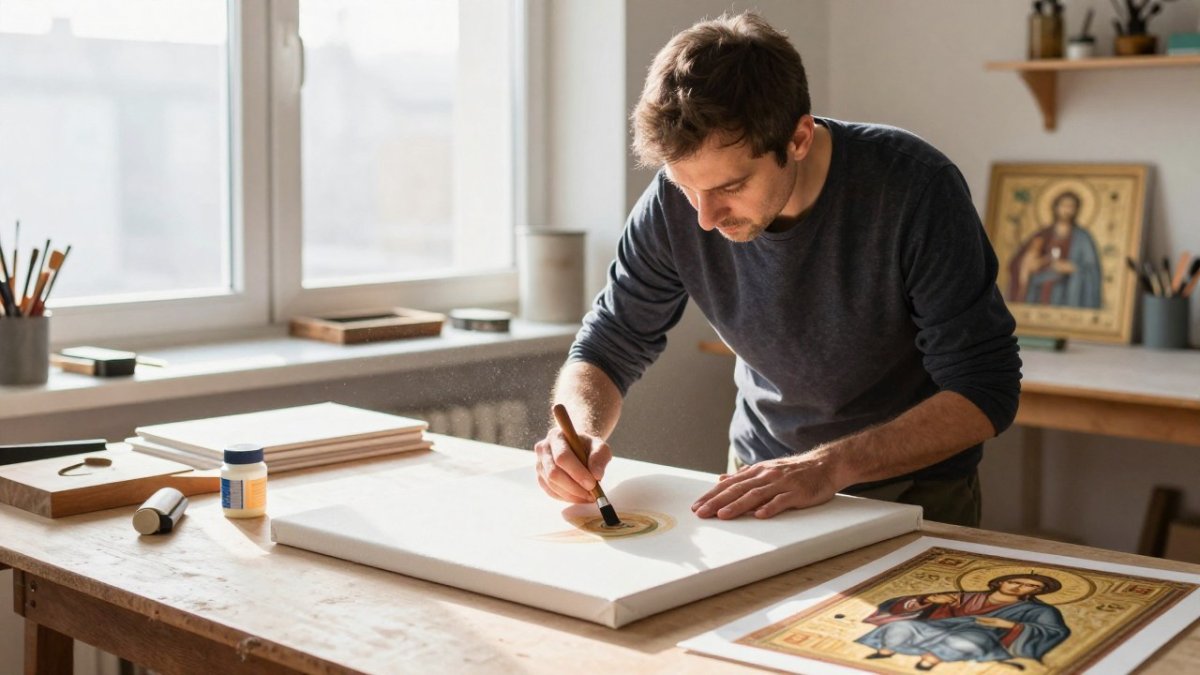
Traditional icon production is a sequence of small steps that are hard to undo, which is why the order matters as much as the materials. The outline below follows the historic hand-painted method from bare board to final finish, then notes where a printed reproduction diverges.
1. Selecting and preparing the wood panel
A traditional panel starts with a hardwood board, linden, maple, oak, or cypress are common, chosen for straight, knot-free grain. The board is seasoned, cut to size, and often reinforced on the back with inset slats or a crossbar to resist warping.
Watch out: green or poorly seasoned wood will cup and split after the gesso is applied, and no amount of careful painting will save a panel that moves underneath the paint.
2. Applying the gesso ground
A linen cloth is sometimes glued over the face and edges to bridge grain and slow cracking. Then comes gesso, a chalk-and-animal-glue ground applied in many thin coats, each sanded back before the next, to create a smooth, slightly absorbent white surface with enough tooth to hold egg tempera.
3. Transferring the prototype
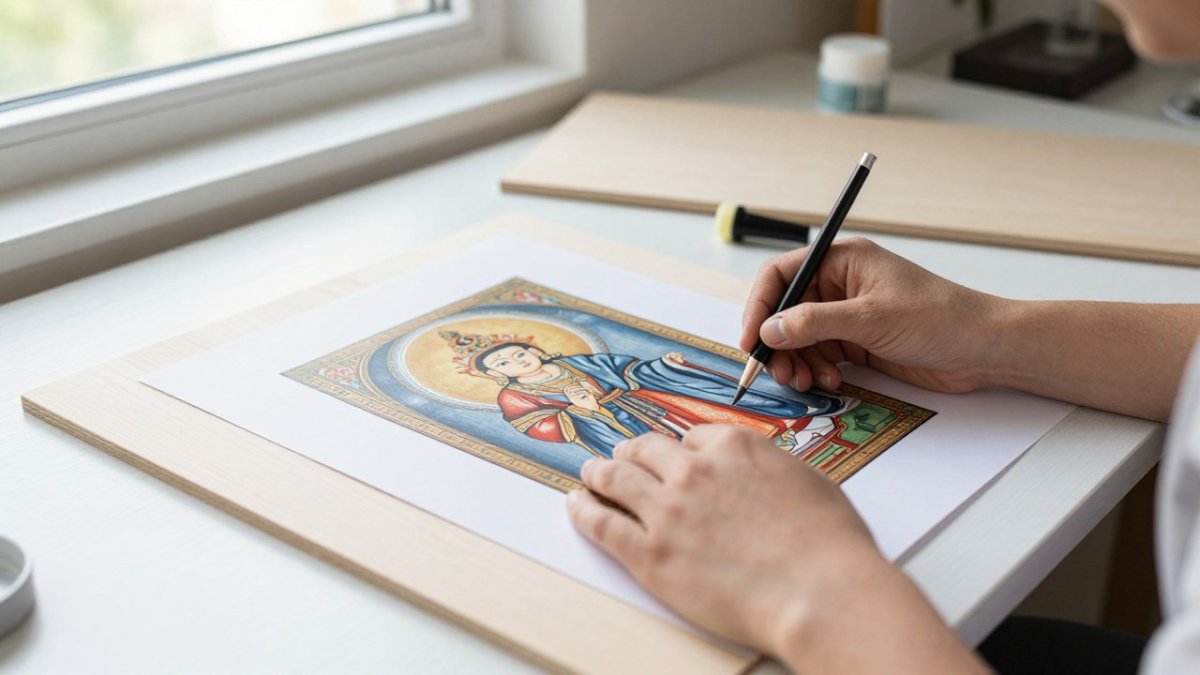
The image is not invented on the panel. An iconographer works from a prototype, a recognized model of the subject, and transfers it by tracing, pouncing charcoal through pricked holes, or freehand drawing guided by measured proportions. This is where canonical accuracy is locked in: pose, gestures, inscriptions, and facial proportions are set before any color goes down.
4. Gilding the halo and background
Gold leaf is applied over a bole layer, a red or yellow clay ground sized with glue, using water gilding or oil gilding. Water gilding allows the gold to be burnished to a mirror finish; oil gilding is more durable but less brilliant. Gold is laid before the figure is painted so the paint edges can overlap it cleanly.
5. Underpainting and building color in egg tempera
Egg tempera is made by mixing dry pigment with egg yolk thinned with a little water or wine. It dries fast and cannot be blended once set, so the painter works in small hatched strokes and builds color in translucent layers. A typical face is built from a dark base tone through lighter ochre and greenish shadows to a final highlight, a technique known as sankir and lights, with each layer dried before the next.
6. Inscriptions, outlines, and final details
The last painting steps are the inscriptions, the name of the person depicted, usually in Church Slavonic or Greek, and the dark outlines that define the forms. Inscriptions are not decorative; an icon without a proper inscription is, in traditional practice, not fully identified as the person it depicts.
7. Varnish, drying, and finishing
A protective varnish, historically linseed oil or a resin varnish, is applied last. It saturates the colors and seals the surface, but it also darkens over time, which is why old icons often look warmer than they did when new. The panel then rests for weeks before it is considered finished.
Where printed reproductions diverge
A printed icon skips steps 1 through 6 in the traditional sense. The image is captured at high resolution, printed with archival inks onto fine art canvas, mounted to a rigid maple panel, and sealed with a UV-protectant clear coat. That produces a stable, accurate, affordable object, but not the layered brushwork or physical depth of gesso and gold.
Orthodox Icon Materials and Their Role in Durability
Materials determine how an icon ages. Two icons with identical images can look very different after a decade if one was built on weak board and cheap ink. Knowing what to ask about the construction helps you compare options fairly.
Canvas, maple panels and archival inks
Fine art canvas is the surface used for Theophany Works' printed icons. Our icons are mounted onto smooth maple panels. Learn how to match hardware to icon weight and wall type before you hang yours. Our icons are printed with archival inks and sealed with a UV protectant clear coat. When comparing icons, ask specifically about ink type, canvas grade, and panel species rather than accepting general terms like "premium."
Traditional egg tempera and gold leaf for comparison
The historic method uses egg tempera, a water-based medium of pigments bound with egg yolk, applied in thin layers over a prepared gesso ground, often with gold leaf for halos and backgrounds. Egg tempera is admired for its luminosity and long survival in early panel paintings and remains the benchmark for hand-painted work.
Hand-Painted Versus Printed Icons: Choosing by Purpose
| Factor | Hand-painted (egg tempera) | Printed on canvas, maple-mounted |
|---|---|---|
| Best suited to | Heirloom pieces, museum-style collecting | Home altars, parish use, gifts |
| Typical cost | Usually the higher end, priced by artisan time | Generally more accessible |
| Surface character | Brushwork and layered depth | Smooth, accurate reproduction |
| Lead time | Often long, tied to the painter's schedule | Typically shorter |
| Reproduction of a specific image | Depends on the painter's interpretation | Faithful to a captured original |
Pros of printed icons: accurate reproduction of a specific sacred image and clear color.
Cons of printed icons: no brushwork and a flatter surface.
Pros of hand-painted icons: unique surface character, the prestige of individual artisan work, and suitability for heirloom collecting.
Cons of hand-painted icons: higher cost, longer waiting times, and variation between painters.
Choosing Durable Icons for Church Interiors
Church interiors place heavier demands on an icon than a home altar does. Candle smoke, incense residue, daylight through windows, and daily veneration by many hands all wear down the surface.
Look for a UV protectant clear coat and a rigid panel rather than bare canvas that can sag. Compare the panels, inks and finishes that keep icons intact for decades. Size matters too: measure the intended location, and plan mounting hardware with the icon's weight in mind. Browse durable icons that hold up to candle smoke, sunlight and daily veneration.
Mission parishes working within a tight budget can still achieve a professional look by choosing sturdy construction and appropriate sizing, rather than paying for ornament they do not need.
Orthodox Icon Care and Maintenance
A well-built icon will last for decades with simple care. Keep it out of direct, prolonged sunlight, since even UV-protected inks fade faster under constant exposure.
Dust gently with a soft, dry cloth. Do not use water, solvents, or household cleaners on the coated surface. Handle icons by the edges and back rather than pressing the face.
Planning Your Icon Order: Next Steps for Your Home or Parish
Start by deciding what the icon is for: personal prayer, a family gift, or a permanent parish installation.
If you need a specific saint or scene that is not in a standard catalog, ask about custom work.
Ready to find the right icon for your altar or parish? Explore our custom iconography projects to discuss a commission, or see how custom icon printing services work before you choose your materials.
Start your order with Theophany Works and bring a lasting, reverent image into your home or church, built to hold its beauty for years.
Frequently Asked Questions
How are Orthodox icons made?
Orthodox icons are traditionally hand-painted by iconographers using egg tempera on wood panels, following canonical rules for each holy figure. Modern reproductions follow a different path: high-resolution images are captured at churches and monasteries, printed with archival inks on fine art canvas, mounted on smooth maple panels, and sealed with a UV protectant clear coat. Each stage is chosen to keep the image clear and lasting. Whichever method is used, the goal is an image that faithfully represents the saint or scene it depicts.
What materials are traditionally used to make Orthodox icons?
Traditional icons use wood panels prepared with gesso, pigments ground and bound in egg tempera, and often gold leaf for halos and backgrounds. Modern printed versions use archival inks, premium fine art canvas, smooth maple panels and a UV protectant clear coat. Material choice affects how an icon ages, how it reflects light and how well colors hold over time. Ask any maker what materials they use and how they are sealed before you buy.
How can a parish choose durable icons for church interiors?
Parishes should look for stable mounting on rigid panels, archival-quality inks, and a protective clear coat that resists handling and light. Size matters as well, since larger icons need sound backing to stay flat. Ask for details on materials and finishing, and request a sample or photograph of the finished piece under typical church lighting. A well-made icon should look appropriate and respectful in a sanctuary, not like a generic print.
How do you care for Orthodox icons in a church?
Keep icons out of direct sunlight and away from heating vents, candle smoke and humidity swings, which can warp panels and fade colors. Dust gently with a soft, dry cloth and avoid harsh cleaners or water on the surface. Handle icons by their edges, and check mounts and seals periodically for lifting or cracking. Good care keeps an icon clear and reverent for many years, whether it hangs on a home altar or in a parish.

Explore Popular Articles
Agiografia Icons vs Christianity Art: What's the Difference?
Last Updated: November 26, 2026 Quick Summary Agiografia icons are liturgical objects made to be ve...
How to Choose Icon Size for Screens and Sacred Art
Last Updated: November 24, 2026 Quick Summary To choose icon size, first decide whether you mean a...
7 Handcrafted Maple Panel Religious Art Pieces Worth Considering
Last Updated: November 22, 2026 Quick Summary Handcrafted maple panel religious art pairs a sacred...
How to Choose Between Modern and Traditional Icon Printing
Last Updated: November 17, 2026 Quick Summary Choose modern icon printing when you need faithful, d...