
7 Steps to Choose Orthodox Icons for Your Home Altar

Quick Summary
To choose orthodox icons for a home altar, start with one icon of Christ and one of the Theotokos, then add a patron saint if you have one. Check the image source, print quality and mounting before buying, and set up your corner in a stable, safe spot.
- Start with an icon of Christ and one of the Theotokos, the core of most home prayer corners.
- Add a patron saint icon once you know whose intercession you seek.
- Ask the seller where the image came from and how it was printed or painted.
- Check that a print is sharp at faces, fingers and lettering, and that the back is finished.
- Place the largest icon, usually Christ, at the center and highest point of the shelf.
Table of Contents
- What an Orthodox Home Altar Is and What It Needs
- Step 1: Start With Christ and the Theotokos
- Step 2: Add a Patron Saint and Local or Family Tradition
- Step 3: Assess Materials, Craftsmanship, and Print Quality
- Step 4: Plan Your Budget and Space, Including Small Homes and Rentals
- How to Arrange Orthodox Icons on an Icon Corner Shelf
- Orthodox Icon Corner Ideas and Where to Source Authentic Icons
- Your Starter Checklist for Setting Up Your Icon Corner
- Frequently Asked Questions
What an Orthodox Home Altar Is and What It Needs
Orthodox icons are sacred images painted or printed to help believers pray and feel close to Christ, the Theotokos (the Virgin Mary), and the saints. A home altar, sometimes called a prayer corner or icon corner, is a small space in the house set apart for prayer.
There is no single required setup. Some families have a shelf with three icons, a candle, and a Bible. Others have a wall with a dozen images. Your parish priest is the best person to ask about what fits your tradition.
Most home altars include a few basic elements:
- One or more icons of Christ, the Theotokos, or a saint
- A stable surface such as a shelf, table, or wall-mounted rack
- A light source, often a small oil lamp or candle (use it safely)
Keep the space simple at first. You can always add to it over time.
Step 1: Start With Christ and the Theotokos
Most Orthodox households begin with an icon of Christ and one of the Theotokos. These two icons are the core of most home prayer corners.
A Christ Pantocrator icon, which shows Christ as ruler of all, is a common first choice.
Watch out: Don't feel pressure to buy a large set at once. Starting with two well-chosen icons is enough for most families.
You can find recommended icons of this kind in the page guide to choosing icons for a prayer corner, which explains how to select and pray with them.
Step 2: Add a Patron Saint and Local or Family Tradition
Once you have Christ and the Theotokos, add a patron saint if you have one. Many Orthodox Christians take a saint's name at baptism or chrismation, and that saint becomes a personal guide.
Family and local customs also shape what you display. Some families include icons of saints connected to their home parish or ancestral region. Ask your priest what is traditional in your community before adding icons that might not fit.
Keep these questions in mind:
- Is there a saint you pray to regularly?
- Does your parish have a patron saint you feel close to?
- Have your family members kept a particular icon for generations?
Step 3: Assess Materials, Craftsmanship, and Print Quality
Icons reach households through several very different production paths, and knowing which one you are looking at helps you judge what you are buying. The goal here is not to rank one form above another; printed and hand-painted icons both have a legitimate place in a prayer corner. The goal is to know what you are buying.
The main categories you will encounter
- Hand-painted icons on wood. Traditionally egg tempera or acrylic on a gessoed panel, often with gold leaf for halos and backgrounds. Expect visible brushwork, slight variation between pieces, and a surface that can be damaged by moisture or direct sun.
- Printed icons on canvas or paper, mounted on a panel. A reproduction of a photographed original, adhered to a rigid board. Quality depends heavily on the source image and the printing method.
- Direct-to-substrate prints. Printed onto wood, metal, or composite board. Convenient and often inexpensive, but check whether the image is sharp at the edges and whether the surface is sealed.
What to check before you buy
Ask the seller, or examine the listing, for these details:
- Source of the image. Is it photographed from a specific icon in a church, monastery, or museum, or is it a loose modern illustration? A named source is a good sign.
- Resolution and sharpness. Look closely at faces, fingers, and lettering. Blurry features or muddy halos usually indicate a low-resolution source.
- Ink or pigment type. Archival pigment inks are formulated to resist fading better than dye-based inks. Ask which is used.
Watch out: A seller who cannot say where the image came from or how it was printed is a risk, regardless of price. Plain answers to plain questions are the best indicator of a reputable source.
Trade-offs to weigh
- Durability: hand-painted panels can last generations if kept dry and out of sun; prints are durable but depend on ink and coating quality.
- Cost: hand-painted work is generally the larger investment; reproductions can let a household place more icons in the corner for a given budget.
- Reproducibility: a print gives you an exact copy of a known original; a hand-painted icon is unique and may differ from the reference image.
For a fuller comparison of where to buy and how to spot imitations, see the page on buying authentic icons.
The main production paths differ in durability, cost and maintenance, so here is a quick comparison of the categories covered above.
| Category | Typical strength | Trade-off |
|---|---|---|
| Hand-painted on wood | Can last generations if kept dry | Largest investment; sun and moisture can damage |
| Printed on canvas or paper, mounted on panel | Exact copy of a known original | Quality depends on source image and printing |
| Direct-to-substrate print | Convenient and often inexpensive | Check edge sharpness and whether surface is sealed |
| Laminated or coated print | Durable and wipeable | Cheap lamination can yellow or peel |
Step 4: Plan Your Budget and Space, Including Small Homes and Rentals
Most guides tell you to "set a budget" and stop there. A more useful approach is to decide what to buy first, what can wait, and how much each tier realistically costs, so you are not pressured into buying a full set before you have prayed with two icons for a few weeks.
A simple purchase-priority framework
Work through these tiers in order and stop wherever your budget lands. Each tier is complete on its own; you do not need the next one to have a valid prayer corner.
- Tier 1, the essentials. One icon of Christ and one of the Theotokos, a stable surface, and a safe light. This is enough for a household to begin praying together.
- Tier 2, personal devotion. A patron saint icon, a family saint, or a saint you already pray to. Add this when you know whose intercession you actually seek.
- Tier 3, the liturgical rhythm. Icons of the great feasts (Nativity, Theophany, Pascha) or a cross for the wall, added over time as the seasons come around.
- Tier 4, expansion. Additional saints, a larger central icon, or a dedicated shelf or cabinet as the corner grows.
A common pattern among beginners is to buy Tier 1 and Tier 2 in the first year and let the rest accumulate through gifts, parish bookstores, and pilgrimage purchases.
Rough price bands to expect
Prices vary widely by size, material, and whether the icon is hand-painted or reproduced, so treat these as broad ranges rather than quotes. Always confirm current prices with the seller.
- Small printed or mounted icons (roughly 4x6 to 8x10 inches): often the least expensive entry point, commonly in the low tens of dollars.
- Larger canvas or panel reproductions (roughly 12x16 inches and up): typically in the tens to low hundreds of dollars depending on mounting and finish.
- Hand-painted icons on wood: the traditional option and the most expensive; small pieces often run into the hundreds of dollars, and larger or commissioned work can reach four figures.
Watch out: A large "complete set" offer can include subjects you will never pray with. Two well-chosen icons usually serve a household better than eight random ones.
Small homes, shared rooms, and rentals
Space constraints are normal, not a sign that your corner is less valid. A few workable setups:
- Wall shelf: a narrow shelf 24 to 36 inches wide holds two to four small icons and a candle without dominating a room.
- Freestanding tabletop stand or small cabinet: good for renters who cannot drill, and easy to move when you relocate.
- Inside a bookcase or glass-front cabinet: keeps icons dust-free and works in a shared living room where a dedicated wall is not available.
Measure the width, height, and depth of the spot before you shop, and note whether the surface is level. An icon that is too large for a shelf can be a tipping hazard, especially in a home with children or pets.
Lighting and safety in tight spaces
Keep open flame away from paper, fabric, curtains, and anything that can be knocked over. If you use an oil lamp or candle, place it on a stable, non-slip surface and never leave it unattended. In a small apartment, a battery-powered lamp is a reasonable substitute where open flame is impractical or against a lease.
How to Arrange Orthodox Icons on an Icon Corner Shelf
Place your largest icon, usually Christ, at the center and highest point of the shelf.
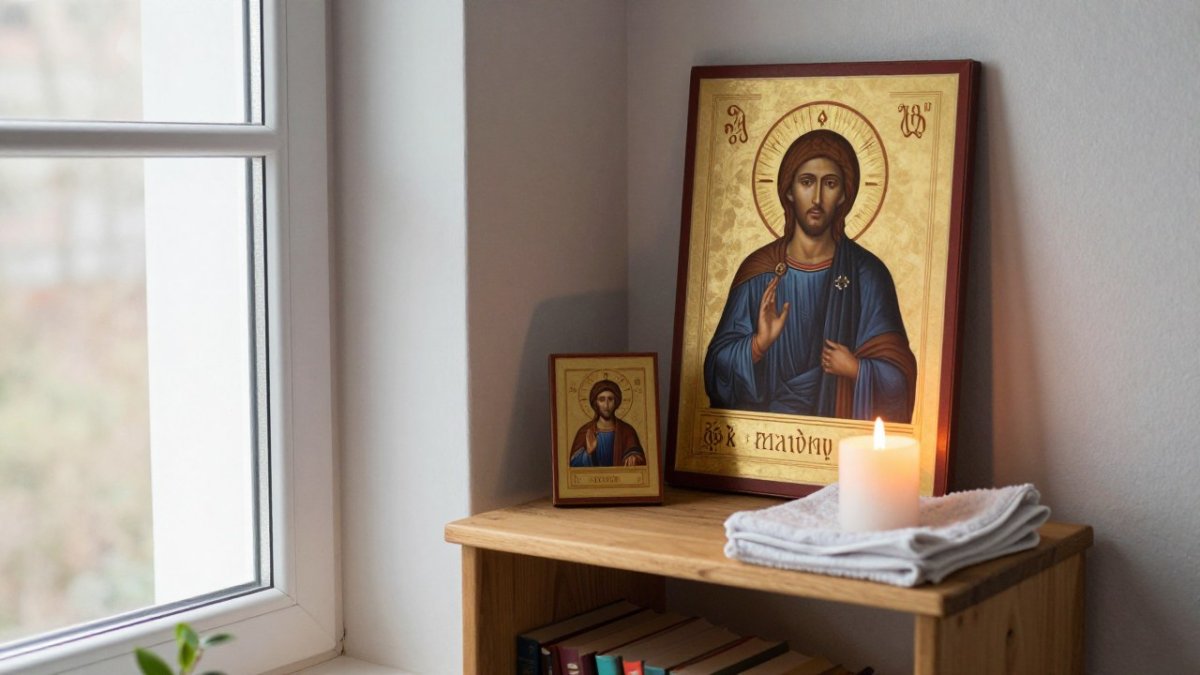
Many Orthodox households also orient the prayer corner toward the east when practical, since the east is traditionally associated with the rising of Christ.
!Quiet prayer corner with a small wooden shelf holding Christ and Theotokos icons, a candle, and folded towel, lit by soft window light
Leave some open space around each icon so each one can be seen clearly.
Orthodox Icon Corner Ideas and Where to Source Authentic Icons
Icon corners can be simple or elaborate. Some families use a wall-mounted rack with several icons. Others use a single cabinet with glass doors.
When you look for authentic icons, check that the seller explains where the images come from, how they are printed or painted, and how they are finished.
For a finished look that suits a church or home altar, you can also browse the Christ Pantocrator icon by Kyriakos Kosova or the Theotokos "All Pure" in Blue icon.
Your Starter Checklist for Setting Up Your Icon Corner
Use this checklist to plan your first prayer corner:
- Choose a stable spot in your home
- Select one icon of Christ
- Select one icon of the Theotokos
Frequently Asked Questions
Which Orthodox icons should you choose first?
Most Orthodox households begin with an icon of Christ and an icon of the Theotokos, the Virgin Mary. These two are central to Orthodox worship and are the subjects most often placed in a home prayer corner. After these, many people add the patron saint of the person praying, usually the saint whose name they received at baptism or chrismation, or a saint with a personal devotional connection. Start with a small set of two or three icons and add others over time as your practice develops. Your parish priest can advise you on what fits your local tradition.
Can you mix icons from different Orthodox traditions?
Yes, many households display icons from several sources, but it helps to be aware of style differences between Greek, Russian, Serbian, and other traditions. Iconographic styles vary in color palette and detail, and some people prefer a consistent look across their corner. There is no single rule that forbids mixing, but if you have a particular jurisdiction or parish, ask your priest whether they have guidance for the home. Choosing a coherent style often makes a prayer corner feel more unified and reverent.
How do you choose the right size icons for a prayer corner?
Measure the shelf or wall space first, then choose icons that leave room for a candle, a small lamp, and a prayer book without crowding. The central icon of Christ or the Theotokos is usually the largest and placed at the highest point, with smaller icons flanking it. For small shelves, a set of modest-sized icons is often more appropriate than one oversized piece. Check each product listing for exact dimensions in inches, and visit the Theophany Works website for current pricing or a quote.
Where should an Orthodox home altar be placed?
Many Orthodox families place the icon corner on an eastern-facing wall when practical, since the east is traditionally associated with prayer and the rising of the sun. The corner should be in a quiet area of the home, away from foot traffic and where it can be shown respect. Keep icons away from direct sunlight and heat sources, such as radiators or open flames, which can damage printed and painted surfaces over time. A wall-mounted shelf or a small table both work well.

Explore Popular Articles
Agiografia Icons vs Christianity Art: What's the Difference?
Last Updated: November 26, 2026 Quick Summary Agiografia icons are liturgical objects made to be ve...
How to Choose Icon Size for Screens and Sacred Art
Last Updated: November 24, 2026 Quick Summary To choose icon size, first decide whether you mean a...
7 Handcrafted Maple Panel Religious Art Pieces Worth Considering
Last Updated: November 22, 2026 Quick Summary Handcrafted maple panel religious art pairs a sacred...
How to Choose Between Modern and Traditional Icon Printing
Last Updated: November 17, 2026 Quick Summary Choose modern icon printing when you need faithful, d...