
7 Steps to Safely Clean Wood-Mounted Icons

Last Updated: November 4, 2026
Quick Summary
To clean wood-mounted icons safely, dust first with a soft natural-bristle brush and a dry microfiber cloth, using light pressure and no moisture. Never use water, ammonia, polish, or oil on the image, and stop cleaning if you see flaking, cracks, or color loss. If the surface is unstable or you cannot identify it, do not clean it and consult a conservator.
- Run a five-minute inspection under raking light to sort your icon as painted, varnished, or printed.
- Work from the top of the icon downward so dust falls away from the image.
- Never wipe candle soot with a wet cloth; lift it in short, gentle passes with a dry soft sponge or brush.
- A damp cloth is only for the bare wood panel and backing, wrung out until barely damp.
- Stop and call a conservator if you see flaking, active cracks, mold, insect damage, or opaque varnish.
Table of Contents
- Before You Touch the Surface: Identify What You Are Cleaning
- How to Dust Orthodox Icons with a Soft Brush or Dry Cloth
- Step-by-Step: How to Clean Wood-Mounted Icons Safely
- What Never to Use: Water, Ammonia, and Household Cleaners
- How to Clean an Old Icon Without Causing Flaking or Color Loss
- Wood Panel and Backing Care After Cleaning
- How to Store Orthodox Icons to Prevent Future Damage
- When to Stop Cleaning and Call a Conservator
- Frequently Asked Questions
Before You Touch the Surface: Identify What You Are Cleaning
Knowing how to clean wood-mounted icons starts with one question: what is actually on the surface, and whether clean wood-mounted icons can be safely handled at home? For printed icons, our high resolution orthodox icon prints guide explains how they are made and what materials they contain.
The stakes are higher than most people expect. Many icons in homes and parishes are older than the furniture around them, and some carry real devotional and monetary value. A common mistake is treating an icon like a picture frame: a quick spray, a paper towel, done.
Below, we'll show you exactly how to identify your icon's surface, which tools are safe at each risk level, and the point where cleaning should stop and a conservator should take over.
Painted, Varnished, or Printed: Three Different Cleaning Rules
Painted icons are usually egg tempera on a gesso ground, often finished with a varnish or oil layer. The paint sits close to the surface and can flake at the edges.
Varnished icons have a clear coating over the image. The coating protects the paint, but it also yellows, cracks, and traps grime over time. Never try to strip or polish a varnish at home.
Printed reproductions, such as canvas-on-panel prints, may carry an archival ink layer sealed under a clear coat. They are the most forgiving of the three, but they still scratch and dull if scrubbed.
A Practical Identification Protocol Before Any Cleaning
Before you pick up a brush, run this five-minute inspection under a bright, raking light (a desk lamp held at a low angle works well). The goal is to assign your icon to one of the three categories above, or to decide that you cannot safely identify it and should stop.
- Look for raised brushwork or texture. Tilt the icon so light skims across the surface. Egg tempera and oil paint often show subtle ridges, brush marks, or a slightly uneven sheen. If you see these, assume painted.
- Check for a continuous glossy film. A varnished icon reflects light evenly across the whole image, with no breaks except at cracks or worn edges. If the gloss looks like a single coat sitting on top of the paint, assume varnished.
- Inspect for dot pattern or canvas weave. Printed reproductions often show a fine halftone dot pattern under magnification (a jeweler's loupe or a phone camera zoom works). Canvas-on-panel prints may show a woven texture. If you see either, assume printed.
- Test an inconspicuous corner with a dry cotton swab. Gently rub a hidden edge. If color transfers to the swab, stop, the surface is unstable or unsealed, and any further cleaning risks loss.
- Look for warning signs that override everything else. Flaking, lifting paint edges, deep cracks with raised edges, a tacky or sticky feel, white bloom, or an unknown cloudy coating all mean do not clean. These are stop conditions, not challenges.
When You Cannot Identify the Surface: The Safe Default
A common pattern is an icon that shows characteristics of more than one type, for example, a print that was later varnished, or a painted icon with a heavily yellowed coating that hides the brushwork. When identification is uncertain, default to the most conservative approach: dry dusting only with a soft brush, no cloth pressure, no moisture, and no chemical sponges. If the icon is old, valuable, or has any of the warning signs above, do not clean it at all. Consult a conservator for identification before proceeding.
Getty Conservation Institute guidance on caring for paintings
How to Dust Orthodox Icons with a Soft Brush or Dry Cloth
Learning how to dust Orthodox icons safely comes down to three rules: soft tool, light pressure, no moisture. Dust is abrasive. Every time you wipe a dry surface with a rough cloth, you drag grit across the finish.
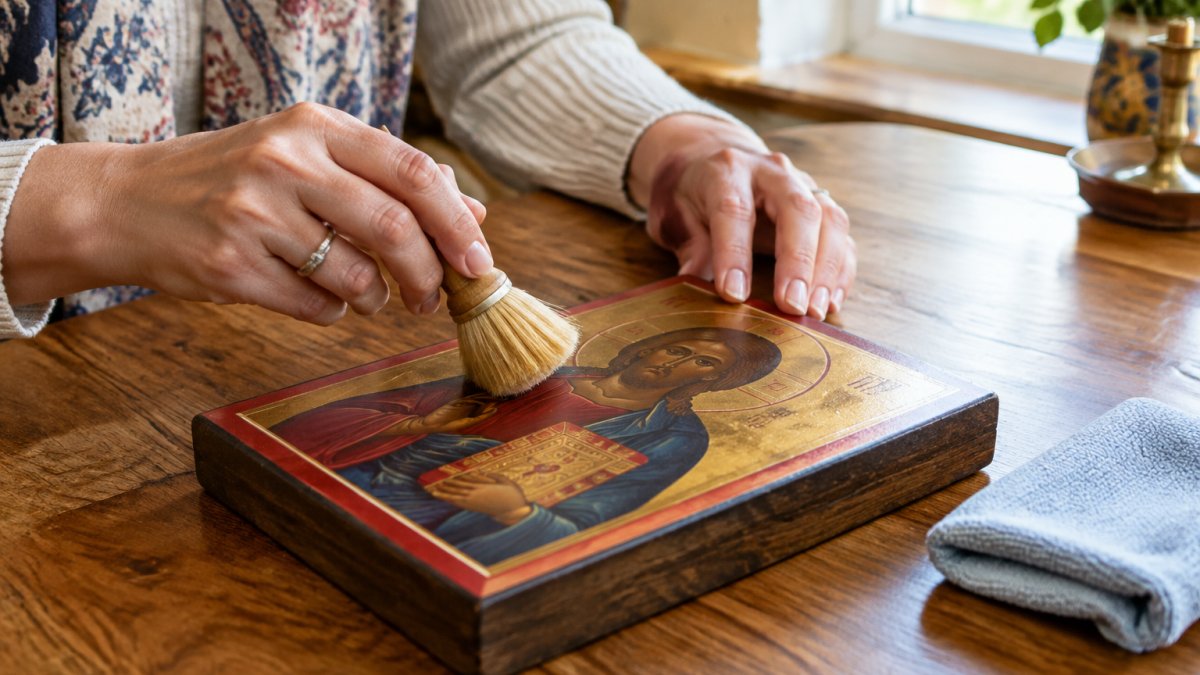
Start with a soft brush made of natural bristles. A squirrel-hair brush or a clean feather duster works well for reaching carved edges and recessed areas.
Follow with a dry microfiber cloth on flat areas, using light pressure only. Never rub. If dust has bonded into a film, stop and move to the deeper cleaning steps below rather than pressing harder.
Step-by-Step: How to Clean Wood-Mounted Icons Safely
Here is the full process, ordered from lowest to highest risk. Stop at any step where the surface reacts.
- Photograph the icon first. Take clear photos before cleaning so you have a record of its condition.
- Test an inconspicuous area. Choose a corner or the back edge and try your tool there first.
- Dust with a soft brush. Natural bristles, light strokes, top to bottom.
- Wipe with a dry microfiber cloth. No pressure, no circular motion.
- Lift loose soot with a dry method only. See the section below.
- Clean the wood panel and backing separately. Keep all moisture away from the image.
- Document and store properly. Record what you did and return the icon to a stable spot.
| Risk Level | Tool | Use On | Avoid |
|---|---|---|---|
| Low | Soft natural-bristle brush | All surface types | Pressing into cracks |
| Low | Dry microfiber cloth | Flat painted and printed areas | Rubbing motion |
| Medium | Dry soft sponge for soot | Varnished and printed surfaces | Painted icons with flaking |
| High | Damp cloth | Wood panel and backing only | Any contact with the image |
| Never | Water, ammonia, polish, oil | Nothing | All icon surfaces |
Removing Candle Soot and Surface Grime Without Rubbing
Candle soot is the most common problem in home chapels and parish churches. It settles as a fine gray film and bonds to varnish over time.
Never wipe soot with a wet cloth. Water drives soot into the coating and leaves a permanent gray haze. Instead, use a dry soft sponge or a clean, dry brush and lift the soot in short, gentle passes.
For heavier surface grime on a varnished icon, a dry chemical sponge used by conservation framers can help. Test it on a hidden edge first.
What Never to Use: Water, Ammonia, and Household Cleaners
The list of banned products is short and absolute. Water, ammonia, hydrogen peroxide, solvents, furniture polish, and oil-based cleaners all cause surface damage on icons. They can swell gesso, lift paint layers, cloud varnish, and darken gold leaf.
Household cleaners are the worst offenders because they are designed to cut grease. On an icon, they cut through the very coating that protects the image.
A damp cloth has one legitimate use: cleaning the bare wood panel and backing, well away from the painted or printed surface. Even then, wring it out until it is barely damp and dry the wood immediately.
How to Clean an Old Icon Without Causing Flaking or Color Loss
Antique icons demand a different posture: less cleaning, more watching. If you see flaking paint, cracks, lifting edges, or color loss, do not clean the icon at all. Loose flakes detach with the lightest touch, and once a paint layer is gone, it cannot be replaced.
Use this decision tree before you start:
- Is the paint flaking or lifting? Do not clean. Call a conservator.
- Are there deep cracks or losses? Do not clean. Call a conservator.
- Is the varnish yellowed or crazed? Dust only. Varnish removal is a conservator's job.
- Is the surface stable with light dust? Proceed with dry dusting only.
Handling matters as much as cleaning. Support the panel from underneath with both hands, never lift an icon by its top edge, and wear clean cotton gloves when the icon is old or valuable.
Wood Panel and Backing Care After Cleaning
The panel is where moisture does its quiet damage. Warping, splitting, and separating joints usually start at the back, not the front.
Wipe the bare wood with a barely damp cloth, then dry it at once with a soft towel.
Check the backing regularly for signs of trouble: white bloom from damp, dark stains, or a musty smell. These point to a humidity problem, not a cleaning problem.
For a deeper look at which panels, inks, and finishes hold up over decades, see our guide to durable icons for church interiors.
How to Store Orthodox Icons to Prevent Future Damage
Learning how to store Orthodox icons well prevents most of the cleaning you would otherwise need to do. Store icons flat or upright in a stable, dry space, wrapped in acid-free tissue or soft cotton.
Keep storage away from direct sunlight, which fades inks and yellows varnish, and away from damp basements or hot attics. Humidity swings do more harm than steady conditions, even if those conditions are not perfect.
If you are planning a prayer corner rather than a storage box, our step-by-step guide on how to set up a home altar covers placement, lighting, and arrangement.
When to Stop Cleaning and Call a Conservator
There is a clear line between routine care and restoration, and crossing it by accident is expensive.
A conservator can stabilize loose paint, clean varnish safely, and reverse old repairs. If the icon is beyond safe home care and you need a replacement for daily devotion, you can browse holy icons made for regular use.
Watch out: cleaning a valuable icon yourself to "see if it helps" can reduce its value and complicate later conservation. When in doubt, do nothing and ask.
Frequently Asked Questions
Can I use water to clean a wood-mounted icon?
Plain water is risky on wood-mounted icons. Moisture can seep into the wood panel, swell the gesso ground, and lift paint or varnish. It can also dissolve tempera paint and damage printed surfaces. For routine care, use only a dry soft brush or dry microfiber cloth. If a stain truly needs moisture, test a damp cloth on an inconspicuous area first and dry immediately. When in doubt, leave wet cleaning to a conservator rather than risk color loss or surface damage.
What is the safest way to dust an Orthodox icon?
Use a soft brush with natural bristles, such as a squirrel-hair brush, and light pressure only. Work from the top down so dust falls away from the image. Follow with a dry microfiber cloth on the wood panel edges. Avoid feather dusters, which can drag grit across the surface, and never rub. Gentle dusting every few weeks prevents surface grime from building up and reduces the need for deeper cleaning later.
How should wood-mounted icons be stored?
Store icons upright, wrapped in acid-free tissue or soft cloth, away from direct sunlight and damp. Keep humidity steady and avoid basements or attics where temperature swings cause wood to warp and paint to crack. Do not stack icons face to face without padding. If you must box an icon, add padding at the corners and keep the box off concrete floors. Stable display conditions prevent most flaking paint, cracks, and stains before they start.
When should an icon be taken to a professional conservator?
Call a conservator if you see flaking paint, active cracks, lifting varnish, or heavy candle soot that will not lift with a dry brush. Old icons with tempera or gold leaf are especially fragile, and home cleaning can cause permanent color loss. A conservator can test an inconspicuous area, stabilize the paint layer, and clean safely. For antique icons, professional restoration is almost always safer than any household method.
Every icon in your home deserves care that matches its age and materials. If you would rather start with pieces built for daily devotion, Theophany Works prints archival images on premium canvas, mounts them on smooth maple panels, and seals each one with a UV protectant clear coat, so routine dusting stays simple for decades. Get started with Theophany Works and give your prayer space icons made to last.

Explore Popular Articles
Agiografia Icons vs Christianity Art: What's the Difference?
Last Updated: November 26, 2026 Quick Summary Agiografia icons are liturgical objects made to be ve...
How to Choose Icon Size for Screens and Sacred Art
Last Updated: November 24, 2026 Quick Summary To choose icon size, first decide whether you mean a...
7 Handcrafted Maple Panel Religious Art Pieces Worth Considering
Last Updated: November 22, 2026 Quick Summary Handcrafted maple panel religious art pairs a sacred...
How to Choose Between Modern and Traditional Icon Printing
Last Updated: November 17, 2026 Quick Summary Choose modern icon printing when you need faithful, d...