
Choosing Icons for Your Prayer Corner: A Guide

Last Updated: October 28, 2026
Quick Summary
Choosing icons for a prayer corner begins with two images: Christ and the Theotokos. Everything else in an Orthodox home prayer corner builds outward from that core, adding your patron saint and other saints one or two at a time. Arrange Christ at the center or to the viewer's right, with the Theotokos beside Him.
- Every Orthodox prayer corner needs an icon of Christ and an icon of the Theotokos as its core pair.
- Add your patron saint after the core pair, then one or two more saints only when you pray before them.
- Place the candle or oil lamp in front of the icons, never behind them.
- Traditional practice places the prayer corner on an east-facing wall, but choose the quietest wall if that is not possible.
- Shelf width times 0.5 gives the combined width available for the core pair.
Table of Contents
- What Icons Should I Have in My Home Prayer Corner
- Orthodox Icons for Home: Choosing by Tradition and Denomination
- How to Arrange Icons in a Prayer Corner
- Assessing an Icon's Subject, Inscription, and Theological Accuracy
- Budget, Materials, and Sizing for Your First Icons
- Choosing the Right Icon Size for Your Altar Space
- Praying with Icons at Home: From Veneration to Daily Prayer
- Building Your Corner Over Time Without Overbuying
- Where Tradition Meets Your Home
- Frequently Asked Questions
What Icons Should I Have in My Home Prayer Corner
Choosing icons for a prayer corner begins with two images: Christ and the Theotokos. Everything else in an Orthodox home icon corner builds outward from that core.
A prayer corner is a designated place in the home, usually a shelf or small table against a wall, holding icons, a candle, a lamp, and prayer books for daily devotion.
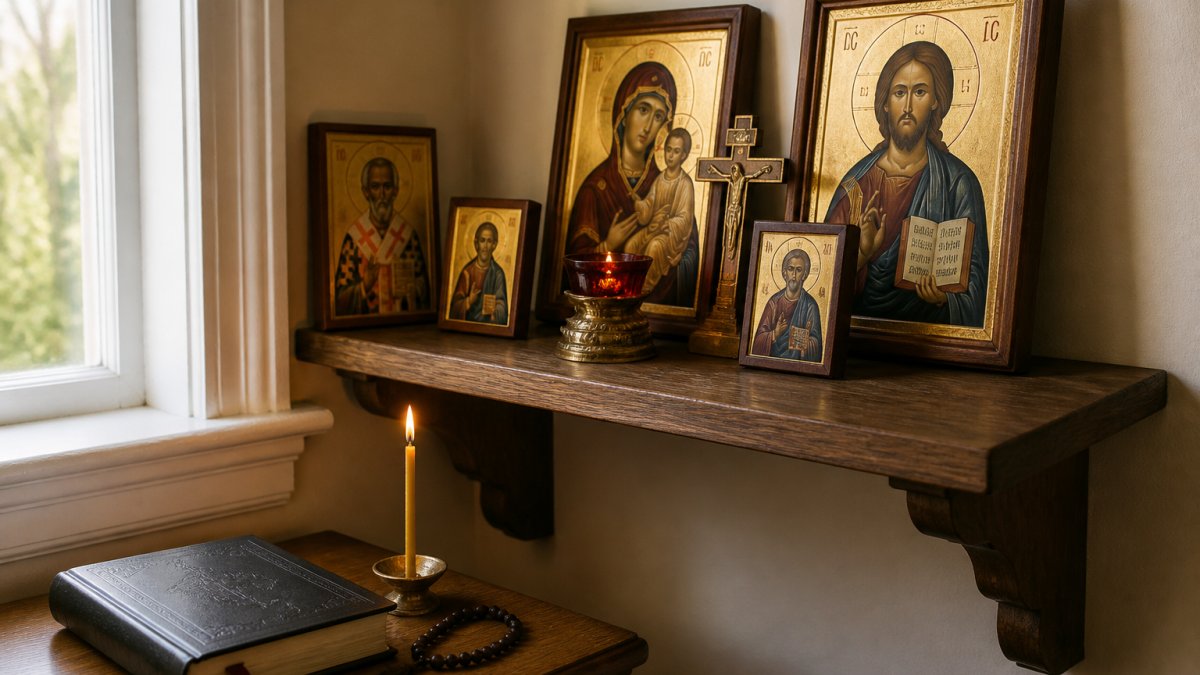
The Essential Core: Christ and the Theotokos
Every Orthodox prayer corner needs an icon of Christ and an icon of the Theotokos, the Mother of God. This pairing is not stylistic; Christ is the center, and the Theotokos points toward Him.
The most common Christ icon is the Pantocrator, holding the Gospels and blessing with His right hand; for the Theotokos, the Hodigitria type, gesturing toward the Christ child, is the classic pairing. Our icon set of Christ and the Mother of God keeps their proportions consistent on one shelf, and readers who prefer a single commanding Christ image often view our Pantocrator icon reproduced from the Hilander Monastery original on Mount Athos.
A common mistake is buying a large saint icon first because it caught your eye, then finding it dominates a corner with no Christ at its center. Start with the pair.
Your Patron Saint and the Heavenly Host
Once Christ and the Theotokos are in place, add your patron saint, the saint whose name you carry, or the saint of your baptism.
Beyond your patron, households commonly add:
- The family's other patron saints, one per member
- Archangel Michael, a frequent choice for protection
- St. Nicholas, especially in families with children
If you are searching for a specific patron, our saints index lets you browse by name. It is easy to accumulate a dozen saint icons in the first year and end up with a crowded, disordered shelf.
Orthodox Icons for Home: Choosing by Tradition and Denomination
Selection criteria shift with your tradition, and most online guides rarely explain which practices are universal, which vary by jurisdiction, and which belong to other Christian traditions entirely.
What Is Consistent Across Orthodox Jurisdictions
A few selection rules hold regardless of jurisdiction:
- Christ and the Theotokos are the non-negotiable core. No jurisdiction treats them as optional.
- The icon must follow the canonical iconographic tradition, not a Western devotional painting relabeled as an icon.
- The inscription identifies the subject. A legible name or feast title in the traditional form is the single most reliable marker of a serious icon.
Those four points are the floor. Everything below them is where practice varies.
Where Orthodox Practice Actually Differs
The differences between jurisdictions are stylistic and customary rather than doctrinal; they affect what your corner looks like, not what it means.
- Greek and Antiochian icons tend toward warmer palettes, softer modeling, and more rounded forms.
- Russian icons often use cooler tones, more angular lines, and a more austere palette.
- Serbian and Romanian icons frequently sit between those poles, with their own regional conventions for folds and backgrounds.
None of these is more correct. What matters is that the icons on one shelf share a visual language, so the corner reads as a single arrangement rather than a gallery of unrelated purchases.
How Other Christian Traditions Approach the Same Question
Not everyone asking about a prayer corner is Orthodox. If you are Anglican, Catholic, or another tradition with a devotional corner, the selection logic changes:
- Catholic homes often center a crucifix, a Marian image, and a patron saint, with icons treated as one devotional option among several rather than the organizing principle.
- Anglican and Episcopal homes may use icons alongside a cross and prayer book, with less emphasis on canonical inscription and more on personal devotion.
- Protestant households without an icon tradition typically build a prayer space around Scripture, a cross, and perhaps a meaningful image rather than a formal icon corner.
If you are not Orthodox, the practical filters below still help, but the canonical core pair does not apply the same way. Ask your own pastor before assuming an Orthodox norm fits your tradition.
Three Practical Filters for Any Icon You Consider
For Orthodox icons for home use, consider three filters:
- Subject clarity: the figure should be identifiable at a glance from traditional attributes, not guesswork.
- Inscription: the name of the saint or feast should be legible and correctly spelled in the traditional form.
- Style consistency: icons on one shelf should share a visual language, so the corner holds together.
A fourth filter for mixed households: provenance. If you cannot tell whether an image is a canonical icon or a Western painting relabeled as one, ask the seller what the inscription says and where the image originates. A seller who cannot answer is one to skip.
If you are building a corner alongside a home altar, our step-by-step guide to setting up a home altar covers location, arrangement, and the sacred objects that accompany the icons.
How to Arrange Icons in a Prayer Corner
Arrange icons in a prayer corner by placing Christ at the center or to the viewer's right, the Theotokos beside Him, and the remaining saints and feasts fanning outward, with the largest and most significant icons highest. Keep the arrangement symmetrical where possible, and leave room for a candle or lamp in front.
A practical sequence:
- Place Christ and the Theotokos first, side by side.
- Add your patron saint to the outer edge.
- Set the candle or oil lamp in front, never behind.
- Keep a prayer book and Bible within reach.
- Leave one empty space for the next icon, a corner with no room to grow forces a reshuffle every time you add something.
East-Facing Placement and Room Orientation
Traditional practice places the prayer corner on an east-facing wall, since east is the direction of Christ's return and the orientation of church altars.
The orientation of the icons matters as much as the wall. Icons should face the person praying, at roughly eye level or slightly above. A shelf mounted too high forces an awkward upward angle; too low and the candle flame sits above the faces.
Assessing an Icon's Subject, Inscription, and Theological Accuracy
Theological accuracy is checkable, and you should check it before you buy. An icon is a visual statement of doctrine, not a religious illustration, and errors in subject or inscription are not minor.
Use this checklist:
- Is the figure identifiable from traditional attributes, not guesswork?
- Is the inscription legible and correctly spelled in the traditional form?
- Does the gesture match the type (blessing hand, pointing hand, orans posture)?
A common mistake is buying a handsome image online that turns out to be a Western painting relabeled as an icon. The giveaway is usually the inscription, missing, garbled, or in the wrong language.
Budget, Materials, and Sizing for Your First Icons
Printed icons on wood-mounted panels make it possible to furnish a prayer corner well without commissioning hand-painted work.
Materials decide how an icon ages. Archival inks resist fading, a UV protectant clear coat guards against window light, and a solid wood panel resists warping in a way thin board does not.
For current pricing, check our site directly rather than relying on estimates; pricing depends on size and format.
Choosing the Right Icon Size for Your Altar Space
Measure the wall before you choose a size, not after.
Start With the Shelf, Not the Icon
Sizing begins with the surface the icons will sit on or hang above. Measure three things before you shop:
- Shelf or table width, the total horizontal run available.
- Shelf depth, panels lean or stand, so depth decides whether a large icon can sit safely.
- Wall height above the surface, the distance from the shelf to the ceiling or the nearest obstruction.
On a narrow shelf, choose taller, narrower formats. On a wide wall, a larger central icon anchors the arrangement.
A Simple Sizing Formula
- Shelf width × 0.5 = combined width available for the core pair.
- Divide that by two = the approximate width of each core icon.
- Shelf depth minus 2 inches = the maximum panel thickness plus lean you can safely accommodate.
How the Main Formats Compare
| Format | Typical Use | Best For | Watch Out For |
|---|---|---|---|
| Small panel | Single saint, travel, gifts | Tight shelves, bedrooms | Can look lost on a large wall |
| Medium panel | Core pair, patron saint | Most home corners | Measure shelf depth first |
| Large panel | Central Christ or feast icon | Wide walls, parish use | Needs secure mounting |
| Set of two or three | Matched core grouping | New corners, weddings | Confirm consistent proportions |
Printed, Painted, Mounted, and Digital Options
- Hand-painted icons are a genuine treasure and a long-term investment, but a household that waits for them may go years without a corner at all.
- Printed icons on wood-mounted panels furnish a corner well without commissioning hand-painted work; archival inks resist fading and a UV protectant clear coat guards against window light.
- Paper or card prints are the least expensive entry point but are vulnerable to moisture, curling, and fading, and they need framing to sit safely on a shelf.
Rental Homes, Small Spaces, and Accessibility
Not every household can mount a shelf on an east wall or dedicate a table. Practical constraints deserve a plan:
- Rentals: use a freestanding shelf, a wall-leaning ladder shelf, or a sturdy bookcase rather than drilling. Command-style removable hooks can hold small panels but should be rated well above the icon's weight.
- Small apartments: a single narrow shelf with the core pair and one patron saint is enough; depth matters more than width in tight rooms.
- Accessibility: place the icons at a height a seated person can see and venerate comfortably; a lower shelf at seated eye level serves better than a high wall arrangement.
For current pricing, check our site directly rather than relying on estimates; pricing depends on size and format.
Praying with Icons at Home: From Veneration to Daily Prayer
An icon corner exists to be prayed in, not just looked at. Veneration, the reverent kiss or bow before an icon, honors the person depicted, not the wood and paint, and the corner anchors a daily rule of prayer.
A simple pattern for households new to the practice:
- Begin with morning prayers facing the corner
- Light the lamp or candle before you start
- Read from a prayer book and the Scriptures
Keep a prayer rope and a Bible on the shelf alongside the icons. If you are moving from occasional veneration into a daily rule, our prayer books give you the texts to pray from, arranged for morning and evening use.
Building Your Corner Over Time Without Overbuying
Growth should follow prayer, not shopping. The most coherent corners add icons slowly, each tied to a real devotion, a name day, or a milestone.
A decision framework:
- If you pray before it weekly, it belongs on the shelf.
- If it marks a family milestone (baptism, wedding, name day), add it.
- If you liked the picture, save it to a wish list and wait a month.
Wedding crowns, censers, and other holy objects can join the corner over time, but each addition should have a place prepared for it. Buying a full set at once often produces a corner that looks complete and feels impersonal, because none of the icons carry a memory.
Where Tradition Meets Your Home
The hardest part of choosing icons for a prayer corner is not finding beautiful images but resisting the urge to buy everything at once.
At Theophany Works, we reproduce icons from high-resolution images photographed onsite at churches and monasteries, print them with archival inks on fine art canvas, mount them to smooth maple panels, and seal them with a UV protectant clear coat.
Frequently Asked Questions
Which icons should I have in a home prayer corner?
Start with an icon of Christ and one of the Theotokos holding the Christ Child. These two form the traditional center of any prayer corner. Add your patron saint and, if you wish, the family's patronal saints. From there, you can add Archangel Michael, the Guardian Angel, or feast-day icons over time. The corner grows with your prayer life rather than being filled all at once.
How do I choose an Orthodox icon for my home?
Look first at the subject: Christ, the Theotokos, a saint, or a feast. Then check the inscription and attributes, since these identify the figure and confirm theological accuracy. Consider size relative to your wall and shelf. Buy from a maker who can explain the source of the image.
What is the traditional arrangement for icons in a prayer corner?
Tradition places the corner facing east when possible. Christ sits at the center or right, the Theotokos to the left, with other saints arranged around them by rank and feast. A shelf or analogion holds the icons at eye level, with a lamp, candle, prayer book, and cross nearby. The arrangement is hierarchical, not decorative, so the most important icons occupy the central place.
Can I put icons of saints together in a prayer corner?
Yes. Icons of saints are commonly grouped in a prayer corner. Place Christ and the Theotokos centrally, then arrange saints around them. Family patrons, the patron of the parish, and beloved saints can all be included. There is no fixed limit, though a crowded wall can distract from prayer, so leave space between icons and keep the central pair visually dominant.
Where should I place icons in a small prayer corner?
In a small space, consider how the icons will fit in the available area.
Do I need a specific icon to start a home prayer corner?
An icon of Christ is the essential starting point, paired with the Theotokos. If you have only one icon, choose Christ. A cross, a candle, and a prayer book complete the basic setup. You can add your patron saint and other icons as your corner develops, so there is no need to buy everything at once.
How do I pray with icons at home?
Begin with the sign of the cross and a veneration of the icons, then pray the morning or evening prayers from your prayer book. Use the icons as a focal point, letting them direct your attention to the persons depicted rather than to the image itself. A prayer rope, candle, and incense can support attention. Pray consistently, ideally at the same time each day.
How do I assess whether an icon is theologically accurate?
Check the inscription, usually in Greek or Church Slavonic, which should name the figure or feast. Verify the attributes: Christ's halo with the cross, the Theotokos with the Christ Child, saints with their customary garments and symbols. Compare with icons venerated in your parish. A maker who can document the source image and its provenance gives you a reliable basis for confidence.

Explore Popular Articles
Agiografia Icons vs Christianity Art: What's the Difference?
Last Updated: November 26, 2026 Quick Summary Agiografia icons are liturgical objects made to be ve...
How to Choose Icon Size for Screens and Sacred Art
Last Updated: November 24, 2026 Quick Summary To choose icon size, first decide whether you mean a...
7 Handcrafted Maple Panel Religious Art Pieces Worth Considering
Last Updated: November 22, 2026 Quick Summary Handcrafted maple panel religious art pairs a sacred...
How to Choose Between Modern and Traditional Icon Printing
Last Updated: November 17, 2026 Quick Summary Choose modern icon printing when you need faithful, d...