
Are Archival Ink Icons Worth It for Home Altars?

Last Updated: November 7, 2026
Quick Summary
Archival ink icons are prints made with pigment-based inks engineered to resist fading over decades rather than years, so they hold their color far longer than dye-based prints. The ink is the single biggest factor in whether a sacred image still looks right in your prayer corner a generation from now.
- Pigment ink sits as solid particles on the surface, while dye ink soaks in and breaks down faster.
- Ask sellers to name the ink category in writing, not just the word archival.
- Place the main icon at standing or kneeling eye level on a low-sunlight wall.
- Keep icons away from radiators, stoves, bathrooms, and kitchens to avoid heat and moisture.
- Dust with a soft dry cloth and never spray cleaner on the printed surface.
Table of Contents
- What Archival Ink Actually Means for a Sacred Image
- How to Set Up a Home Altar Around Your Icons
- Choosing Home Altar Icons: Subjects, Sizes, and Styles
- Hand-Painted Originals vs. Archival Reproductions
- Materials That Make or Break an Icon Print: Wood, MDF, and Canvas
- Caring for Orthodox Icons: Light, Humidity, and Cleaning
- How to Verify Archival Claims Before You Buy
- Ordering Your First Icon for a Home Altar
- Frequently Asked Questions
What Archival Ink Actually Means for a Sacred Image
Archival ink icons for home altars are prints made with pigment-based inks engineered to resist fading over decades rather than years, which is why archival ink icons hold their color. The ink is the single biggest factor in whether a sacred image still looks right in your prayer corner a generation from now.
Most people buy an icon because of the image. They should be checking the ink.
At Theophany Works, we print our icons with archival inks on fine art canvas, then seal them with a UV protectant clear coat.
Archival ink is a pigment-based ink formulated for long-term color stability, meaning the print resists fading and shifting color over time. It is not a marketing label. It describes a specific chemistry.
Pigment Ink vs. Dye-Based Ink: The Difference That Decides Longevity
Pigment ink holds color because the colorant sits as solid particles on the paper surface. Dye ink soaks into the material and looks vivid at first, but it breaks down faster when exposed to light and air.
Here is what that means in practice:
- Pigment ink: slower fade, steadier color, better for long-term display
- Dye ink: brighter out of the box, quicker to shift, best for short-term use
- The test that matters: ask which one the printer uses, in writing
The Library of Congress guidance on care of prints and drawings notes that light exposure is one of the leading causes of print deterioration. Ink chemistry decides how fast that happens.
When comparing sellers, ask for the ink category, not just the word "archival."
How to Set Up a Home Altar Around Your Icons
A home altar works best when it is built around the icons, not decorated after them. Choose the wall first, place the central icon at eye level, and let everything else serve that focal point.
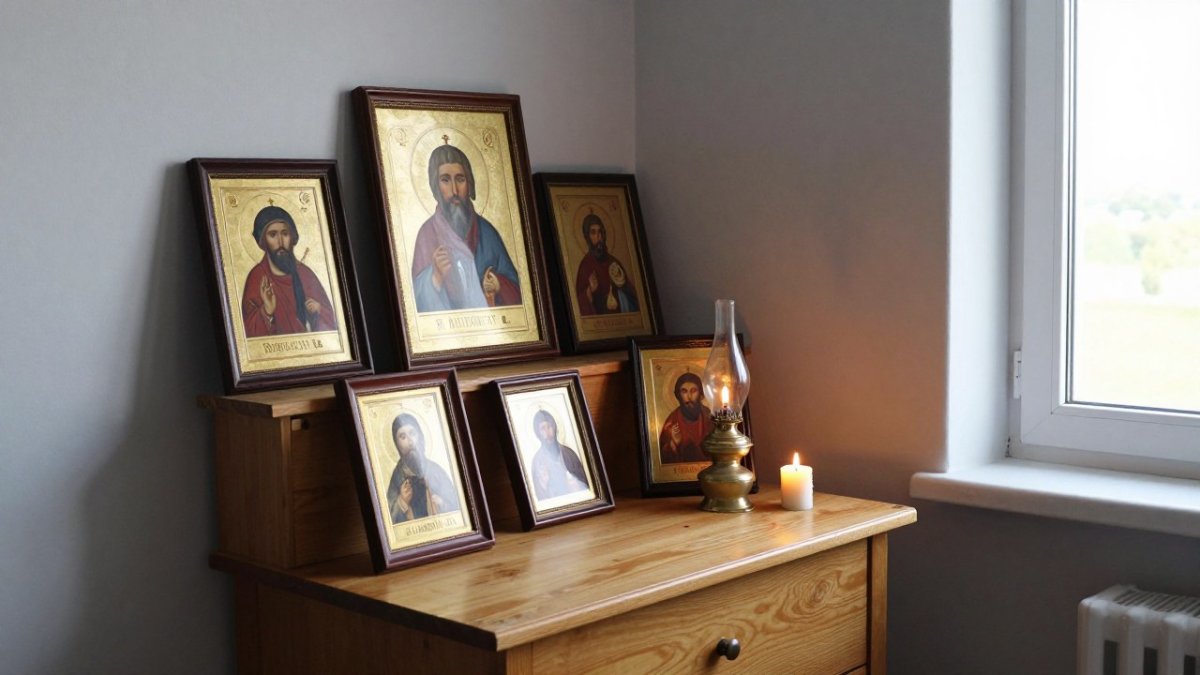
Start with these steps:
- Pick a spot with low direct sunlight and little foot traffic.
- Set the main icon at standing or kneeling eye level.
- Add a shelf or table for a lamp, candle, and cross.
- Keep the surface clear and easy to dust.
- Face the altar toward the east where your room allows it.
For a fuller walkthrough of placement and arrangement, our guide on how to set up a home altar covers location, icon selection, and arranging sacred objects step by step.
The goal is a prayer corner you can use daily without moving furniture. Simple beats elaborate.
Choosing Home Altar Icons: Subjects, Sizes, and Styles
The right icon for a home altar is one you will actually pray before, sized to your wall and true to tradition. Subject, size, and style each carry weight, and none should be an afterthought.
On subject, most home altars center on Christ, the Theotokos, or a family patron saint. A triptych works well for small spaces because it folds and frames a central image. A single Madonna or Christ panel suits a narrow wall.
On size, match the icon to viewing distance:
| Space | Suggested Icon Height | Why It Works |
|---|---|---|
| Small shelf or corner | 15-25 cm | Fits tight spaces, reads at close range |
| Wall above a table | 30-45 cm | Visible from standing distance |
| Dedicated altar wall | 60 cm and up | Anchors the space as a focal point |
On style, traditional Byzantine iconography uses flattened perspective and gold tones. Catholic icon traditions lean toward different framing and palettes. Neither is wrong; pick what fits your devotional life.
When you are ready to browse subjects and formats, the full holy icons collection lets you start with the saint or scene you need.
Hand-Painted Originals vs. Archival Reproductions
Hand-painted originals and archival reproductions serve different buyers, and the honest answer is that both belong in Orthodox homes. The question is what you need the piece to do.
A hand-painted original is a one-of-a-kind work by an iconographer. A reproduction is a high-resolution capture of an original, printed with archival materials.
Here is the trade-off:
- Original: unique, tactile, costly, long lead time
- Reproduction: consistent, affordable, repeatable in any size
- Both: can be devotional, beautiful, and durable
A reproduction is only as good as its source image. Our icons are reproduced from high-resolution images captured onsite at churches and monasteries.
Materials That Make or Break an Icon Print: Wood, MDF, and Canvas
The substrate under the ink decides how the icon feels and how long it lasts. Canvas, wood, and MDF each behave differently, and the backing matters as much as the print. Most buying guides stop at the ink; the whole print is what ages.
Our icons are mounted onto smooth maple panels, giving a rigid surface with a natural grain.
For a deeper look at resolution checks and panel options, our high resolution Orthodox icon prints buyer's guide walks through sizing for home altars and how to print icons well.
Caring for Orthodox Icons: Light, Humidity, and Cleaning
Caring for Orthodox icons comes down to three enemies: light, moisture, and clumsy cleaning. Control those and an archival print will hold its color for a very long time. The practical version of that advice is about placement, enclosure, and handling, not just dusting.
On light, keep icons off walls that get direct afternoon sun. UV coats help, but they slow damage rather than stop it. A common pattern is that a south- or west-facing wall near a window fades a print far faster than an interior wall, even with a UV clear coat. The Library of Congress guidance on care of prints and drawings notes that light exposure is one of the leading causes of print deterioration, and that damage is cumulative and irreversible.
On humidity, avoid bathrooms, kitchens, and damp basements. Steady indoor conditions suit icons better than swings between wet and dry.
On cleaning, dust with a soft dry cloth. Never spray cleaner on the surface or wipe with a wet rag. For canvas, a gentle brush beats a cloth. For framed pieces, dust the frame and glazing, not the print, and never press on the surface behind the glazing.
The National Park Service guidance on environmental monitoring for collections makes the same point for any sensitive object: stable temperature and humidity prevent most damage before it starts. For a home altar, that translates into a few concrete habits:
- Keep the icon out of direct sun and away from heat sources such as radiators, stoves, and lamps that sit close to the surface
- Avoid hanging above a fireplace, a kettle, or a bathroom door where steam passes
- Handle the piece by the frame or panel edges, not the printed face, and wear clean hands or gloves
- Store spare or seasonal icons flat, face up, in a dry interior closet, interleaved with acid-free tissue rather than newsprint or bubble wrap against the surface
- Check the back of a framed piece once a year for staining, rust, or loose backing
Avoid hanging an icon above a radiator or a stove, since heat and moisture can warp a panel and dull an image. Avoid cleaning a print with household sprays.
How to Verify Archival Claims Before You Buy
Verifying an archival claim means asking for specifics and accepting only answers that name materials. "Museum quality" is not a material. "Pigment ink on acid-free canvas with a UV clear coat" is.
Use this checklist before you order:
- Does the seller name the ink type (pigment vs. dye)?
- Is the canvas or panel described, not just called "premium"?
- Is there a UV-protective coating or glazing?
- Can they show the source image or its origin?
- Do they explain how to care for the piece?
- Are they clear about where and how it is made?
If a seller dodges these questions, treat the claim as unproven. A confident answer takes seconds; a vague one tells you something.
For help telling genuine pieces from decorative copies, our guide on where to buy authentic icons covers how to spot fakes and buy with confidence.
Ordering Your First Icon for a Home Altar
Ordering your first icon should take one careful conversation, not a week of guessing. Measure your space, pick your subject, confirm the materials, and ask about sizing before you check out.
A simple order flow:
- Measure the wall or shelf and note the height you can see comfortably.
- Choose the subject: Christ, the Theotokos, or a patron saint.
- Confirm ink type, backing, and coating in writing.
- Ask for a size recommendation based on your measurement.
- Check the care instructions that ship with the piece.
At Theophany Works, every icon is made in our studio, printed with archival inks on fine art canvas, mounted on smooth maple panels, and sealed with a UV protectant clear coat. You can see how the process works in our guide on how custom Orthodox icon printing services work, including which materials matter before you order.
A home altar deserves an image built to last, not a print that fades by the next feast day. If you want sacred art that holds its color and its dignity for years of daily prayer, Theophany Works makes icons with archival inks, fine art canvas, smooth maple panels, and a UV protectant clear coat, all crafted in our studio. Start with a piece sized for your prayer corner, and let it serve your devotion for the long haul.
Frequently Asked Questions
What does archival ink mean for an icon?
Archival ink, also called pigment ink, is a print ink formulated to resist fading and color shift over time. Unlike dye-based inks that soak into paper, pigment particles sit on the surface and hold their color longer, especially under normal indoor light. For archival ink icons, this means the faces, gold tones, and detail in the sacred image stay true for years rather than washing out. Our icons are printed with archival inks on fine art canvas and sealed with a UV protectant clear coat.
What is the difference between a printed icon and a hand-painted icon?
A hand-painted icon is created by an iconographer using traditional egg tempera or acrylic on prepared wood, and it carries the artist's direct work, which is why hand-painted pieces often cost far more. A printed icon reproduces a photographed original using archival ink on canvas or paper, then mounts it on a panel. An archival reproduction captures the detail and color of the source image, and can suit home altars and parishes.
How do you clean and care for an icon?
Dust icons gently with a soft, dry microfiber cloth, working with the grain and never scrubbing. Avoid sprays, solvents, and wet cloths, which can damage the surface coat or canvas. Keep icons out of direct sunlight and away from heat sources, since UV exposure and fluctuating humidity are the main causes of fading and warping. If an icon sits near a candle or oil lamp, place it far enough away that smoke and soot do not settle on the surface, and wipe the panel lightly every few weeks.
Which icons are traditionally placed together on a home altar?
Most home altars center on Christ and the Theotokos, often as a matched pair placed side by side. From there, families add icons of their patron saints, guardian angels, and saints connected to their name days or milestones. A small triptych works well when space is tight, and a central icon of the Resurrection or the Savior is common above the altar. The arrangement should feel ordered and prayerful rather than crowded, so start with two or three home altar icons and add as the space allows.

Explore Popular Articles
Agiografia Icons vs Christianity Art: What's the Difference?
Last Updated: November 26, 2026 Quick Summary Agiografia icons are liturgical objects made to be ve...
How to Choose Icon Size for Screens and Sacred Art
Last Updated: November 24, 2026 Quick Summary To choose icon size, first decide whether you mean a...
7 Handcrafted Maple Panel Religious Art Pieces Worth Considering
Last Updated: November 22, 2026 Quick Summary Handcrafted maple panel religious art pairs a sacred...
How to Choose Between Modern and Traditional Icon Printing
Last Updated: November 17, 2026 Quick Summary Choose modern icon printing when you need faithful, d...