
Legacy Icons vs Damascene Gallery: A Buyer's Guide

Last Updated: October 23, 2026
Quick Summary
Legacy Icons vs Damascene Gallery represents a choice between two distinct approaches to Orthodox Christian iconography: printed icons on archival canvas and maple panels with quick turnaround, versus hand-painted icons by trained iconographers with longer production timelines and premium pricing. Your decision depends on budget, timeline, and whether you prioritize durability and accessibility or hand-painted artistry and personal collaboration.
- Theophany Works uses archival inks on canvas mounted to maple panels with UV protection, while Damascene Gallery emphasizes hand-painted work by individual iconographers on traditional wood.
- Theophany Works delivers catalog items within weeks; Damascene Gallery hand-painted commissions require months of production time.
- Printed icons require minimal maintenance beyond gentle dusting and sun protection, while hand-painted icons demand more attentive climate control and careful handling.
- Theophany Works offers competitive, accessible pricing for institutional and personal use, while Damascene Gallery commands premium prices for bespoke commissions.
- Both approaches endure for decades in stable environments, but printed icons prove more forgiving in spaces with temperature fluctuations or humidity challenges.
Table of Contents
- Orthodox Christian Icons: What Sets These Retailers Apart
- Handcrafted Orthodox Icons: Construction and Reproduction Methods
- Orthodox Icon Materials and Finishes: Durability and Longevity
- Where to Buy Orthodox Icons: Comparing Product Range and Availability
- How to Choose an Orthodox Icon for Your Home Altar or Parish
- Shipping, Returns, and Customer Service: Practical Considerations
- Making Your Decision: Which Retailer Fits Your Needs
- Frequently Asked Questions
Orthodox Christian Icons: What Sets These Retailers Apart
When you're searching for an Orthodox icon to grace your home altar or furnish a parish, the choice between retailers in Legacy Icons vs Damascene Gallery matters more than many realize. The difference between a mass-produced reproduction and a thoughtfully crafted piece shapes not just how your space looks, but how it functions as a devotional focal point. Legacy Icons vs Damascene Gallery represents a meaningful comparison for those serious about quality, authenticity, and long-term value in Orthodox Christian iconography.
At Theophany Works, we understand this distinction intimately. The question isn't simply which retailer to buy from, it's understanding what makes one approach to Orthodox Christian icons fundamentally different from another. This guide walks you through the construction methods, materials, pricing philosophy, and practical considerations that separate these two retailers, so you can make an informed decision aligned with your needs and your faith.
Handcrafted Orthodox Icons: Construction and Reproduction Methods
Theophany Works creates Orthodox icons through a meticulous process that begins at the source: high-resolution photography captured onsite at churches and monasteries. This approach ensures theological accuracy and authentic representation of the iconography.
The handcrafted element here isn't in the painting, it's in the curation, photography, and assembly. Every step reflects intentional craftsmanship.
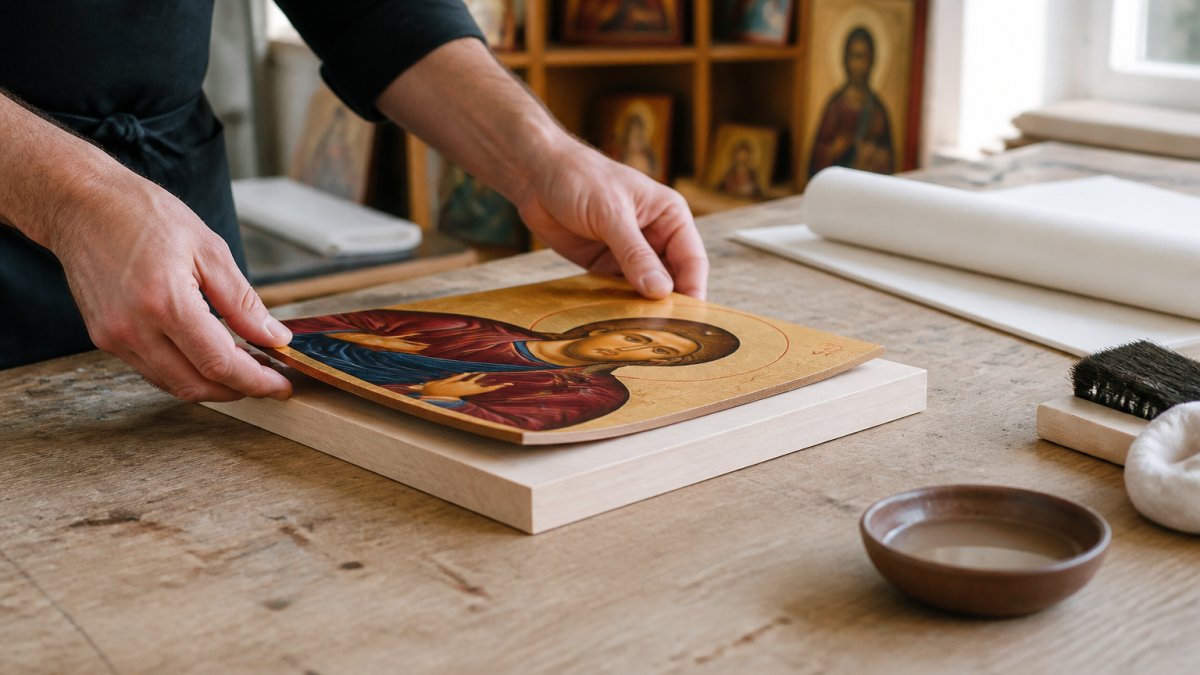
Damascene Gallery, by contrast, emphasizes hand-painted icons created by individual iconographers. These are true paintings on wood, executed by artists trained in traditional methods. The hand-painted approach carries deep theological significance for many Orthodox Christians, the artist's devotion becomes part of the work.
The trade-off is real. Hand-painted icons offer aesthetic qualities that printed reproductions cannot fully replicate: the texture of brushstrokes, the subtle color variations, the tactile presence of paint on wood. A printed icon on canvas, however archivally sound, reads differently in person.
Orthodox Icon Materials and Finishes: Durability and Longevity
The materials you choose determine how your icon will age. Theophany Works uses archival-grade inks and premium fine art canvas as the base, then mounts the printed canvas onto smooth maple panels. The maple provides structural stability and a natural, tactile surface.
Maple was chosen deliberately. It resists warping, accepts mounting hardware easily, and ages gracefully. The finish remains consistent across pieces, ensuring uniformity if you're outfitting a parish with multiple icons. Over time, the wood develops a subtle patina that complements the iconography rather than detracting from it.
Damascene Gallery's hand-painted icons use traditional wood panels, typically birch or linden, with paints applied in layers according to classical technique. The paints themselves are often egg tempera or oil-based, materials that have proven their longevity over centuries in Orthodox churches worldwide. A well-maintained hand-painted icon can last generations without significant deterioration.
The durability question hinges on maintenance. Printed icons sealed with UV protection require minimal care: dust gently, avoid direct sunlight, and maintain stable humidity. Hand-painted icons demand more attention: they should not be exposed to excessive moisture, temperature fluctuations, or direct heat. In a stable home environment, both will endure.
Where to Buy Orthodox Icons: Comparing Product Range and Availability
Theophany Works maintains a curated catalog of icons photographed from authentic sources, churches, monasteries, and historical collections. This approach ensures theological accuracy but limits immediate availability to existing catalog items. Custom orders are possible.
The range spans common devotional icons (Christ Pantocrator, the Theotokos, patron saints) to liturgical scenes and monastic traditions. Sizing options accommodate everything from small personal altar pieces to large parish installations. This flexibility makes Theophany Works practical for both individual households and institutional buyers.
Damascene Gallery offers both hand-painted commissions and reproductions of established works. Their hand-painted inventory typically features work by specific iconographers, each with their own style and spiritual approach. Custom commissions are the primary offering, you work directly with the artist or gallery to develop a piece tailored to your needs.
The product range difference is significant. Theophany Works emphasizes accessibility and quick fulfillment. Damascene Gallery emphasizes personalization and artistic collaboration. If you need an icon within weeks, Theophany Works is the practical choice. If you're willing to wait for a bespoke piece created specifically for your space, Damascene Gallery's approach offers something mass-production cannot replicate.
| Aspect | Theophany Works | Damascene Gallery |
|---|---|---|
| Production Method | Printed on canvas, mounted on maple | Hand-painted by iconographers |
| Turnaround Time | Weeks for catalog items | Months for commissions |
| Customization | Custom orders available | Bespoke commissions standard |
| Price Range | Competitive, accessible | Premium, variable by artist |
| Inventory | Curated catalog | Artist-dependent availability |
How to Choose an Orthodox Icon for Your Home Altar or Parish
Choosing the right icon depends on several practical factors. First, consider your space. A small home altar benefits from a focused, intimate piece, perhaps 12 to 18 inches. A parish sanctuary requires something commanding enough to anchor the space and visible from the back pews.
Second, reflect on your devotional practice. Are you drawn to specific saints or feast days? Do you prefer iconographic styles associated with particular Orthodox traditions, Byzantine, Russian, Greek?
Third, evaluate your budget and timeline. Theophany Works serves those seeking quality at accessible prices with reasonable wait times. Damascene Gallery serves those willing to invest significantly for hand-painted work and can accommodate a longer production schedule.
Fourth, consider maintenance capacity. Printed icons require minimal care beyond gentle dusting and protection from direct sun. Hand-painted icons demand more attentive stewardship, climate control, careful handling, periodic professional restoration if needed.
Finally, examine the theological dimension. Some Orthodox Christians hold that hand-painted icons carry a spiritual weight that reproductions cannot fully convey, the artist's prayer becomes part of the work. Others emphasize that the icon's power lies in its representation of the holy subject, regardless of medium.
Shipping, Returns, and Customer Service: Practical Considerations
Theophany Works ships across the United States and internationally. Because printed icons on mounted panels are relatively lightweight and durable, shipping damage is uncommon. Packaging is designed to protect the UV-sealed surface and the maple mounting. Delivery typically takes 5-10 business days depending on destination.
Returns are handled on a case-by-case basis. If an icon arrives damaged or significantly misrepresents the product listing, replacement or refund is standard.
Damascene Gallery's shipping depends on whether you're purchasing an existing piece or commissioning new work. Existing inventory ships similarly to Theophany Works. Custom commissions are shipped upon completion, and turnaround is measured in months rather than weeks.
Return policies for hand-painted commissions are typically non-refundable once work has begun, though adjustments during the creative process are usually accommodated. This reflects the labor-intensive nature of the work and the artist's time investment.
Customer service quality differs in character. Theophany Works offers email and phone support focused on order status, sizing guidance, and technical questions about materials and durability.
For institutional buyers (parishes, monasteries), both retailers offer bulk ordering options and custom pricing. Damascene Gallery requires extended timelines and typically works with one major commission at a time.
Making Your Decision: Which Retailer Fits Your Needs
The choice between Theophany Works and Damascene Gallery ultimately reflects your priorities. If you value accessibility, quick turnaround, archival durability, and competitive pricing, Theophany Works is the logical choice. The printed approach on archival canvas and maple panels delivers exceptional clarity and longevity. The curated catalog ensures theological accuracy.
If you prioritize hand-painted artistry, personal collaboration with an iconographer, and are willing to invest significantly and wait patiently, Damascene Gallery offers an experience Theophany Works cannot replicate. You're not simply purchasing an icon, you're commissioning a work of devotional art created specifically for your spiritual practice.
Consider also your experience level. Experienced collectors or those with specific iconographic traditions in mind may prefer Damascene Gallery's artist-centered model.
The practical reality is that many Orthodox households and parishes eventually use both. Theophany Works icons furnish spaces quickly and accessibly. Damascene Gallery commissions become centerpieces, the primary devotional focus around which other pieces are arranged.
Choosing where to buy Orthodox icons shapes your spiritual practice for years to come. At Theophany Works, we've built our entire approach around making authentic, durable iconography accessible to the faithful without compromise on quality.
Frequently Asked Questions
What is the difference between Legacy Icons and Damascene Gallery?
Legacy Icons and Damascene Gallery differ primarily in production methods and material options. Damascene Gallery offers hand-painted icons on wood panels created by professional iconographers, while retailers like Theophany Works provide museum-quality reproductions printed on fine art canvas and mounted on maple panels. Each approach has distinct advantages: hand-painted icons represent traditional Orthodox craftsmanship, while printed reproductions on archival materials offer durability, affordability, and exceptional clarity at larger sizes. Your choice depends on budget, devotional preference, and whether you value the hand-painted tradition or the archival longevity of printed fine art.
How can I tell whether an Orthodox icon is handcrafted or reproduced?
Handcrafted icons typically show visible brushstrokes, subtle color variations, and slight irregularities that reflect the artist's hand. Reproduced icons on canvas have uniform color consistency and sharper detail throughout, especially visible under magnification. Ask retailers directly about their production process: handcrafted icons should include the iconographer's name and background, while reproductions should specify the source image, printing method (archival inks), and mounting materials. Examine product photos closely for texture and finish details, and request close-up images if the online listing doesn't show enough detail.
What should I look for when buying an Orthodox Christian icon online?
Prioritize theological accuracy by verifying the icon matches Orthodox tradition and includes proper saint identification or scriptural scene. Evaluate materials: archival inks, fine art canvas, and UV-protective finishes ensure color longevity. Check construction details like mounting panels (smooth maple is standard) and sealing methods. Review customer feedback specifically about durability and color stability over time. Confirm the retailer's sourcing: icons should be photographed from authentic sources like churches or monasteries, not generic religious art. Finally, verify sizing options match your space and that the retailer offers clear return or replacement policies.
Are icons from these retailers suitable for a home altar or church setting?
Both handcrafted and high-quality reproduced icons work well in home altars and parish settings when materials and construction meet Orthodox standards. Printed icons on archival canvas with UV protection and proper mounting maintain their appearance for decades in church environments. For parish use, consider durability in high-traffic areas and whether the icon's finish resists dust and damage. Home altars benefit from icons that reflect personal devotion and suit your prayer space's lighting and size. Verify that the retailer's production process, whether hand-painted or printed, results in icons appropriate for liturgical use by consulting your priest or spiritual father.

Explore Popular Articles
Agiografia Icons vs Christianity Art: What's the Difference?
Last Updated: November 26, 2026 Quick Summary Agiografia icons are liturgical objects made to be ve...
How to Choose Icon Size for Screens and Sacred Art
Last Updated: November 24, 2026 Quick Summary To choose icon size, first decide whether you mean a...
7 Handcrafted Maple Panel Religious Art Pieces Worth Considering
Last Updated: November 22, 2026 Quick Summary Handcrafted maple panel religious art pairs a sacred...
How to Choose Between Modern and Traditional Icon Printing
Last Updated: November 17, 2026 Quick Summary Choose modern icon printing when you need faithful, d...