Where to Buy Mounted Canvas Icons Online: A Buyer's Guide

Quick Summary
Mounted canvas icons are sold by specialist religious art retailers, general marketplaces, and print-on-demand services, but specialists usually offer deeper catalogs and clearer mounting details. Compare sellers on subject coverage, image provenance, panel and finish disclosure, custom options, and shipping policy before buying.
- Specialist retailers usually cover the full liturgical calendar and more saints than general marketplaces.
- Ask sellers to name the backing material, finish, and hardware included with each icon.
- Listed dimensions often exclude the mounting panel, so measure the full frame before ordering.
- Two icons with the same price can differ greatly in construction, so compare them side by side.
- Confirm return, packing, and transit damage policies in writing before paying for a made-to-order piece.
Table of Contents
- What a Mounted Canvas Icon Is and How It Differs From a Paper Print
- Comparing Online Retailers: Product Categories, Saints Offered and Custom Options
- Icon Sizes, Dimensions and Pricing Across Retailers
- Orthodox Icon Mounting Techniques: Pros and Cons of Each Style
- How to Judge Print Quality, Authenticity and Archival Quality of Icon Prints
- Setting Up Your Home Altar: Placement, Display and Care
- Placing Your Order: Made-to-Order Timelines, Returns and Support
- Choosing Your Next Icon: Start With the Saint or Feast You Need
- Frequently Asked Questions
What a Mounted Canvas Icon Is and How It Differs From a Paper Print
A mounted canvas icon is a sacred image printed onto fine art canvas, then fixed to a rigid backing so it holds its shape on a wall or altar shelf, which is what makes these mounted canvas icons suited to devotional display. At Theophany Works, every icon starts as a high-resolution image photographed onsite at churches and monasteries, then printed with archival inks and mounted onto smooth maple panels.
The difference from a paper print is structural. A paper print sits flat, curls at the edges, and shows wear quickly. A mounted canvas icon has body, texture, and a finished edge that reads as a permanent object rather than a poster.
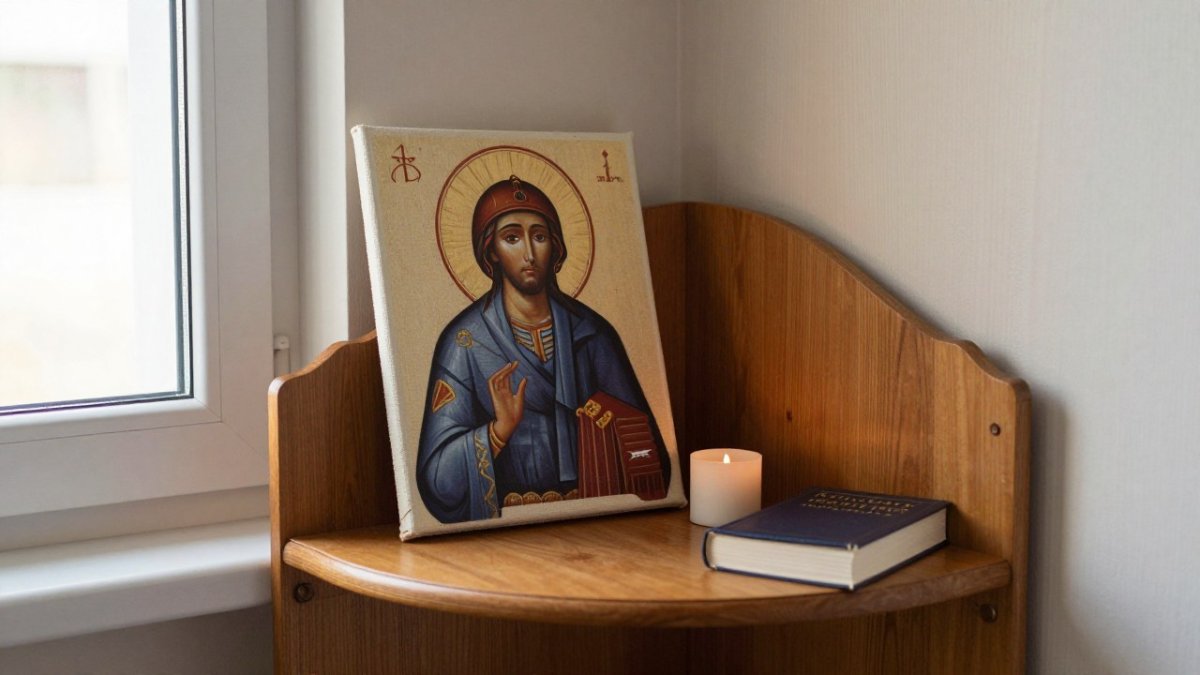
Three features separate a true mounted canvas icon from a generic canvas print, and each one matters when comparing mounted canvas icons from different sellers:
- Panel backing: A rigid panel keeps the image flat and supports hanging hardware.
- Protective finish: A UV protectant clear coat slows fading from light exposure.
- Canvas texture: The surface gives the image a tactile, natural quality that paper cannot match.
When shopping, check whether a seller names the backing material and finish. Vague listings often mean the icon is only a printed canvas with no panel.
Comparing Online Retailers: Product Categories, Saints Offered and Custom Options
Online sellers of Orthodox imagery fall into a few broad groups.
A useful way to compare sellers is to build a short evaluation sheet before you open a single product page.
**1.
2. Image provenance. Ask who produced the source image and where it was captured. A reproduction from a traceable source, a photographed church or monastery icon, differs from an unattributed stock image.
3. Mounting and construction disclosure. A serious seller names the backing material (maple panel, MDF, stretched canvas over pine), the finish (UV clear coat, varnish, glass), and the hardware included.
4. Custom and commission options. Ask whether a seller can reproduce a specific saint, scene, or icon type you need for a home altar, and what the lead time is.
5. Shipping, returns, and damage policy. Confirm in writing how made-to-order pieces are packed, what the return window is, and how transit damage is handled.
6. Price transparency. Note whether the seller publishes a fixed price table, a starting price, or prices only at checkout.
A neutral comparison of these six variables across two or three sellers will tell you more than any single product page. Keep the research honest: many listings omit mounting details or dimensions, so confirm specifics before ordering. Theophany Works offers handcrafted reproductions of Orthodox iconography; for custom subjects, contact the studio directly, since availability depends on the image source and production schedule.
Icon Sizes, Dimensions and Pricing Across Retailers
Icon sizes vary widely, and listed dimensions do not always include the mounting panel. For guidance on resolution checks, canvas and wood panel options, and sizing for home altars, see how to print and size icons.
Pricing depends on size, quantity, finish, and delivery timing, so published figures rarely compare directly. Some retailers show a starting price, while others display prices only at checkout. A marketplace listing may appear far cheaper because it lacks a panel or protective finish.
For current prices and a quote on a specific size, contact Theophany Works directly, since pricing is not published in a fixed table.
Tip: Before comparing prices, write down the image size, panel size, and finish for each listing. Two icons with the same price can differ greatly in construction.
Listed sizes and prices differ across sellers, so the figures below are worth checking side by side before you compare.
| Check | What to note | Why it matters |
|---|---|---|
| Image size | Record the printed image area | Shows the visible artwork |
| Panel size | Record the full backing panel separately | Dimensions may exclude the panel |
| Finish | Note any UV clear coat or varnish | Affects price and light resistance |
| Price | Note the starting price or quote | Listings rarely match in construction |
| Pricing format | Fixed table, starting price, or checkout only | Changes how easily you can compare |
Orthodox Icon Mounting Techniques: Pros and Cons of Each Style
Mounting affects both appearance and durability. Three common approaches are worth knowing.
Panel mounting attaches the canvas to a rigid wood panel. This keeps the surface flat and supports standard hanging hardware. The drawback is weight and the need for a secure wall anchor.
Canvas stretching wraps the print over a wooden frame without a solid panel. It is lighter and simpler to hang, but the surface can show slight flex over time, especially in larger sizes.
Framed mounting places the icon behind glass or in a molded frame. It offers strong protection from dust and handling. It also adds cost and can reflect light in a dim prayer corner.
Choose the style based on wall type, icon weight, and how often the icon will be moved. For a full explainer on matching hardware to icon weight, wall type, and panel or canvas construction, see our mounting guide. Heavier panels need anchors rated for the load.
How to Judge Print Quality, Authenticity and Archival Quality of Icon Prints
Print quality shows in color depth, edge sharpness, and fine detail in the faces and gold areas.
Printed canvas icons are reproductions of an existing image, printed onto canvas with pigment or dye inks and then mounted or stretched.
Hand-painted icons are painted by an iconographer, usually in egg tempera or acrylic on a gessoed panel. They carry visible brushwork, variation between pieces, and a much higher price.
Traditional panel icons are painted or printed on a rigid wood panel, often with a recessed central area (the kovcheg) and a raised border.
Once you know which category a listing belongs to, judge print quality on these points:
- Source resolution. Ask what the original capture was. A high-resolution photograph of a church or monastery icon will show detail in faces and gold; a low-resolution web image will look soft when printed large.
- Ink type. Ask the seller which ink type they use.
- Coating. A UV-protective clear coat slows fading from light exposure. Vague claims without specifics deserve caution.
- Edge sharpness. Request a close-up photo of the finish and edges. Soft edges and banding in gradients are signs of a low-quality print.
- Gold areas. Printed gold is the hardest area to reproduce. Look for whether the gold reads as flat yellow or has the tonal variation of the original.
Ask whether the inks are archival and whether the coating is UV-protective, and ask for a rated lifespan if the seller publishes one.
Authenticity matters for devotional use. Confirm where the source image came from. Reproductions made from images captured at churches and monasteries carry a clearer provenance than images pulled from unknown websites.
Practical checks before ordering:
- Request a close-up photo of the finish and edges.
- Ask what the inks and coating are rated for.
- Confirm the image source and whether the piece is printed or hand-painted.
- Ask for the panel dimensions separately from the image dimensions.
Watch out: a listing that uses the word "icon" without stating printed or hand-painted is usually a print, and a listing that shows the same image across many sizes is almost always a reproduction.
Setting Up Your Home Altar: Placement, Display and Care
Place the icon at eye level and keep it away from direct sunlight.
Group icons with a candle holder, a prayer book, and a small cloth. Follow this step-by-step guide to setting up a home altar to choose a location and arrange sacred objects. Dust gently with a soft dry cloth, and avoid household cleaners on the finish.
Placing Your Order: Made-to-Order Timelines, Returns and Support
Made-to-order pieces take longer than stock items, so ask for a production estimate before paying. Learn how custom icon printing works and which materials matter before you place your order. Confirm return and damage policies in writing, and photograph the package on arrival in case of transit damage.
For support, contact Theophany Works with your order details and a clear photo of any issue. Keep the packing materials until the piece is confirmed undamaged.
Choosing Your Next Icon: Start With the Saint or Feast You Need
Start with the saint or feast that matters most to your home or parish, then narrow by size and mounting style. Confirm the image source, the finish, and the delivery timeline before ordering.
When you are ready to compare options, see Theophany Works's collection and reach out for a quote on your chosen size.
Frequently Asked Questions
What is the difference between a mounted canvas icon and a paper print?
A mounted canvas icon is printed on fine art canvas and bonded to a rigid backing, usually a panel, so it holds its shape and can hang on a wall without a frame. A paper print is thinner, more easily damaged by moisture and handling, and usually needs glass or a frame to stay flat. Mounted canvas gives a more substantial, tactile surface, which many buyers prefer for a home altar or parish space. Check the product description for the exact construction, since some sellers use the word mounted loosely.
How do I care for a mounted canvas icon?
Keep the icon out of direct sunlight and away from heating vents, humidity and kitchen steam, since these speed fading and warping. Dust gently with a soft, dry cloth or a soft brush rather than household cleaners. Avoid touching the printed surface with bare hands, and hang the icon on a secure hook that carries its full weight. If the finish is sealed with a UV-protectant clear coat, it still benefits from indirect light. Following these habits helps the image keep its color and clarity for many years.
Are mounted canvas icons considered authentic religious art?
A mounted canvas icon is a reproduction of a traditional sacred image, not an original painted icon. Many faithful use reproductions for prayer and devotion, provided the image itself follows the traditional iconography of the saint or feast. When evaluating a seller, look for a clear description of how the source image was obtained and whether the seller explains its process for matching Orthodox tradition. Clarity about what the product is will serve you better than any label.
What should I look for in terms of archival quality for icons?
Look for archival inks, fine art canvas and a UV-protectant clear coat, and ask the seller which of these they use. Archival quality matters most for color stability, so a description that names specific materials is more useful than a vague claim of longevity. Ask whether the seller has tested color life, and whether the product carries any warranty on fading. Sellers who answer these questions directly are generally easier to trust for long-term display.
Can I have a custom image turned into a mounted canvas icon?
Some retailers offer custom or made-to-order work, while others only sell from a fixed catalog. Before ordering, confirm that the seller can produce the specific saint or scene you need, and that you have the rights or permission to reproduce the source image. Ask about the image resolution required, the available sizes, and how long made-to-order production takes. Pricing depends on size, quantity and delivery, so request a written quote from the seller.

Explore Popular Articles
Agiografia Icons vs Christianity Art: What's the Difference?
Last Updated: November 26, 2026 Quick Summary Agiografia icons are liturgical objects made to be ve...
How to Choose Icon Size for Screens and Sacred Art
Last Updated: November 24, 2026 Quick Summary To choose icon size, first decide whether you mean a...
7 Handcrafted Maple Panel Religious Art Pieces Worth Considering
Last Updated: November 22, 2026 Quick Summary Handcrafted maple panel religious art pairs a sacred...
How to Choose Between Modern and Traditional Icon Printing
Last Updated: November 17, 2026 Quick Summary Choose modern icon printing when you need faithful, d...