




-

Icon of St. John the Theologian - 21st c. - 00STJT01
$38.00 - $325.00Feast Day/Commemorated: May 8 The final earthly moments of Saint John the Theologian, as recounted by tradition, are shrouded in an aura of profound reverence and mystery. At over a hundred year -

Icon of St. John of Kronstadt-21st c. - 00STJK01
$38.00 - $325.00Feast Day/Commemorated: December 20 Saint John of Kronstadt was born in 1829 to a poor but deeply pious Russian family. Though he initially struggled so severely with his studies that he co -

Icon of St. John Maximovich of San Francisco-21st c.- 00STJS01
$38.00 - $335.00Feast Day/Commemorated: July 2 Saint John (Maximovitch), born Michael Maximovitch in 1896, was a revered diocesan bishop of the Russian Orthodox Church Outside Russia (ROCOR), whose ministry spanned... -

Icon of St. John Maximovich of San Francisco-21st c.- 00STJS04
$38.00 - $335.00Feast Day/Commemorated: July 2 Saint John (Maximovitch), born Michael Maximovitch in 1896, was a revered diocesan bishop of the Russian Orthodox Church Outside Russia (ROCOR), whose ministry spanned... -

Icon of St. John Maximovich of San Francisco-21st c.- 00STJS02
$38.00 - $335.00Feast Day/Commemorated: July 2 Saint John (Maximovitch), born Michael Maximovitch in 1896, was a revered diocesan bishop of the Russian Orthodox Church Outside Russia (ROCOR), whose ministry spanned...
Description
Feast Day/Commemorated: August 18
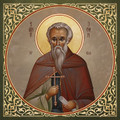
Born in 876 in the village of Skrino near modern Sofia, Saint John of Rila showed early signs of divine favor while working as an orphaned cowherd. After miraculously crossing the swollen Struma River on his tattered shirt to retrieve a stray calf, he gave away his worldly possessions to pursue monasticism. Setting off into the wilderness, John lived as a solitary hermit, first on a barren hill and later in a deep cave where he endured severe temptations and physical beatings from both demons and robbers. During this time, his young nephew Luke joined him to emulate his ascetical life, but Luke's furious father tracked them down, accused John of theft, and forcibly dragged the boy away. Shortly after their departure, Luke died painlessly from a snakebite; acknowledging the tragedy as a divine safeguard protecting the child's soul from worldly corruption, John buried his nephew and made the grave a cherished place of prayer.
Seeking further solitude, Saint John relocated deeper into the Rila wilderness, where he lived inside a hollow tree for twelve years, sustained by wild grass and miraculous beans that God caused to grow. His presence was eventually discovered by local shepherds when their flock fled directly to his dwelling, leading to his reputation as a holy man and healer. To escape growing renown, he moved to a high, rocky crag for seven years of open-air asceticism, even declining a personal meeting with Bulgarian King Peter out of deep humility. Eventually, disciples gathered around him, leading to the establishment of the famous Rila Monastery at the site of his original cave. Before his death in 946 at age seventy, John authored his famed "Testament to Disciples," a classic of Old Bulgarian literature that provided spiritual guidance to a newly Christianized nation.
Following his death, Saint John's holy life and incorrupt relics became a central pillar of national identity and Orthodox faith across Eastern Europe. Around 980, his relics were transferred to Sredets (Sofia) following a heavenly vision, while his right hand was eventually taken to Russia, where his veneration took deep root. Despite being seized as war booty by Hungarian King Bela II in 1183 and subsequently relocated to the capital of Trnovo in 1238, the relics were triumphantly returned to the Rila Monastery on July 1, 1469. Today, Saint John of Rila remains venerated as the principal heavenly protector of the Bulgarian nation, with his continuous miracles and monastic rules leaving a lasting imprint on Slavic Orthodoxy.
About Our Icons (Print and Mounted):
Theophany Works Icons are handcrafted reproductions, made with prayer and a desire for excellence. Choose from our standard mounted option on Museum Quality Paper or you may choose to upgrade to Museum Quality Matte Canvas. Both offer a rich print with saturated coloration and are finished with our high-grade UV protection sealant offering a subtle tactile texture that gives our icons a truly authentic feel & can be cleaned with a damp cloth. Additionally, each Maple-shelled panel is prepared with a painted chamfered front edge as well as a round-over on the back edge to give a shadow box effect when hung on the wall. Our Icons come standard with a sliding key-hole slot on the back which allows for balanced hanging. These beautiful American-made reproductions will be a beloved addition to any home or parish at the fraction of the cost of a hand painted icon.


