


-

Icon of St. Paraskevi of Rome - 20th c. - 00STPR01
$38.00 - $335.00Feast Day/Commemorated: July 26 The Holy Virgin Martyr Paraskevi of Rome, the only daughter of devout Christian parents, dedicated her early life to God through prayer and scripture study. Follo -
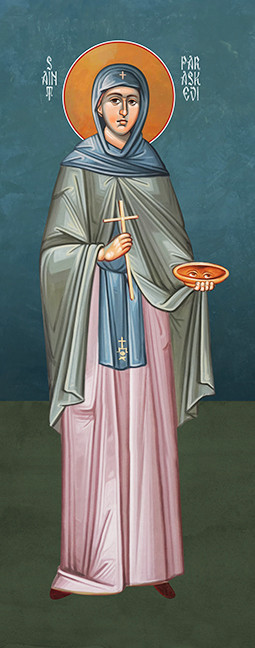
Icon of St. Paraskevi of Rome - 21th c. - 00STPR07
$38.00 - $625.00Feast Day/Commemorated: July 26 The Holy Virgin Martyr Paraskevi of Rome, the only daughter of devout Christian parents, dedicated her early life to God through prayer and scripture study. Follo -
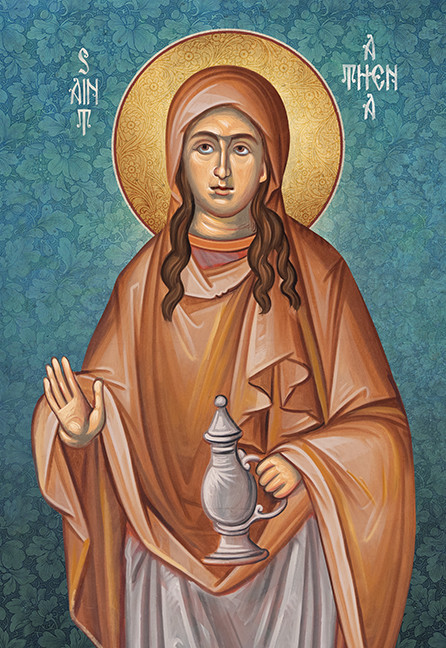
Icon of St. Athena 21st c. - 00STAT02
$38.00 - $335.00Feast Day/Commemorated: September 1 Saint Athena was one of the forty ascetic virgin-martyrs of Adrianople, Thrace, who studied under the guidance of Deacon Ammoun. During the persecutions of... -

Icon of St. Jerome -21st c. - 00STJE01
$38.00 - $335.00Feast Day/Commemorated: June 15 Saint Jerome, born Eusebius Hieronymos Sophronius in Stridon, was a pivotal figure in Christian history. He received a thorough secular education in Rome, where he... -

Icon of St. Christopher 21st c. - 00STCH02
$38.00 - $335.00Feast Day/Commemorated: May 9 Saint Christopher lived during the 3rd century and was martyred around the year 250 under the reign of Emperor Decius. He was a man of immense stature and strength,...
Description
Feast Day/Commemorated: December 24
Noble Origins and Spiritual Awakening
Born to Philip, a prominent Roman official governing Egypt under Emperor Commodus, Eugenia grew up in Alexandria surrounded by wealth and intellectual privilege. Highly educated in Greek and Latin literature, her beauty and philosophical gravity drew many aristocratic suitors, all of whom she rejected in favor of moral integrity. Her life shifted dramatically when she read early Christian texts, including the Acts of Paul and Thecla. Inspired by these writings and moved by the hymns of local Christians, Eugenia cut her hair, disguised herself in men's clothing, and set out with her loyal eunuchs, Protus and Hyacinth, to seek out the Christian faith.
Monastic Life and False Accusations
The local bishop, Helenus, saw through Eugenia's male disguise but accepted her into the faith anyway, baptizing her alongside Protus and Hyacinth. Adopting the male name Eugene, she embraced monastic life, earning a profound reputation for piety and spiritual healing. Her virtue was so pronounced that her community eventually elected her as abbot. However, her hidden identity triggered a crisis when a wealthy matron named Melanthia sought healing at the monastery. Mistaking Eugenia for a young monk, Melanthia fell in love with her. When Eugenia fiercely rejected the matron's romantic advances, the scorned woman returned to Alexandria and falsely accused the abbot of attempted rape.
Dramatic Unveiling and Mass Conversion
The accusation brought "Eugene" before the tribunal of the governor—who happened to be Eugenia's own father, Philip. To defend her virtue against the capital charge, Eugenia tore open her tunic to reveal her biological sex, exposing her true identity to her stunned family. The dramatic reunion sparked a massive wave of religious fervor; the accuser Melanthia was consumed by divine fire, and the entire city of Alexandria converted to Christianity. Following these events, Philip was elected bishop of Alexandria. He successfully evangelized much of Egypt before being assassinated by pagan mercenaries hired by his political successor.
Persecution in Rome and Divine Deliverance
Decades later, during the anti-Christian purges under Emperor Valerian, an elderly Eugenia was living in Rome, actively converting young women to the faith. Her missionary work drew the fury of Emperor Gallienus after she converted his niece, Basilla. Arrested and sentenced to death, Eugenia consistently defied execution through a series of miraculous interventions. When ordered to sacrifice to Diana, the pagan idol crumbled at her prayer; when thrown into the Tiber River tied to a heavy stone, she miraculously floated; and when sent to be scalded to death in the imperial baths, the furnaces instantly extinguished.
Martyrdom and Lasting Legacy
Even after being sealed inside a dark cave without food or water, Eugenia survived through divine comfort, receiving a vision of Christ who foretold the exact day of her death. On the Feast of the Nativity in 258 AD, shortly after the beheading of her companions Protus and Hyacinth, Eugenia was finally martyred by the sword. Following her death, she appeared to her grieving mother, Claudia, comforting her and prompting her final conversion before her peaceful passing that same week. Inspired by Eugenia's ultimate sacrifice, her surviving brothers spent the remainder of their lives evangelizing the Roman public, cementing the entire family's legacy as revered Christian saints.
About Our Icons (Print and Mounted):
Theophany Works Icons are handcrafted Orthodox Christian icon reproductions made in the United States with prayer and a desire for excellence. Each of our icons are printed on museum-quality matte canvas, providing a rich print with saturated coloration that lends to a beautiful handwritten-icon appearance.
All Theophany Works Icons are mounted on beveled wooden boards and finished with a high-quality UV protection sealant. This offers a subtle authentic-feeling texture while also enhancing durability, allowing for cleaning with a damp cloth. Additionally, each icon is given a maple-shelled keyhole slot on its back for easy and balanced hanging.
Our beautiful icon reproductions are lovingly made in our Lancaster, Pennsylvania studio. We pray they are a blessing to all who receive them, and we believe they will be a beloved addition to any home or parish—each at a fraction of the cost of a hand-painted icon.
***Our Beloved Brothers & Sisters in Christ: Please allow 3 weeks for production as each icon is made to order. If an icon is needed sooner for a baptism, chrismation, wedding, or name day, please contact us—we will always do our very best to accommodate your request.

