




-

Icon of Christ the Pantocrator of Hilander Monastery - (Mt. Athos 13th c.) - 00LJC005
$36.00 - $335.00The Hilandar Monastery on Mount Athos, Greece, is home to a renowned icon of Christ Pantocrator, a Greek term meaning "Ruler of All." This significant icon powerfully portrays Christ's authority and... -


Icon of The Holy Prophet Elias (Elijah) - (Cretan) - 17th c. - 00PREL01
$36.00 - $335.00Feast Day/Commemorated: July 20 The Life and Legacy of the Prophet Elias Born into the L -

Icon of The Holy Theotokos - Standing 20th c. - 00VMT001
$36.00 - $625.00Feast Day/Commemorated: The Nativity of the Theotokos (September 8)The Entrance of the Theotokos (November 21)The Dormition of the Theotokos (August 15) -

Icon of Christ the Pantocrator of Mt. Sinai - 6th c. - 00LJC005
$28.00 - $440.00The Christ Pantocrator icon from Mount Sinai is a profoundly significant and widely recognized image of Jesus Christ, especially within the Eastern Orthodox tradition. Dating back to the 6th century... -

Icon of The Hospitality of Abraham (Holy Trinity) -21st c. - 00HTHA018
$36.00 - $335.00About This Icon This icon is based on the story of the Hospitality of Abraham from the Book of Genesis. The story says that Abraham was sitting in the heat of the day by the Oak of Mam
Description
Feast Day/Commemorated: May 1
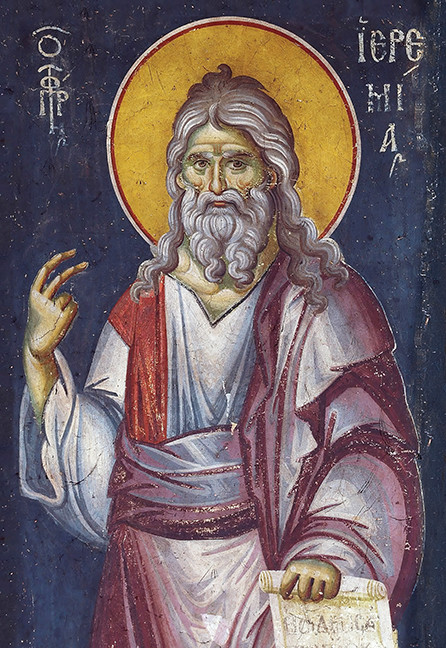
The Calling and Ministry of Jeremiah
Born into a priestly family in Anathoth, Jeremiah was called to his prophetic ministry at the tender age of fifteen, roughly 600 years before the birth of Christ. Despite his initial protests regarding his youth and lack of eloquence, the Lord touched his mouth and declared that he had been chosen from the womb to be a prophet to the nations. For over two decades, he served as a fearless voice of divine warning, tirelessly denouncing the idolatry of the Jewish people and urging them toward repentance at the gates of Jerusalem and the entrance of the Temple.
A Life of Suffering and Symbolic Warning
Jeremiah’s ministry was defined by profound personal sacrifice and dramatic symbolic acts intended to wake a slumbering nation. To illustrate the impending Babylonian captivity, he famously wore a wooden—and later an iron—yoke around his neck. His dire predictions earned him the hatred of the Jewish elders, who subjected him to mockery, physical abuse, and imprisonment. At one point, he was cast into a pit filled with "horrid, slimy creatures" where he nearly perished, only to be rescued by a royal official named Habdemelek.
The Fall of Jerusalem and the Babylonian Exile
The prophet’s warnings were ultimately vindicated when King Nebuchadnezzar laid waste to Jerusalem, pillaging the city and carrying the populace into exile. While Jeremiah was offered his freedom by the Babylonian king, he chose to remain amidst the ruins of the holy city to bewail the misfortunes of his people. According to tradition, during this period of desolation, he hid the original Ark of the Covenant and the Tablets of the Law in a cave on Mount Nebo to protect them from further desecration, where they remain hidden from the world.
Exile in Egypt and the Prophet’s Martyrdom
In his final years, Jeremiah was forcibly taken to Egypt by a remnant of Jews who fled in fear of Babylonian retaliation. Even in a foreign land, he continued his miraculous ministry, reportedly clearing the region of crocodiles through his prayers. However, when he prophesied that the Babylonian conquest would eventually reach Egypt and destroy the refugees there, his own people turned on him and murdered him. His legacy lives on through his biblical books of Prophecy and Lamentations, and he is still venerated today as a wonderworker and a symbol of the "weeping prophet" who suffered for the truth.
***This icon depicts the Prophet Jeremiah (Greek: Ιερεμίας), and it is a masterpiece of the Late Byzantine period, specifically the late 13th century (c. 1290–1300).
Origin and Artist
The image is a famous fresco from the Protaton Church in Karyes, the administrative center of Mount Athos, Greece. It is the work of Manuel Panselinos, the most celebrated iconographer of the "Macedonian School" of painting.
About Our Icons (Print and Mounted):
Theophany Works Icons are handcrafted reproductions, made with prayer and a desire for excellence. Choose from our standard mounted option on Museum Quality Paper or you may choose to upgrade to Museum Quality Matte Canvas. Both offer a rich print with saturated coloration and are finished with our high-grade UV protection sealant offering a subtle tactile texture that gives our icons a truly authentic feel & can be cleaned with a damp cloth. Additionally, each Maple-shelled panel is prepared with a painted chamfered front edge as well as a round-over on the back edge to give a shadow box effect when hung on the wall. Our Icons come standard with a sliding key-hole slot on the back which allows for balanced hanging. These beautiful American-made reproductions will be a beloved addition to any home or parish at the fraction of the cost of a hand painted icon.