


-


Icon of St. James the Just - (Macedonia) - 14th c. - 00STJA01
$36.00 - $335.00Feast Day/Commemorated: October 23 The Identity and Kinship of Saint James -


Icon Sts. Basil and John Chrysostom - 17th c. - 00SSBC01
$36.00 - $335.00Feast Day/Commemorated: January 30 (3 Holy Hierarchs Saint Basil the Great Born in 330 AD to a remarkably devout family in Caesarea, Saint Basil -
Icon of St. John Chrysostom - Russian - 00STJC02
$36.00 - $335.00Feast Day/Commemorated: November 13 Early Life and Monastic Formation -

Icon of the Holy Napkin "Made without Human Hands" - (Russian) -17th c. - 00LJC015
$36.00 - $335.00Holy Icon Made without Human Hands The Image of Edessa, also known as the Mandylion or Acheiropoieton (meaning "not made by hands"), stands as one of the earliest and most revered icon -

Icon of St. Jerome -21st c. - 00STJE01
$36.00 - $335.00Feast Day/Commemorated: June 15 Saint Jerome, born Eusebius Hieronymos Sophronius in Stridon, was a pivotal figure in Christian history. He received a thorough secular education in Rome, where he...
Description
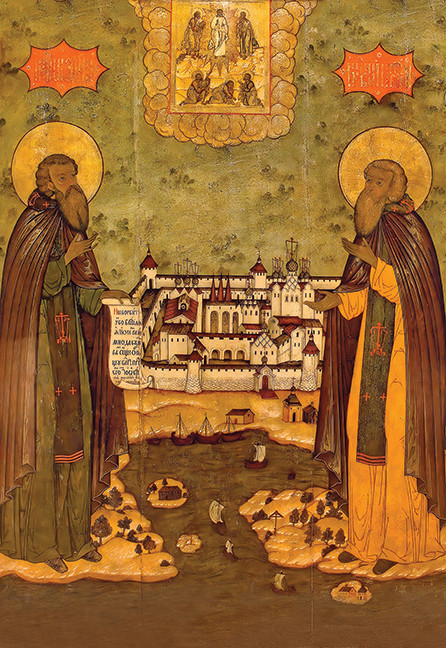
Feast Day/Commemorated: April 17 & September 27
The Founders of the Northern Thebaid
The spiritual foundation of the Solovetsky Monastery began with Saint Sabbatius, a monk of the Kirillo-Belozersky Monastery who sought a life of absolute solitude and silent prayer. His quest for a more austere lifestyle led him first to the Valaam Monastery on Lake Ladoga, and eventually to the shores of the White Sea. In 1429, near the Vyg River, Sabbatius met the monk Herman, who agreed to accompany him to a remote, deserted island. Together, they crossed the treacherous waters to the Solovki archipelago, where they erected a cross and a hermit’s cell, living in rigorous asceticism until Sabbatius’s repose.
Following the death of Sabbatius, the mission was taken up by Saint Zosimas, a devout man from the Novgorod diocese who had distributed his worldly wealth to follow the monastic path. Guided by Saint Herman, Zosimas arrived at the islands around 1436 and was immediately struck by a divine vision of a celestial church, confirming the holiness of the site. Alongside Herman, Zosimas labored to cultivate the frozen earth and build the first monastic cells. His early years were marked by extreme trials, including a winter of total isolation where he survived starvation only through the miraculous appearance of two strangers bearing provisions.
As a community of hermits gathered around them, Zosimas constructed a wooden church dedicated to the Transfiguration of the Lord. Although leaders were initially sent from Novgorod, the brutal Arctic conditions proved too harsh for them, leading the brethren to elect Zosimas as their Igumen. He established a strict cenobitic rule, organizing the monks into a cohesive spiritual body. Zosimas also became a protector of the monastery’s interests, famously traveling to Novgorod to defend the monks' fishing rights against the nobility. During this visit, he prophetically envisioned the execution of six impious nobles who had mistreated the monastics.
Saint Zosimas reposed on April 17, 1478, and was buried in a grave he had prepared himself. In 1566, his relics and those of Saint Sabbatius were transferred to a dedicated chapel within the Transfiguration Cathedral, cementing their legacy as the joint patrons of the "Northern Thebaid." Today, they are venerated not only as the architects of one of Orthodoxy’s most famous strongholds but also as miraculous intercessors. Saint Zosimas is uniquely remembered as "The Bee-keeper," the protector of apiaries, while both saints continue to be invoked as healers and guardians of those traveling the dangerous northern seas.
About Our Icons (Print and Mounted):
Theophany Works Icons are handcrafted reproductions, made with prayer and a desire for excellence. Choose from our standard mounted option on Museum Quality Paper or you may choose to upgrade to Museum Quality Matte Canvas. Both offer a rich print with saturated coloration and are finished with our high-grade UV protection sealant offering a subtle tactile texture that gives our icons a truly authentic feel & can be cleaned with a damp cloth. Additionally, each Maple-shelled panel is prepared with a painted chamfered front edge as well as a round-over on the back edge to give a shadow box effect when hung on the wall. Our Icons come standard with a sliding key-hole slot on the back which allows for balanced hanging. These beautiful American-made reproductions will be a beloved addition to any home or parish at the fraction of the cost of a hand painted icon.