


-

Icon of St. Anthony the Great - 00STAG01
$36.00 - $335.00Feast Day/Commemorated: January 17 Saint Anthony the Great, born in Egypt in 251, is revered as the Father of monasticism. At twenty, orphaned and responsible for his sister, he heard the Gospel call... -

Icon of St. Efthymios the Great - 00STEG01
$36.00 - $625.00Feast Day/Commemorated: January 20 The Prophesied Birth and Early Devotion of Saint Euthymius -

Icon of St. Constantine the Great - 00STCO01
$36.00 - $335.00Feast Day/Commemorated: May 21 The fourth century marked a pivotal period for Christianity, particularly in Greek-speaking lands, with events and figures directly linked to the First Ecumenical... -


Saint Photios the Great - Vestment Woven Blankets (60x80")
$98.00Vestments as seen on the icons of St Photios & other glorious saints are the inspiration for this comfy woven blanket. Our Vestment Series of blankets was created with the Holy Fathers in mind... -
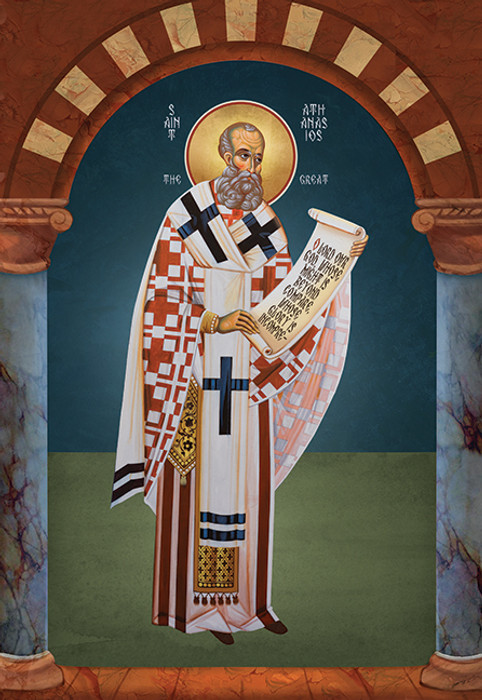
Icon of St. Athanasios the Great (Liturgizing) - 00STAT01
$36.00 - $335.00Feast Day/Commemorated: May 2 Saint Athanasios the Great, Archbishop of Alexandria, was born around 297 AD and quickly became known for his piety and d
Description
Feast Day/Commemorated: February 6
Early Life and Ascent to the Patriarchate
Saint Photius, Patriarch of Constantinople, born in the ninth century, emerged from a family profoundly dedicated to Christianity; his father, Sergius, died a martyr in defense of holy icons. Photius received an exceptional education, distinguishing himself across nearly all secular sciences, leading contemporaries to compare his intellectual prowess to the ancients. Due to his family's imperial connections, he served as the first state secretary in the Senate, yet his deep Christian piety shielded him from courtly seductions, fostering a strong desire for monasticism. In 857, following Patriarch Ignatius's deposition by Bardas, the ruling co-emperor, bishops recognized Photius's piety and vast knowledge, deeming him worthy of the patriarchal throne. With profound humility, he accepted, rapidly ascending through all clerical ranks within six days to be consecrated bishop and elevated to the patriarchal throne on the Nativity of Christ.
Early Challenges and Conflict with Rome
Soon after his enthronement, discord arose within the Church due to Patriarch Ignatius's removal. The Synod of 861 was convened to restore order, reaffirming Ignatius's deposition and Photius's rightful installation. However, Pope Nicholas I, whose envoys attended this council, aimed to assert papal supremacy over the East. When Patriarch Photius proved unwilling to submit to his authority, Pope Nicholas I retaliated by anathematizing Photius at a Roman council, initiating a long-standing conflict. Until the end of his life, Saint Photius remained a staunch opponent of papal intrigues and attempts to undermine the Orthodox Church of the East.
Missionary Efforts and Doctrinal Defense
Saint Photius was instrumental in the spread of Orthodoxy to the Slavic world. In 864, Bulgaria voluntarily converted to Christianity, with Prince Boris being baptized personally by Patriarch Photius. Subsequently, Photius dispatched an archbishop and priests to evangelize the Bulgarian people. In 865, he sent Saints Cyril and Methodius to preach Christ in the Slavonic language. However, papal partisans stirred up opposition among the Bulgarians against the Orthodox missionaries. A calamitous situation ensued when a German invasion compelled Bulgaria to seek Western aid, prompting Prince Boris to request papal bishops. Upon their arrival, these papal legates began replacing Orthodox teachings and customs with Latin ones. As a resolute defender of truth, Saint Photius wrote an encyclical to Eastern bishops, exposing the Roman Church's deviation not only in ritual but also in its confession of faith, particularly regarding the addition of the Filioque to the Creed. A council was then convened, censuring the growing arrogance of the West.
Deposition, Imprisonment, and Vindication
In 867, the imperial throne was seized by Basil the Macedonian, who murdered Emperor Michael. Saint Photius bravely denounced the regicide, refusing him Holy Communion, which led to his removal from the patriarchal throne and imprisonment in a monastery under guard. Patriarch Ignatius was then restored to his position. The Synod of 869, influenced by papal legates, sought to condemn Photius and affirm papal primacy. Despite demands to sign a document condemning him, Eastern bishops resisted. Summoned to the council, Saint Photius met all accusations with dignified silence, only speaking to question his judges' authority. Though unjustly condemned and anathematized by his opponents, he thanked the Lord for enduring their judgment and was imprisoned for seven years. During this period, Latin clergy were expelled from Bulgaria, and Patriarch Ignatius sent his own bishops there. However, in 879, two years after Ignatius's death, another council (often considered the Eighth Ecumenical Council) formally recognized Saint Photius as the lawful Patriarch of Constantinople. Pope John VIII, who knew Photius personally, annulled previous papal condemnations, and the council affirmed the unalterable nature of the Nicean-Constantinople Creed, explicitly rejecting the Latin Filioque and affirming the independence and equality of the Eastern and Western Churches.
Final Years and Enduring Theological Legacy
Under Emperor Leo, Basil's successor, Saint Photius again faced false accusations of speaking against the emperor. He was once more deposed from his See in 886 and lived the remainder of his life in quietude, reposing in 891 at the monastery of Eremia. The Orthodox Church profoundly venerates Saint Photius as a "pillar and foundation of the Church," an "inspired guide of the Orthodox," and a wise theologian. His extensive literary legacy includes works exposing Latin errors, refuting soul-destroying heresies, explicating Holy Scripture, and exploring numerous facets of the Christian Faith. His life stands as a testament to unwavering Orthodox conviction, intellectual brilliance, and courageous defense of the Church against theological and political pressures.
About Our Icons (Print and Mounted):
Theophany Works Icons are handcrafted Orthodox Christian icon reproductions made in the United States with prayer and a desire for excellence. Each of our icons are printed on museum-quality matte canvas, providing a rich print with saturated coloration that lends to a beautiful handwritten-icon appearance.
All Theophany Works Icons are mounted on beveled wooden boards and finished with a high-quality UV protection sealant. This offers a subtle authentic-feeling texture while also enhancing durability, allowing for cleaning with a damp cloth. Additionally, each icon is given a maple-shelled keyhole slot on its back for easy and balanced hanging.
Our beautiful icon reproductions are lovingly made in our Lancaster, Pennsylvania studio. We pray they are a blessing to all who receive them, and we believe they will be a beloved addition to any home or parish—each at a fraction of the cost of a hand-painted icon.
***Our Beloved Brothers & Sisters in Christ: Please allow 3 weeks for production as each icon is made to order. If an icon is needed sooner for a baptism, chrismation, wedding, or name day, please contact us—we will always do our very best to accommodate your request.