


-

Icon St. Gregory the Theologian (Liturgizing) - 00STGT01
$36.00 - $335.00Feast Day/Commemorated: January 23 Saint Gregory the Theologian, Archbishop of Constantinople, was a pivotal figure in early Christianity, born in 329 into a devout family. His extensive education,... -
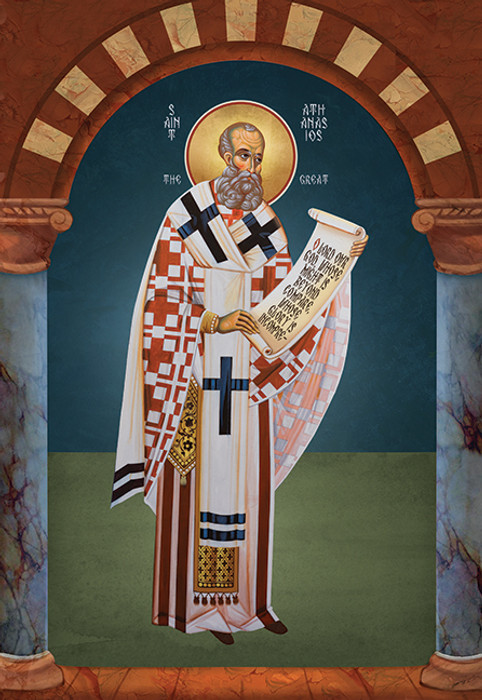
Icon of St. Athanasios the Great (Liturgizing) - 00STAT01
$36.00 - $335.00Feast Day/Commemorated: May 2 Saint Athanasios the Great, Archbishop of Alexandria, was born around 297 AD and quickly became known for his piety and d -

Icon St. Basil the Great (Liturgizing) - 00STBG01
$36.00 - $335.00Feast Day/Commemorated: January 1 Saint Basil the Great, born in 330 AD in Caesarea, Cappadocia, hailed from an eminent and devout Christian family, with many members, including his parents... -

Icon of St. Cyril of Alexandria (Liturgizing) - 00STCA01
$36.00 - $335.00Feast Day/Commemorated: June 9 Saint Cyril, Archbishop of Alexandria, emerged from a devout family, dedicating his youth to both secular philosophy and -

Icon St. Nicholas of Myra (Liturgizing) - 00STNI02
$36.00 - $335.00Feast Day/Commemorated: December 6 Saint Nicholas, born to pious parents Theophanes and Nonna in Patara, Lycia, was destined for a life of holiness from birth. His miraculous arrival, healing his...
Description
Feast Day/Commemorated: November 13
Early Life and Monastic Formation
Saint John Chrysostom, Archbishop of Constantinople and one of the revered Three Hierarchs, was born around 347 AD in Antioch to a military commander's family. His father, Secundus, died shortly after John's birth, leaving his twenty-year-old mother, Anthusa, to raise him in profound Christian piety. John received an excellent education under leading philosophers and rhetoricians but chose to pursue the deeper wisdom of Holy Scripture and prayerful contemplation. He was baptized by Saint Meletius, Bishop of Antioch, who loved him like a son. After three years, John was tonsured as a Reader. Following Meletius's exile in 372, John and his peer Theodore continued their studies under ascetic instructors, presbyters Flavian and Diodorus of Tarsus. Upon his mother's death, John embraced monasticism, which he called "the true philosophy." He then withdrew into the wilderness with his friend Basil to avoid episcopal office, secretly aiding Basil's consecration while humbly declining it for himself.
Asceticism, Theological Writings, and Ordination
Saint John spent four years in the wilderness, living a rigorous ascetic life under an experienced spiritual guide. During this period, he penned significant theological works, including "Six Discourses on the Priesthood," a foundational text in Orthodox pastoral theology, and "Against the Opponents of Those Attracted to the Monastic Life," which profoundly reflected on the monastic vocation's worthiness. For two years, he maintained complete silence in a cave, only returning to Antioch due to ill health. In 381, Saint Meletius ordained him deacon. The following years were dedicated to prolific theological writing, including works on Providence, virginity, and apologetics against pagans. In 386, Bishop Flavian of Antioch ordained him presbyter. John's exceptional eloquence as a preacher quickly earned him the moniker "Golden-Mouthed" or "Chrysostom." For twelve years, he preached frequently, often twice a week or even daily, deeply moving the hearts of his listeners.
Pastoral Zeal and Exegetical Ministry in Antioch
In his role as a priest in Antioch, Saint John Chrysostom demonstrated immense pastoral zeal, particularly in helping Christians understand Holy Scripture through hermeneutics—the interpretation and analysis of the Word of God. His extensive exegetical works included commentaries on entire books of the Bible such as Genesis, the Psalter, the Gospels of Matthew and John, and the Epistles of Saint Paul. He also delivered numerous homilies on individual biblical texts, feast days, and lives of saints, alongside apologetic discourses against heresies. Beyond his preaching, Saint John zealously fulfilled the Lord's command to care for the needy; under his leadership, the Antiochian Church daily provided sustenance for up to 3,000 virgins and widows, in addition to countless shut-ins, wanderers, and the sick. His homilies, such as his denunciation of schism in his commentary on Ephesians, emphasized the Church's unity as the "house of the heavenly Father, one Body and one Spirit."
Archbishop of Constantinople and Imperial Conflict
The fame of Saint John's preaching led to his election as Archbishop of Constantinople in 397, succeeding Saint Gregory the Theologian. In the capital, he dedicated himself to the spiritual perfection of the clergy, serving as an exemplary model himself. He redirected the archbishop's financial resources to establish hospices for the sick and hostels for pilgrims, and maintained a strict personal asceticism. His zeal extended beyond Constantinople, initiating missionary efforts in Thrace, Asia Minor, and the Pontine region, sending missionaries to Phoenicia, Persia, and the Scythians, and working to bring Marcionites back into the Church. He vehemently opposed the establishment of an Arian church by a powerful Gothic commander, preserving the Church's unity. Saint John also significantly enhanced liturgical splendor, compiling a Liturgy, introducing antiphonal singing, and composing prayers. However, his uncompromising denunciation of the capital's dissolute morals, particularly those at the imperial court, drew the ire of Empress Eudoxia.
Exile, Repose, and Enduring Veneration
Empress Eudoxia's animosity towards Saint John intensified when he defended a disgraced dignitary's family and when false reports suggested his sermons targeted her. A council of hostile hierarchs, justly condemned by Chrysostom, convened and unjustly deposed him, sentencing him to execution, though the emperor opted for exile. A popular uprising in his defense led to his temporary return after an earthquake terrified Eudoxia. However, renewed slanders in March 404 led to his definitive exile. Upon his removal, a catastrophic fire consumed the Hagia Sophia and the Senate building, followed by barbarian incursions and Eudoxia's death later that year—events widely seen by both Christians and pagans as divine retribution. In Armenia, despite illness, Saint John continued to minister through numerous letters, consoling, guiding, and supporting his flock. His enemies ordered his transfer to desolate Pityus in Abkhazia. Exhausted by the arduous three-month journey in harsh conditions, his strength failed him at Comana. There, he received a comforting vision of Saint Basiliscus and, after receiving the Holy Mysteries, reposed in the Lord on September 14, 407, with his last words being, "Glory to God for all things!" His holy relics were solemnly transferred to Constantinople in 438, and he remains celebrated on multiple feast days for his profound theological contributions and exemplary life.
About Our Icons (Print and Mounted):
Theophany Works Icons are handcrafted Orthodox Christian icon reproductions made in the United States with prayer and a desire for excellence. Each of our icons are printed on museum-quality matte canvas, providing a rich print with saturated coloration that lends to a beautiful handwritten-icon appearance.
All Theophany Works Icons are mounted on beveled wooden boards and finished with a high-quality UV protection sealant. This offers a subtle authentic-feeling texture while also enhancing durability, allowing for cleaning with a damp cloth. Additionally, each icon is given a maple-shelled keyhole slot on its back for easy and balanced hanging.
Our beautiful icon reproductions are lovingly made in our Lancaster, Pennsylvania studio. We pray they are a blessing to all who receive them, and we believe they will be a beloved addition to any home or parish—each at a fraction of the cost of a hand-painted icon.
***Our Beloved Brothers & Sisters in Christ: Please allow 3 weeks for production as each icon is made to order. If an icon is needed sooner for a baptism, chrismation, wedding, or name day, please contact us—we will always do our very best to accommodate your request.